
Fedora Core 6 Installation Guide
|
|
|
- Anna Lundberg
- för 10 år sedan
- Visningar:
Transkript
1 Fedora Core 6 Installation Guide Suart Ellis Paul Frields
2 Installation Guide Fedora Core 6 Installation Guide Utgåva 2.0 Author Author Suart Ellis Paul Frields [email protected] [email protected] Copyright 2006 Red Hat, Inc. and Others. The text of and illustrations in this document are licensed by Red Hat under a Creative Commons Attribution Share Alike 3.0 Unported license ("CC-BY-SA"). An explanation of CC-BY-SA is available at The original authors of this document, and Red Hat, designate the Fedora Project as the "Attribution Party" for purposes of CC-BY-SA. In accordance with CC-BY-SA, if you distribute this document or an adaptation of it, you must provide the URL for the original version. Red Hat, as the licensor of this document, waives the right to enforce, and agrees not to assert, Section 4d of CC-BY-SA to the fullest extent permitted by applicable law. Red Hat, Red Hat Enterprise Linux, the Shadowman logo, JBoss, MetaMatrix, Fedora, the Infinity Logo, and RHCE are trademarks of Red Hat, Inc., registered in the United States and other countries. For guidelines on the permitted uses of the Fedora trademarks, refer to Legal:Trademark_guidelines. Linux is the registered trademark of Linus Torvalds in the United States and other countries. Java is a registered trademark of Oracle and/or its affiliates. XFS is a trademark of Silicon Graphics International Corp. or its subsidiaries in the United States and/or other countries. All other trademarks are the property of their respective owners.
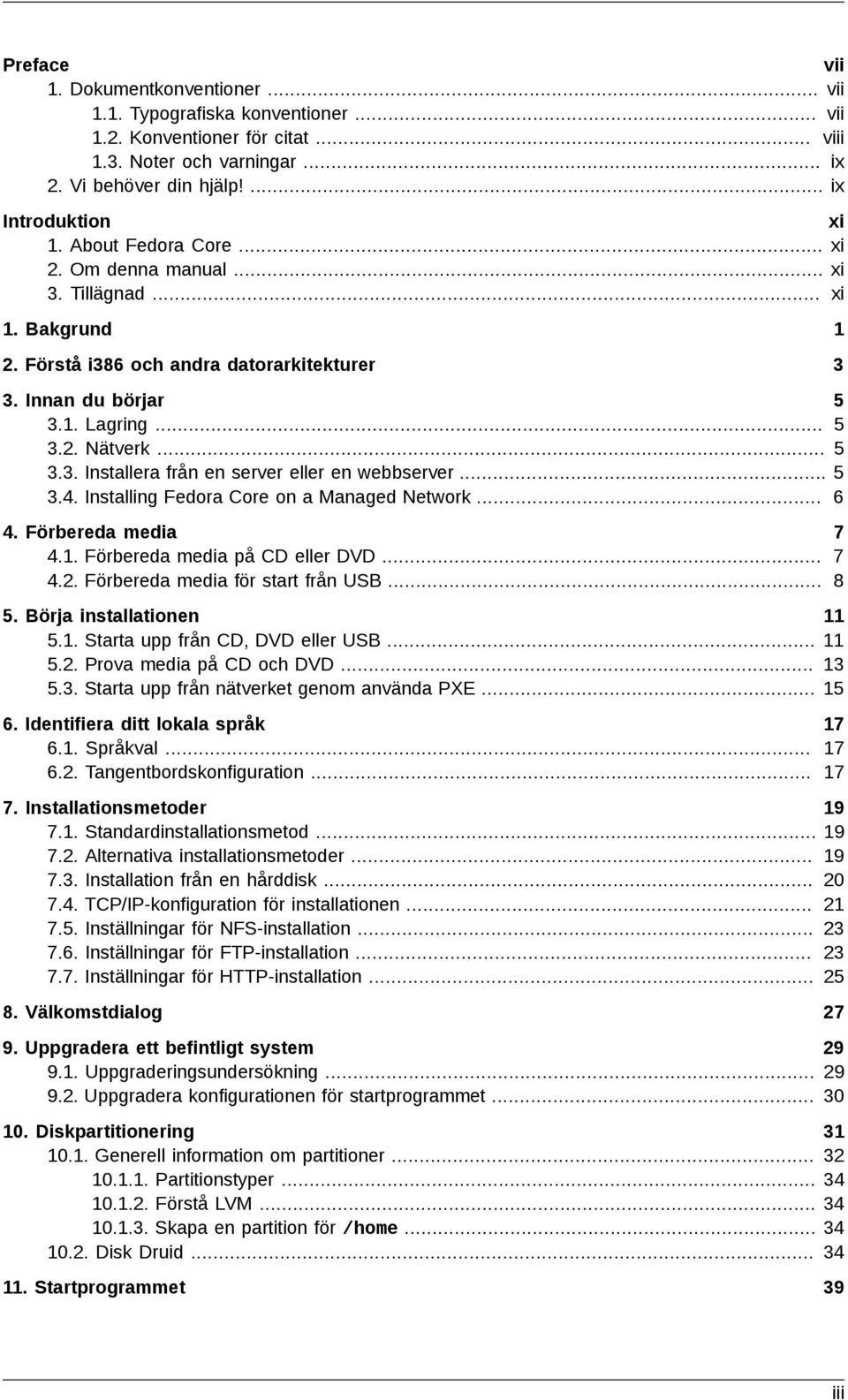
3 Preface vii 1. Dokumentkonventioner... vii 1.1. Typografiska konventioner... vii 1.2. Konventioner för citat... viii 1.3. Noter och varningar... ix 2. Vi behöver din hjälp!... ix Introduktion 1. About Fedora Core Om denna manual Tillägnad... xi xi xi xi 1. Bakgrund 1 2. Förstå i386 och andra datorarkitekturer 3 3. Innan du börjar 3.1. Lagring Nätverk Installera från en server eller en webbserver Installing Fedora Core on a Managed Network Förbereda media Förbereda media på CD eller DVD Förbereda media för start från USB Börja installationen 5.1. Starta upp från CD, DVD eller USB Prova media på CD och DVD Starta upp från nätverket genom använda PXE Identifiera ditt lokala språk Språkval Tangentbordskonfiguration Installationsmetoder 7.1. Standardinstallationsmetod Alternativa installationsmetoder Installation från en hårddisk TCP/IP-konfiguration för installationen Inställningar för NFS-installation Inställningar för FTP-installation Inställningar för HTTP-installation Välkomstdialog Uppgradera ett befintligt system Uppgraderingsundersökning Uppgradera konfigurationen för startprogrammet Diskpartitionering Generell information om partitioner Partitionstyper Förstå LVM Skapa en partition för /home Disk Druid Startprogrammet 39 iii
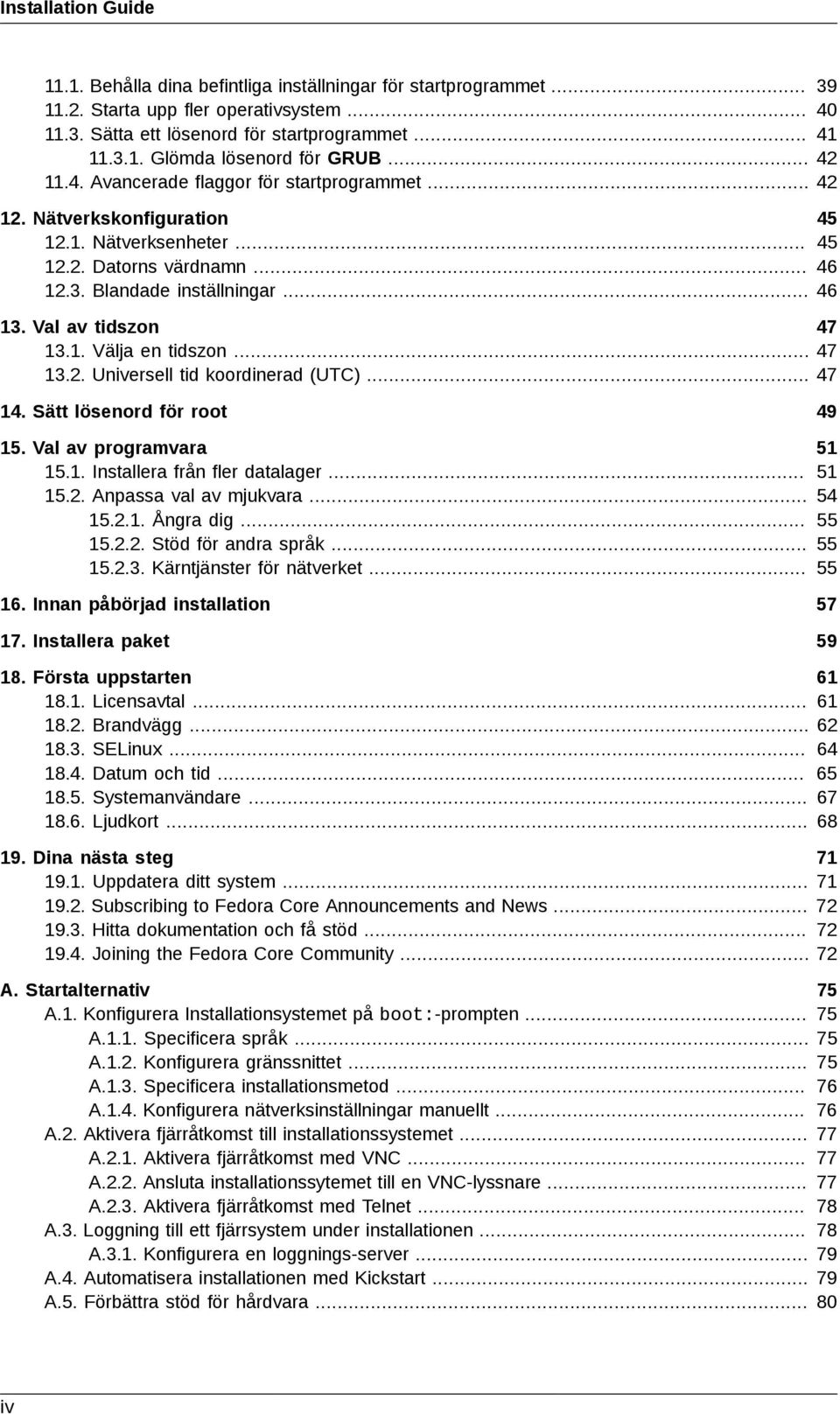
4 Installation Guide Behålla dina befintliga inställningar för startprogrammet Starta upp fler operativsystem Sätta ett lösenord för startprogrammet Glömda lösenord för GRUB Avancerade flaggor för startprogrammet Nätverkskonfiguration Nätverksenheter Datorns värdnamn Blandade inställningar Val av tidszon Välja en tidszon Universell tid koordinerad (UTC) Sätt lösenord för root Val av programvara Installera från fler datalager Anpassa val av mjukvara Ångra dig Stöd för andra språk Kärntjänster för nätverket Innan påbörjad installation Installera paket Första uppstarten Licensavtal Brandvägg SELinux Datum och tid Systemanvändare Ljudkort Dina nästa steg Uppdatera ditt system Subscribing to Fedora Core Announcements and News Hitta dokumentation och få stöd Joining the Fedora Core Community A. Startalternativ A.1. Konfigurera Installationsystemet på boot:-prompten... A.1.1. Specificera språk... A.1.2. Konfigurera gränssnittet... A.1.3. Specificera installationsmetod... A.1.4. Konfigurera nätverksinställningar manuellt... A.2. Aktivera fjärråtkomst till installationssystemet... A.2.1. Aktivera fjärråtkomst med VNC... A.2.2. Ansluta installationssytemet till en VNC-lyssnare... A.2.3. Aktivera fjärråtkomst med Telnet... A.3. Loggning till ett fjärrsystem under installationen... A.3.1. Konfigurera en loggnings-server... A.4. Automatisera installationen med Kickstart... A.5. Förbättra stöd för hårdvara iv
5 A.5.1. Lägga till hårdvarustöd med drivrutinsdiskar... A.5.2. Inaktivera automatisk detektering av hårdvara... A.6. Använda startlägen för underhåll... A.6.1. Starta läge för testning av RAM-minne... A.6.2. Starta upp din dator med räddningsläget B. Annan teknisk dokumentation 85 Index 87 v
6 vi

7 Preface 1. Dokumentkonventioner Denna manual använder flera konventioner för att markera vissa ord och fraser och dra uppmärksamheten till speciella delar av information. I PDF- och pappersutgåvor använder denna manual typsnitt tagna från uppsättningen Liberation 1 Fonts. Uppsättningen Liberation Fonts används också i HTML-utgåvor om uppsättningen är installerad på ditt system. Om inte visas alternativa men likvärdiga typsnitt. Observera: Red Hat Enterprise Linux 5 och senare innehåller uppsättningen Liberation Fonts som standard Typografiska konventioner Fyra typografiska konventioner används för att dra uppmärksamheten till särskilda ord och fraser. Dessa konventioner, och de omständigheter när de används, är som följer. Mono-spaced Bold Used to highlight system input, including shell commands, file names and paths. Also used to highlight keycaps and key combinations. For example: För att se innehållet i filen min_nästa_bästsäljande_roman i din aktuella arbetskatalog, ange kommandot cat min_nästa_bästsäljande_roman vid skalprompten och tryck Retur för att utföra kommandot. The above includes a file name, a shell command and a keycap, all presented in mono-spaced bold and all distinguishable thanks to context. Key combinations can be distinguished from keycaps by the hyphen connecting each part of a key combination. For example: Tryck Retur för att utföra kommandot. Tryck Ctrl+Alt+F1 för att byta till den första virtuella terminalen. Tryck Ctrl+Alt+F7 för att återvända till din X-fönstersession. The first paragraph highlights the particular keycap to press. The second highlights two key combinations (each a set of three keycaps with each set pressed simultaneously). If source code is discussed, class names, methods, functions, variable names and returned values mentioned within a paragraph will be presented as above, in mono-spaced bold. For example: Filrelaterade klasser inkluderar filesystem för filsystem, file för filer, och dir för kataloger. Varje klass har sin egen uppsättning rättigheter. Proportional Bold This denotes words or phrases encountered on a system, including application names; dialog box text; labeled buttons; check-box and radio button labels; menu titles and sub-menu titles. For example: 1 vii
8 Preface Choose System Preferences Mouse from the main menu bar to launch Mouse Preferences. In the Buttons tab, click the Left-handed mouse check box and click Close to switch the primary mouse button from the left to the right (making the mouse suitable for use in the left hand). To insert a special character into a gedit file, choose Applications Accessories Character Map from the main menu bar. Next, choose Search Find from the Character Map menu bar, type the name of the character in the Search field and click Next. The character you sought will be highlighted in the Character Table. Doubleclick this highlighted character to place it in the Text to copy field and then click the Copy button. Now switch back to your document and choose Edit Paste from the gedit menu bar. The above text includes application names; system-wide menu names and items; application-specific menu names; and buttons and text found within a GUI interface, all presented in proportional bold and all distinguishable by context. Icke proportionell kursiv fet eller proportionell kursiv fet Whether mono-spaced bold or proportional bold, the addition of italics indicates replaceable or variable text. Italics denotes text you do not input literally or displayed text that changes depending on circumstance. For example: För att ansluta till en fjärrmaskin med ssh, skriv ssh användarnamn@domän.namn vid en skalprompt. Om fjärrmaskinen är example.com och ditt användarnamn på den maskinen är johan, skriv ssh [email protected]. Kommandot mount -o remount filsystem monterar om det angifna filsystemet. Till exempel, för att montera om filsystemet /home, är kommandot mount -o remount /home. För att ta reda på versionen av ett installerat paket, använd kommandot rpm -q paket. Det kommer returnera ett resultat enligd: paket-version-utgåva. Observera orden i kursiv fetstil ovan användarnamn, domän.namn, filsystem, paket, version och utgåva. Varje ord håller en plats, antingen för text du skriver in när du skickar ett kommando eller för text som visas av systemet. Förutom standardanvändningen för att presentera namnet på ett verk, anger kursiv stil den första användningen av en ny och viktig term. Till exempel: Publican is a DocBook publishing system Konventioner för citat Terminal output and source code listings are set off visually from the surrounding text. Output sent to a terminal is set in mono-spaced roman and presented thus: books books_tests viii Desktop Desktop1 documentation downloads drafts images mss notes photos scripts stuff svgs svn
9 Noter och varningar Source-code listings are also set in mono-spaced roman but add syntax highlighting as follows: package org.jboss.book.jca.ex1; import javax.naming.initialcontext; public class ExClient { public static void main(string args[]) throws Exception { InitialContext inictx = new InitialContext(); Object ref = inictx.lookup("echobean"); EchoHome home = (EchoHome) ref; Echo echo = home.create(); System.out.println("Created Echo"); System.out.println("Echo.echo('Hello') = " + echo.echo("hello")); } } 1.3. Noter och varningar Slutligen använder vi tre visuella stilar för att dra uppmärksamheten till infomation som annars kanske förbises. Not Notes are tips, shortcuts or alternative approaches to the task at hand. Ignoring a note should have no negative consequences, but you might miss out on a trick that makes your life easier. Viktigt Important boxes detail things that are easily missed: configuration changes that only apply to the current session, or services that need restarting before an update will apply. Ignoring a box labeled 'Important' won't cause data loss but may cause irritation and frustration. Varning Warnings should not be ignored. Ignoring warnings will most likely cause data loss. 2. Vi behöver din hjälp! Om du hittar typografiska fel i denna manual eller om du har en idé om hur man kan göra denna manual bättre, vill vi gärna att du hör av dig! Skriv gärna en rapport i Bugzilla: bugzilla.redhat.com/bugzilla/ mot produkten Fedora Documentation. När du skickar en felrapport, var noga att ange manualens identifierare: install-guide ix
10 Preface Om du har ett förslag på förbättring av dokumentationen så försök att vara så specifik som möjligt när du beskriver det. Om du har hittat ett fel, ta gärna med numret på stycket och lite av den omgivande texten så att vi hittar det lätt. x
11 Introduktion 1. About Fedora Core Fedora Core is a complete desktop and server operating system created entirely with open source software. Fedora Core Lifecycle Fedora Core is a rapidly evolving system which follows the latest technical developments. Fedora Core may not be appropriate for use in business-critical applications in your organization. For complete access to information about Fedora Core, refer to the official project wiki at fedoraproject.org/ and Kapitel 19, Dina nästa steg. 2. Om denna manual This manual helps you install Fedora Core on desktops, laptops and servers. The installation system is flexible enough to use even if you have no previous knowledge of Linux or computer networks. If you select default options, Fedora Core provides a complete desktop operating system, including productivity applications, Internet utilities, and desktop tools. Detta dokument beskriver inte detaljer om alla funktioner i installationssystemet. 3. Tillägnad Många användbara kommentarer och förslag gavs av Rahul Sundaram och Anaconda-laget. David Neimi och Debra Deutsch tillförde ytterligare information om startprogrammet och RAIDkonfigurationer. Sektionerna om LVM drog nytta av hjälp från Bob McKay. xi
12 xii

13 Bakgrund The Fedora Project, which produces and maintains Fedora Core, is a collaboration between Red Hat, Inc. and the free and open source software (FOSS) community. The Fedora Project also provides Fedora Extras, additional software packaged for installation on a Fedora Core system. For more information about the Fedora Project, please visit Refer to and for more information about open source software. 1
14 2

15 Förstå i386 och andra datorarkitekturer The Fedora Project provides distributions of Fedora Core for several different types of computer systems. Each distribution of Fedora Core is built for computers based on a specific architecture. The architecture describes the processor on which the computer is built. Most computers come with identifying marks and literature describing the processor inside the computer. Refer to your computer's marks or literature and find its architecture in the list below: i386 Intel x86-kompatibla processorer, inklusive Intel Pentium och Pentium-MMX, Pentium Pro, Pentium-II, Pentium-III, Celeron, Pentium 4, Xeon, Core Duo och Centrino/Centrino Duo; VIA C3/ C3-m och Eden/Eden-N; och AMD Athlon, AthlonXP, Duron, AthlonMP, Sempron och Turion ppc PowerPC processorer, som de som finns i Apple Power Macintosh, G3, G4 och G5 och IBM pseries-system x86_64 64-bitars AMD-processors som t.ex. Athlon64, Turion64, Opteron; och Intel 64-bitars processorer som t.ex. EM64T 3
16 4

17 Innan du börjar Before you install Fedora Core, you need access to: boot or installation media (refer to Kapitel 4, Förbereda media for more information) information om din nätverkskonfiguration a copy of this Installation Guide and the Release Notes for this version of Fedora Core The Release Notes specify the hardware requirements for Fedora Core 6. They also provide advice on any known problems with particular hardware and software configurations. The Release Notes are available on the first disc in HTML and plain text format. The latest versions of this Installation Guide and the Release Notes are available at Lagring A Fedora Core system requires a minimum of 700 MB storage for a command-line system. A desktop system with the default applications requires at least 3 GB of storage. You may install multiple copies of Fedora Core on the same computer. Configure any RAID functions provided by the mainboard of your computer, or attached controller cards, before you begin the installation process. Fedora Core can automatically detect many RAID devices and use any storage they provide Nätverk By default, Fedora Core systems attempt to discover correct connection settings for the attached network using Dynamic Host Configuration Protocol, or DHCP. Your network may include a DHCP provider which delivers settings to other systems on demand. The DHCP provider may be a router or wireless access point for the network, or a server. In some circumstances you may need to provide information about your network during the installation process. Refer to Avsnitt 3.3, Installera från en server eller en webbserver and Avsnitt 3.4, Installing Fedora Core on a Managed Network for more information. Modemkonfiguration The installation system for Fedora Core does not configure modems. If your computer has a modem, configure the dialing settings after you complete the installation and reboot Installera från en server eller en webbserver You may install Fedora Core using a mirror, a Web site or network server that provide a copy of the necessary files. To use a mirror, you need to know: namnet på servern nätverksprotokollet som används för installation (FTP, HTTP eller NFS) 5
18 Kapitel 3. Innan du börjar sökvägen till installationsfilerna på servern You may install Fedora Core from your own private mirror, or use one of the public mirrors maintained by members of the community. To ensure that the connection is as fast and reliable as possible, use a server that is close to your own geographical location. The Fedora Project maintains a list of HTTP and FTP public mirrors, sorted by region, at fedora.redhat.com/download/mirrors.html. To determine the complete directory path for the installation files, add /6/architecture/os/ to the path shown on the web page. If your computer uses the ppc architecture, for instance, add /6/ppc/os/ to the path shown. Bygga din egna spegel Refer to for information on how to create your own Fedora Core mirror for either public or private use. To use a mirror, boot your computer with Fedora Core boot media, and follow the instructions in Kapitel 7, Installationsmetoder. Refer to Kapitel 4, Förbereda media for more information on creating the boot media. Använda installationsskivorna Om du startar upp din dator med antingen en installations-dvd, eller den första installations-cd:n, skriv linux askmethod på boot:-prompten för att komma åt installationsflaggorna för servern. If your network includes a server, you may also use PXE (Pre-boot execution Environment) to boot your computer. PXE (also referred to as netboot) is a standard that enables PCs to use files on a server as a boot device. Fedora Core includes utilities that allow it to function as a PXE server for other computers. You can use this option to install Fedora Core on a PXE-enabled computer entirely over the network connection, using no physical media at all Installing Fedora Core on a Managed Network Some corporate networks include a directory service that manages user accounts for the organization. Fedora Core systems can join a Kerberos, NIS, Hesiod, or Microsoft Windows domain as part of the installation process. Fedora Core can also use LDAP directories. Fråga nätverksadministratörer Always consult the administrators before you install a Fedora Core system on an existing network owned by someone besides yourself. They can provide correct network and authentication settings, and guidance on specific organizational policies and requirements. 6
19 Förbereda media To install Fedora Core from discs, you need five installation CDs, or the installation DVD. There are separate disc sets for each supported architecture. For instructions to download and prepare this CD or DVD installation media, refer to fedoraproject.org/wiki/distribution/download. If you already have the full set of Fedora Core installation media, skip to Avsnitt 5.1, Starta upp från CD, DVD eller USB. Arkitekturspecifika distributioner To install Fedora Core, you must use the boot and installation media that is particular to your architecture. Refer to Kapitel 2, Förstå i386 och andra datorarkitekturer for information on hardware architectures and how to determine the right one for your computer. You may use the first CD or DVD installation disc from the complete Fedora Core distribution to boot your computer. The Fedora Core distribution also includes image files for boot-only CD or DVD media and USB media. You can convert these files into bootable media using standard Linux utilities or thirdparty programs on other operating systems. You may boot your computer with boot-only media, and load the installation system from another source to continue the process. The types of installation source for Fedora Core include: installationsskivor på CD eller DVD hårddisk, antingen inkopplad med USB eller internt i datorn installationsserver på nätverket, som använder HTTP, FTP eller NFS You can use this facility to install Fedora Core on machines without using installation discs. For example, you may install Fedora Core on a laptop with no CD or DVD drive by booting the machine with a USB pen drive, and then using a hard drive as an installation source. The supported boot media for Fedora Core include: CD eller DVD (antingen installationsskiva 1 eller en speciell skiva endast för uppstart) USB-media nätverksgränssnitt (via PXE) Installation från disketter There is no option to either boot or install Fedora Core from diskettes Förbereda media på CD eller DVD The images/boot.iso file on the first Fedora Core installation disc is a boot image designed for CD and DVD media. This file also appears on FTP and Web sites providing Fedora Core. You can also find this file on mirror sites in the Fedora Core distribution directory for your particular architecture. 7
20 Kapitel 4. Förbereda media The Fedora Core distribution is also downloadable as a set of CD-sized ISO image files or a single DVD-sized ISO image file. You can record these files to CD or DVD using a CD or DVD burning program on your current operating system: Windows operativsystem Burn an ISO image to disc using your installed CD or DVD burning software. Most software has an option labeled Burn image file to disc or Make disc from ISO image. If your software offers a choice of image formats, choose "ISO image" as the file type. If several ISO formats are offered, choose the closest match to "Mode 1, 2048-byte blocks." Apple Mac OS X Open the Disk Utility application, found in the /Applications/Utilities folder. Select File Open Disk Image and select the ISO image. From the list of volumes, select the item representing the ISO image. Select Burn and follow the instructions. Linux operativsystem If you are using a recent version of the GNOME desktop environment, right-click the ISO image file and choose Write to disc. If you are using a recent version of the KDE desktop environment, use K3B and select Tools Burn CD Image, or Tools Burn DVD ISO Image if appropriate. The following command line works for many other environments: cdrecord --device=cdwriter-device -tao -eject image-file.iso Systemspecifika instruktioner Unfortunately this guide cannot offer specific instructions for every possible combination of hardware and software. You can find more information at Docs/Drafts/BurningDiscs. Consult your operating system's documentation and online support services, and Avsnitt 19.3, Hitta dokumentation och få stöd for additional help if needed Förbereda media för start från USB Dataförlust Denna procedur förstör data på ditt media. Ta en säkerhetskopia på viktig information innan du börjar. En del modeller av USB-media använder ytterligare partitioner eller mjukvara för att erbjuda funktioner som kryptering. Denna procedur kan göra det svårt eller omöjligt att komma åt dessa speciella områden på ditt startmedia. The images/diskboot.img file on the first Fedora Core installation disc is a boot image designed for USB media. This file also appears on FTP and Web sites providing Fedora Core. Flera mjukvarutillbehör finns tillgängliga för Windows och Linux som kan skriva en avbildsfil till en enhet. Linux inkluderar kommandot dd för detta syfte. Tillbehöret dd kräver att du anger den enhetsfil som motsvarar det fysiska mediat. Namnet på enhetsfilen matchar det tilldelade namnet på enheten av ditt system. Alla enhetsfiler finns i katalogen 8
21 Förbereda media för start från USB /dev/. Till exempel /dev/sda betecknar den första USB, SATA eller SCSI-enheten som är anslutet till systemet. För att få ut namnet som ditt system tilldelar till media: 1. Open a terminal window. On a Fedora Core system, choose Applications Accessories Terminal to start a terminal. 2. Anslut eller sätt i media. 3. I terminalfönstret, skriv följande kommando: dmesg Leta efter rader i utsrkiften från dmesg som relaterar till upptäckten av nya SCSI-enheter. Linuxsystem behandlar USB-media som SCSI-enheter. Använda enhetskartläggaren On Fedora Core 5 and later systems, it may be easier to find the right device name by examining the /dev/disk/ directory. Use the command ls -l /dev/disk/byid/ to see the disk devices collated by model and device name. 4. Unmount the media. On a Fedora Core system, right-click the icon that corresponds to the media, and select Unmount Volume. Alternatively, enter this command in a terminal window: umount /dev/<device> Replace <device> with the name of the correct device file for the media. To write an image file to boot media with dd on a current version of Fedora Core, carry out the following steps: 1. Lokalisera avbildsfilen. 2. Anslut eller sätt i media. 3. Ditt system kan automatiskt upptäcka och öppna ditt media. Om det händer, stäng och avmontera ditt media innan du fortsätter. 4. Öppna ett terminalfönster. 5. I terminalfönstret, skriv följande kommando: dd if=diskboot.img of=/dev/<device> Replace <device> with the name of the correct device file for the media. 9
22 10
23 Börja installationen To begin installation of Fedora Core, boot the computer from the bootable media. The bootable media provides the necessary programs and files to start the installation program. Once you start the installation program, you may be able to install from a completely different piece of media. For more information on finding and creating bootable media, refer to Kapitel 4, Förbereda media. If you boot from the first installation disc of the Fedora Core distribution, you may choose a different source for installation. The default source is the CDs themselves. To change this behavior, enter linux askmethod at the boot: prompt. If you boot from other media, the installation program always asks you to choose the installation source. The BIOS (Basic Input/Output System) on your computer must support the type of boot media you select. The BIOS controls access to some hardware devices during boot time. Any computer that meets the minimum recommended specification for Fedora Core can boot from a CD or DVD drive with the first disc. USB drives and flash media are newer technologies, but many computers can use them as boot media. Some network cards and chipsets include support for network booting with PXE. PXE (pronounced "pixie") allows a computer to load boot files from a network server instead of directly-connected hardware. Om du inte är säker på vilka möjligheter din dator har, eller hur du konfigurerar BIOS:et, använd dokumentationen utgiven av tillverkaren. Detaljerad information om hårdvaruspecifikationer och konfigurationen täckts inte av detta dokument. Avbryta installationen To abort the installation process at any time before the Installing Packages screen, either press Ctrl+Alt+Del or power off the computer with the power switch. Fedora Core makes no changes to your computer until package installation begins Starta upp från CD, DVD eller USB För att starta upp din dator: 1. Slå på datorn. 2. Sätt i första skivan i CD eller DVD-enheten, eller anslut USB-media. 3. En startskärm visas, med en boot:-prompt vid slutet. Startordning på BIOS The BIOS contains settings that control the order of boot devices. If your PC boots from a device other than the Fedora Core boot media, check the BIOS boot configuration. 11
24 Kapitel 5. Börja installationen Figur 5.1. Startskärm If you hit Enter, the installation runs in default mode. In the default mode, the installation uses a graphical interface if possible. If the installation program runs from the Fedora Core installation CD or DVD media, in default mode it uses these media as the installation source. To change the installation mode, at the boot: prompt, type linux followed by one or more of the following options: För att installera från en hårddisk eller nätverks-server, lägg till direktivet askmethod. För att använda ett text-gränssnitt, lägg till direktivet text. För att försöka installera igen efter installationen avbrutits på ett tidigt stadium, lägg till direktivet acpi=off. ACPI är ansvarig för många olika installationsfel. Om du stänger av ACPI, kan du komma runt många av dessa fel. Refer to the Release Notes for additional options that may help if you encounter problems with the installation program. A current copy of the Release Notes is always available at docs.fedoraproject.org/en-us/fedora_core/6/html/release_notes/. När du kör ett kommando på boot:-prompten, startar den första scenen i installationsprogrammet. 12
25 Prova media på CD och DVD 5.2. Prova media på CD och DVD Figur 5.2. Skärmen för mediatest Välj OK för att testa skivan, eller välj Hoppa över för att fortsätta med installationen utan att testa skivan. Prova skivor Testa de skivor som du inte testat tidigare. Ett skivfel under installationsprocessen kan tvinga dig att starta om hela proceduren. Efter du testat den första skivan, visas ytterligare en skärm och visar resultatet: 13
26 Kapitel 5. Börja installationen Figur 5.3. Resultat för mediakontroll Välj OK. Följande skärm visas: 14
27 Starta upp från nätverket genom använda PXE Figur 5.4. Skärm för nästa skiva Välj Testa för att testa nästa skiva i setet eller Fortsätta för att fortsätta med installationen. Efter du testat dina skivor och valt Fortsätt, eller om du väljer att hoppa över testningen, läses det grafiska installatiosprogrammet in. Startordning på BIOS The BIOS contains settings that control the order of boot devices. If your PC boots from a device other than the Fedora Core boot media, check the BIOS boot configuration Starta upp från nätverket genom använda PXE To boot with PXE, you need a properly configured server, and a network interface in your computer that supports PXE. Configure the computer to boot from the network interface. This option is in the BIOS, and may be labeled Network Boot or Boot Services. Once you properly configure PXE booting, the computer can boot the Fedora Core installation system without any other media. För att starta upp en dator från en PXE-server: 1. Kontrollera att nätverkskabeln är ansluten. Länkindikatorlampan på nätverksuttaget ska lysa, även om datorn inte är påslagen. 15
28 Kapitel 5. Börja installationen 2. Slå på datorn. 3. En menyskärm visas. Tryck på den nummertangent som motsvarar det önskade alternativet. PXE-felsökning Om din PC inte startar från nätstart-servern, kontrollera att BIOS är konfigurerad att starta från det korrekta nätverksgränssnittet först. En del BIOS-system anger nätverksgränssnittet som en möjlig startenhet men stöder inte PXE-standarden. Gå till din hårdvarudokumentation för mer information. 16
29 Identifiera ditt lokala språk Om installationssystemet misslyckas identifiera skärmhårdvaran på din dator visar den textskärmar istället för det standardmässiga grafiska gränssnittet. Textskärmarna har samma funktioner som standardskärmarna. Senare i installationsprocessen kan du manuellt specificera din skärmhårdvara Språkval The installation program displays a list of languages supported by Fedora Core. Figur 6.1. Skärm för språkval Markera önskat språk på listan och välj Nästa. Installera stöd för fler språk To select support for additional languages, customize the installation at the package selection stage. For more information, refer to Avsnitt , Stöd för andra språk Tangentbordskonfiguration The installation program display a list of the keyboard layouts supported by Fedora Core: 17
30 Kapitel 6. Identifiera ditt lokala språk Figur 6.2. Skärm för tangentbordskonfiguration Markera den rätta layouten i listan och välj Nästa. 18
31 Installationsmetoder You can install Fedora Core using any of several different methods. You can install from CD or DVD media burned from downloaded ISO images, from the ISO images stored on hard disk, or from a network using NFS, FTP, or HTTP methods. If you booted a Fedora Core DVD, or the first installation CD, without the askmethod option, proceed to Avsnitt 7.1, Standardinstallationsmetod. Otherwise, proceed to Avsnitt 7.2, Alternativa installationsmetoder Standardinstallationsmetod A default installation runs directly from CD or DVD installation media. The next stage loads automatically from the installation media. Proceed to Kapitel 8, Välkomstdialog Alternativa installationsmetoder Skärmen för installationmetod nedan, visas om ett av följande är sant: 1. Du startade installationen med endast-start PXE, USB, CD- eller DVD-media. 2. Du angav askmethod-flaggan på boot: prompten. Figur 7.1. Installationsmetod-skärm 19
32 Kapitel 7. Installationsmetoder CD/DVD-aktivitet If you booted with Fedora Core installation Disc 1, the installation program loads its next stage from that disc. This happens regardless of which installation method you choose, unless you eject the disc before you proceed. The installation program still downloads package data from the source you choose. Even if you booted from alternative media, you can still install Fedora Core from CD or DVD media. Alternately, you can install from ISO images stored on your computer's hard disk, or from a network server. To install from CD or DVD media, insert a Fedora Core DVD or the first installation CD, select Local CDROM, and proceed to Kapitel 8, Välkomstdialog. To install from ISO images on a hard disk, select Hard drive and proceed to Avsnitt 7.3, Installation från en hårddisk. To install from a network, using NFS, FTP, or HTTP, proceed to Avsnitt 7.4, TCP/IP-konfiguration för installationen Installation från en hårddisk Once you have booted your computer, you may use ISO image files of the Fedora Core discs to continue the installation process. The ISO files must be located on a hard drive that is either internal to the computer, or attached to the machine by USB. You can use this option to install Fedora Core on computers that have neither a network connection nor CD or DVD drives. The partition on the hard drive holding the ISO files must be formatted with the ext2, ext3 or vfat file system. In Fedora Core, vfat includes a range of file systems, such as FAT-16 and FAT-32, found on most removable media. External hard drives usually contain vfat (FAT-32) file systems. Some Microsoft Windows systems also use vfat file systems on internal hard disk partitions. Before you begin installation from a hard drive, check the partition type to ensure that Fedora Core can read it. To check a partition's file system under Windows, use the Disk Management tool. To check a partition's file system under Linux, use the fdisk utility. Kan inte installera från LVM-partitioner Du kan inte använda ISO-filer på partitioner kontrollerade av LVM (Logical Volume Management). Om du väljer denna flagga, visas följande skärm: 20
33 TCP/IP-konfiguration för installationen Figur 7.2. Skärm för välja partition Välj den partition som innehåller ISO-filerna från listan av tillgängliga partitioner. Namnen på interna IDE-enheter börjar med /dev/hd. SATA, SCSI och USB-enhetnamn börjar med /dev/sd. Varje enhet har sin egna bokstav, till exempel /dev/hda. Varje partition på en enhet är numrerad, till exempel /dev/sda1. Specificera också Katalog som innehåller avbilder. Ange hela katalogsökvägen till den enhet som innehåller ISO-avbildsfilerna. Select OK to continue. Proceed with Kapitel 8, Välkomstdialog TCP/IP-konfiguration för installationen The installation program is network-aware and can use network settings for a number of functions. For instance, you can install Fedora Core from a network server using FTP, HTTP, or NFS protocols. You can also instruct the installation program to consult additional software repositories later in the process. Som standard, använder installationsprogrammet DHCP för att automatiskt ställa in nätverksinställningar. Om du använder ett kabel- eller DSL-modem, router, brandvägg eller andra nätverkshårdvara för att kommunicera med Internet, är DHCP en bra lösning. I en affärsmiljö, rådfråga dina nätverksadministratörer för lämpliga inställningar. om ditt nätverk inte har någon DHCP-server, rensa kryssrutan kallad Använd dynamisk IP-konfiguration (DHCP). Installationsprogrammet stöder både IPv4 och IPv6. Om du inte är säker på vilket adresseringschema ditt nätverk använder, är det säkraste att låta båda vara aktiverade. 21
34 Kapitel 7. Installationsmetoder DHCP-svar tar tid Om du väljer båda valen IPv4 och IPv6, kan det ta extra tid att ta emot nätverksinställningar från DHCP servern. Om du väljer en nätverksbaserad installation, visas följande skärm: Figur 7.3. Configure TCP/IP Dialog Dessa inställningar gäller endast under installationen. Installations-programmet gör att du konfigurera de slutgiltiga nätverksinställningarna senare. You can install from a Web, FTP, or NFS server either on your local network or, if you are connected, on the Internet. To use a public server, or mirror website, refer to Avsnitt 3.3, Installera från en server eller en webbserver for information on valid server names and directory paths. Stor nerladdning If you are not booting from a Fedora Core DVD or installation CD, a network installation downloads the main installation program from the network. The graphical installation program is over 75 MB in size. If you are installing via NFS, proceed to Avsnitt 7.5, Inställningar för NFS-installation. If you are installing via FTP, proceed to Avsnitt 7.6, Inställningar för FTP-installation. 22
35 Inställningar för NFS-installation If you are installing via HTTP, proceed to Avsnitt 7.7, Inställningar för HTTP-installation Inställningar för NFS-installation För att installera från en NFS-server, välj NFS från menyn Installationsmetod och välj OK. Följande skärm visas: Figur 7.4. Dialog för NFS-inställningar Ange namn eller IP-adress för NFS servern och katalogen där installationsfilerna finns. Tillgänglighet för NFS-speglar Public NFS mirrors are rare due to security concerns with NFS that do not necessarily apply to FTP or HTTP servers. The Fedora Project does not maintain a list of public NFS mirrors for Fedora Core. Select OK to continue. Proceed with Kapitel 8, Välkomstdialog Inställningar för FTP-installation För att installera från en FTP-server, välj FTP från menyn Installationsmetod och välj OK. Följande skärm visas: 23
36 Kapitel 7. Installationsmetoder Figur 7.5. Dialog för uppsättning av FTP Enter the name or IP address of the FTP server and the directory where the installation files reside. Refer to Avsnitt 3.3, Installera från en server eller en webbserver for information on how to locate a FTP mirror and enter its information here. Dialogen för FTP-tjänstens inställningar har också en flagga Använd icke-anonym ftp. Om din FTPserver inte tillåter anonym åtkomst, välj denna kryssruta. Du måste ha ett konto på FTP-servern för att använda denna flagga. Select OK to continue. If you are using the default, anonymous FTP service, continue with Kapitel 8, Välkomstdialog. Om du använder icke-anonym FTP-inloggning, visas följande skärm: 24
37 Inställningar för HTTP-installation Figur 7.6. Dialog för icke-anonymt FTP-konto Enter your username and password in the spaces provided. Then select OK to continue. Proceed with Kapitel 8, Välkomstdialog Inställningar för HTTP-installation För att installera från en webb(http)-server, välj HTTP från menyn Installationsmetod och välj OK. Följande skärm visas: 25
38 Kapitel 7. Installationsmetoder Figur 7.7. Dialog för uppsättning av HTTP Enter the name or IP address of the Web server and the directory where the installation files reside. Refer to Avsnitt 3.3, Installera från en server eller en webbserver for information on how to locate a Web mirror and enter its information here. Select OK to continue. Proceed with Kapitel 8, Välkomstdialog. 26
39 Välkomstdialog Efter installationprogrammet läser in sin nästa scen, visas följande dialog: Figur 8.1. Välkomstskärm Installationsskärmar kan sklija Installationsprogrammet kan fortsätta i textläge om: din dator har 128 MB minne eller mindre du startade upp med text flaggan Skärmarna som visas i följande kapitel är baserade på en standard grafisk installation. Men de flesta funktionerna är liknande oavsett vilket installationsläge man väljer. Välj Nästa för att fortsätta. 27
40 28
41 Uppgradera ett befintligt system The installation system automatically detects any existing installation of Fedora Core. The upgrade process updates the existing system software with new versions, but does not remove any data from users' home directories. The existing partition structure on your hard drives does not change. Your system configuration changes only if a package upgrade demands it. Most package upgrades do not change system configuration, but rather install an additional configuration file for you to examine later Uppgraderingsundersökning If your system contains a Fedora Core or Red Hat Linux installation, the following screen appears: Figur 9.1. Skärm för uppgraderingsundersökning För att uppgradera ett befintligt system, välj lämplig installation från rullgardinslistan och välj Nästa. Manuellt installerad programvara Software which you have installed manually on your existing Fedora Core or Red Hat Linux system may behave differently after an upgrade. You may need to manually recompile this software after an upgrade to ensure it performs correctly on the updated system. 29
42 Kapitel 9. Uppgradera ett befintligt system 9.2. Uppgradera konfigurationen för startprogrammet Your completed Fedora Core installation must be registered in the boot loader to boot properly. A boot loader is software on your machine that locates and starts the operating system. Refer to Kapitel 11, Startprogrammet for more information about boot loaders. Figur 9.2. Skärm för uppgradera startprogrammet If the existing boot loader was installed by a Linux distribution, the installation system can modify it to load the new Fedora Core system. To update the existing Linux boot loader, select Update boot loader configuration. This is the default behavior when you upgrade an existing Fedora Core or Red Hat Linux installation. GRUB is the standard boot loader for Fedora Core. If your machine uses another boot loader, such as BootMagic, System Commander, or the loader installed by Microsoft Windows, then the Fedora Core installation system cannot update it. In this case, select Skip boot loader updating. When the installation process completes, refer to the documentation for your product for assistance. Installera ett nytt startprogram som en del av en uppgraderingsprocess endast om du är säker på att du vill byta ut existerande startprogram. Om du installerar ett nytt startprogram, kanske du inte kan starta andra operativsystem på samma maskin tills du har konfigurerat det nya startprogrammet. Välj Skapa ny konfiguration för startprogrammet för att ta bort befintligt startprogram och installera GRUB. Efter du gjort ditt val, klicka Nästa för att fortsätta. 30
43 Diskpartitionering Fedora Core creates and uses several partitions on the available hard drives. You may customize both the partitions, and how the drives on your system are managed. Avsnitt 10.1, Generell information om partitioner explains drive partitions in more detail. Konfigurera RAID-enheter RAID facilities enable a group, or array, of drives to act as a single device. Configure any RAID functions provided by the mainboard of your computer, or attached controller cards, before you begin the installation process. Each active RAID array appears as one drive within Fedora Core. On systems with more than one hard drive you may configure Fedora Core to operate several of the drives as a Linux RAID array without requiring any additional hardware. Linux software RAID arrays are explained in Avsnitt 10.2, Disk Druid. Ångra dig Installationsprocessen ändrar inget i ditt system förrän installationen av paket börjar. Du kan när som helst använda Bakåt för att återgå till föregående skärm och ändra dina inställningar. Figur Skärm för partitioningsflaggor 31
44 Kapitel 10. Diskpartitionering Rutan på skärmen listar de tillgängliga enheterna. Som standard, kan installationsprocessen påverka alla enheterna på din dator. För att försäkra dig om att specifika enheter inte blir ompartitionerade, rensa kryssrutan brevid dessa enheter i listan. The installation process erases any existing Linux partitions on the selected drives, and replaces them with the default set of partitions for Fedora Core. All other types of partitions remain unchanged. For example, partitions used by Microsoft Windows, and system recovery partitions created by the computer manufacturer, are both left intact. You may choose an alternative from the drop-down list: Remove all partitions on selected drives and create default layout Undvik denna flagga, såvida du inte vill ta bort alla existerande operativsystem och data på de valda enheterna. Remove linux partitions on selected drives and create default layout If the selected drives have any Linux partitions, this option removes them and installs Fedora Core into the resulting free space. This option does not modify partitions assigned to other non-linux operating systems. It does not discriminate, however, between partitions assigned to different Linux distributions, and will remove all of them. Use free space on selected drives and create default layout If the selected drives have free space that has not been assigned to a partition, this option installs Fedora Core into the free space. This option ensures that no existing partition is modified by the installation process. Create custom layout You manually specify the partitioning on the selected drives. The next screen enables you to configure the drives and partitions for your computer. If you choose this option, Fedora Core creates no partitions by default. Select Review and modify partitioning layout to customize the set of partitions that Fedora Core creates, to configure your system to use drives in RAID arrays, or to modify the boot options for your computer. If you choose one of the alternative partitioning options, this is automatically selected. Use the Advanced storage options option if: You want to install Fedora Core to a drive connected through the iscsi protocol. Select Advanced storage options, then select Add iscsi target, then select Add drive. Provide an IP address and the iscsi initiator name, and select Add drive. Du kan inaktivera en dmraid-enhet som upptäcktes vid start. Välj ett partitioneringsalternativ och välj Nästa för att fortsätta. Nästa skärm The next screen is Network Devices, explained Kapitel 12, Nätverkskonfiguration, unless you select an option to customize the partition layout. If you choose to either Create custom layout, or Review and modify partitioning layout, proceed to Avsnitt 10.1, Generell information om partitioner Generell information om partitioner A Fedora Core system has at least three partitions: 32
45 Generell information om partitioner En datapartition monterad på /boot En datapartition monterad på / En utväxlings-partition Many systems have more partitions than the minimum listed above. Choose partitions based on your particular system needs. For example, consider creating a separate /home partition on systems that store user data, for the reasons explained in Avsnitt , Skapa en partition för /home. Om du inte är säker på hur du bäst konfigurerar partioner för din dator, acceptera den partitionslayout som är standard. The RAM installed in your computer provides a pool of memory for running systems. Linux systems use swap partitions to expand this pool, by automatically moving portions of memory between RAM and swap partitions if insufficient RAM is available. In addition, certain power management features store all of the memory for a suspended system in the available swap partitions. If you manually specify the partitions on your system, create one swap partition that has more capacity than the computer RAM. Data partitions provide storage for files. Each data partition has a mount point, to indicate the system directory whose contents reside on that partition. A partition with no mount point is not accessible by users. Data not located on any other partition resides in the / (or root) partition. Rot och /root The / (or root) partition is the top of the directory structure. The /root (sometimes pronounced "slash-root") directory is the home directory of the user account for system administration. I den minimala konfigurationen ovan: All data under katalogen /boot/ finns på partitionen /boot. Till exempel, filen /boot/grub/ grub.conf finns på partitionen /boot. Alla filer utanför partitionen /boot, som /etc/passwd finns på partitionen /. Underkataloger kan också tilldelas till partitioner. En del administratörer skapar både /usr och / usr/local partitioner. I det fallet, filer under /usr/local som /usr/local/bin/foo finns på partitionen /usr/local. Andra filer i katalogen /usr/, som /usr/bin/foo finns på partitionen / usr. If you create many partitions instead of one large / partition, upgrades become easier. Refer to the description of Disk Druid's Edit option for more information. Lämna överflödig kapacitet oallokerad Tilldela endast lagringskapacitet till partitioner som du behöver omedelbart. Du kan när som helst allokera ledigt utrymme, när du behöver mer utrymme. 33
46 Kapitel 10. Diskpartitionering Partitionstyper Every partition has a partition type, to indicate the format of the file system on that partition. The file system enables Linux to organize, search, and retrieve files stored on that partition. Use the ext3 file system for data partitions that are not part of LVM, unless you have specific needs that require another type of file system Förstå LVM LVM (Logical Volume Management) partitions provide a number of advantages over standard partitions. LVM partitions are formatted as physical volumes. One or more physical volumes are combined to form a volume group. Each volume group's total storage is then divided into one or more logical volumes. The logical volumes function much like standard partitions. They have a file system type, such as ext3, and a mount point. /boot-partitionen och LVM Endast ett aktivt Linux-system får läsa eller skriva till LVM-volymer. Av denna anledning, måste partitionen /boot, som initierar ditt system, hållas utanför fysiska volymer med LVM. En administratör kan öka eller minska storlek på logiska volymer utan att förstöra data, till skillnad från standardpartitioner. Om fysiska volymer i en volymgrupp finns på separata enheter eller i ordnade listor av RAID-enheter, så kan administratörer också sprida en logisk volym över lagringsenheter. Du kan förlora data om du krymper en logisk volym till en mindre kapacitet än vad datat på volymen kräver. För att garantera maximal flexibilitet, skapa logiska volymer som uppfyller dina nuvarande behov och lämna överflödigt utrymme oallokerat. Du kan med säkerhet låta logiska volymer använda oallokerat utrymme, i enlighet med dina krav. LVM och standardpartitionslayouten Som standard, skapar installationsprocessen data och utväxlingspartitioner inom LVMvolymer, med en separat partition kallad /boot Skapa en partition för /home If you expect that you or other users will store data on the system, create a separate partition for the / home directory within a volume group. With a separate /home partition, you may upgrade or reinstall Fedora Core without erasing user data files. LVM provides you with the ability to add more storage capacity for the user data at a later time Disk Druid Disk Druid is an interactive program for editing disk partitions. Users run it only within the Fedora Core installation system. Disk Druid enables you to configure Linux software RAID and 34
47 Disk Druid LVM to provide more extensible and reliable data storage. Modifiera standardlayouten för LVM The default layout pools all of the available storage into a single LVM physical volume, with one LVM logical volume for the system. To make capacity available for additional partitions, Edit the logical volume with the mount point /, and reduce it's size as necessary. Figur Skärm för diskinställningar Disk Druid visar följande åtgärder i installationsprogrammet: New Select this option to add a partition or LVM physical volume to the disk. In the Add partition dialog, choose a mount point and a partition type. If you have more than one disk on the system, choose which disks the partition may inhabit. Indicate a size in megabytes for the partition. Ogiltiga partitioner The /bin/, /dev/, /etc/, /lib/, /proc/, /root/, and /sbin/ directories may not be used for separate partitions in Disk Druid. These directories reside on the / (root) partition. 35
48 Kapitel 10. Diskpartitionering Partitionen /boot får inte ligga på en LVM volymgrupp. Skapa partitionen /boot innan du konfigurerar några volymgrupper. Du kan också välja från tre val för att välja storlek på din partition: Fixed size Använd en fixerad storlek så nära som din inmatning som möjligt. Fill all space up to Väx partitionen till en maximal storlek som du väljer själv. Fill to maximum allowable size Väx partitionen tills den fyller de återstående av de valda diskarna. Partitionsstorlekar Den faktiska partitionen på disken kan vara lite mindre eller större än ditt val. Problem med diskgeometri orsakar denna effekt och är inte ett fel i programmet. Efter du angivit detaljerna för din partition, välj OK för att fortsätta. Edit Select this option to edit an existing partition, LVM volume group, or an LVM physical volume that is not yet part of a volume group. To change the size of a LVM physical volume partition, first remove it from any volume groups. Ta bort fysiska volymer för LVM Om du tar bort en fysisk volym för LVM från en volymgrupp, så tar du bort alla logiska volymer som den innehåller. Ändra en partition för att ändra dess storlek, monteringspunkt eller filsystemstyp. Använd denna funktion för att: rätta till ett misstag när du satte upp dina partitioner migrate Linux partitions if you are upgrading or reinstalling Fedora Core tillhandahåll en monteringspunkt för icke-linux-partitioner som används på en del Windowsoperativsystem Windows-partitioner You may not label Windows partitions that use the NTFS file system with a mount point in the Fedora Core installer. You may label vfat (FAT16 or FAT32) partitions with a mount point. Om du behöver göra drastiska ändringar till till partitionskonfiguration, kanske du ska ta bort partitionerna och börja om igen. Om din disk innehåller data du vill spara, ska du ta en 36
49 Disk Druid säkerhetskopia innan du börjar ändra några partitioner. Om du ändrar storleken på en partition, kommer du troligen förlora all data på den. If your system contains many separate partitions for system and user data, it is easier to upgrade your system. The installation program allows you to erase or retain data on specific partitions. If your user data is on a separate /home partition, you can retain that data while erasing system partitions such as /boot. Delete Select this option to erase an existing partition or LVM physical volume. To delete an LVM physical volume, first delete any volume groups of which that physical volume is a member. Om du gör ett misstag, använd knappen Återställ för att ångra alla ändringar du gjort. Reset Välj detta alternativ för att tvinga Disk Druid att kasta bort alla gjorda ändringar i diskpartitionerna. RAID Select this option to set up software RAID on your Fedora Core system. Create a software RAID partition Välj denna flagga för att lägga till en partition för mjukvaru-raid. Denna flagga är det tillgängliga valet om din disk inte innehåller några partitioner med mjukvaru-raid. Create a RAID device Välj denna flagga för att skapa en RAID-enhet från två eller fler existerande partitioner med mjukvaru-raid. Denna flagga är tillgänglig om två eller fler partitioner med mjukvaru-raid har konfigurerats. Clone a drive to create a RAID device Välj denna flagga för att sätta upp en RAID-spegel från en befintlig disk. Denna flagga är tillgänglig om två eller fler diskar är anslutna till systemet. LVM Select this option to set up LVM on your Fedora Core system. First create at least one partition or software RAID device as an LVM physical volume, using the New dialog. För att tilldela en eller flera fysiska volymer till en volymgrupp, tilldela först volymgruppen ett namn. Välj sedan de fysiska volymer som ska användas i volymgruppen. Till slut, konfigurera logiska volymer på eventuella volymgrupper genom använda valen Lägg till, Redigera och Ta bort. You may not remove a physical volume from a volume group if doing so would leave insufficient space for that group's logical volumes. Take for example a volume group made up of two 5 GB LVM physical volume partitions, which contains an 8 GB logical volume. The installer would not allow you to remove either of the component physical volumes, since that would leave only 5 GB in the group for an 8 GB logical volume. If you reduce the total size of any logical volumes appropriately, you may then remove a physical volume from the volume group. In the example, reducing the size of the logical volume to 4 GB would allow you to remove one of the 5 GB physical volumes. 37
50 Kapitel 10. Diskpartitionering LVM ej tillgänglig i text-installation LVM initial set up is not available in a text-mode installation. The installer allows you to edit pre-configured LVM volumes. If you need to create an LVM configuration from scratch, hit Alt+F2 to use the terminal, and run the lvm command. To return to the text-mode installation, hit Alt+F1. Efter du slutfört sätta upp och granska din partitionskonfiguration, välj Nästa för att fortsätta installationsprocessen. 38
51 Startprogrammet A boot loader is a small program that reads and launches the operating system. Fedora Core uses the GRUB boot loader by default. If you have multiple operating systems, the boot loader determines which one to boot, usually by offering a menu. You may have a boot loader installed on your system already. An operating system may install its own preferred boot loader, or you may have installed a third-party boot loader.if your boot loader does not recognize Linux partitions, you may not be able to boot Fedora Core. Use GRUB as your boot loader to boot Linux and most other operating systems. Follow the directions in this chapter to install GRUB. Installera GRUB Om du installerar GRUB kan det skriva över ditt existerande startprogram. Följande skärm visar konfigurationsflaggorna för startprogrammet. Figur Skärm för konfiguration av startprogrammet Behålla dina befintliga inställningar för startprogrammet By default, the installation program installs GRUB in the master boot record, 39
52 Kapitel 11. Startprogrammet or MBR, of the device for the root file system. To decline installation of a new boot loader, select No boot loader will be installed. Startprogram krävs Din dator måste ha GRUB eller ett annat startprogram installerad för att att starta upp, såvida du inte skapar en startsdiskett att starta upp från. You may need to customize the GRUB installation to correctly support some hardware or system configurations. To specify compatibility settings, select Configure advanced boot loader options. This causes a second screen of options to appear when you choose Next. Avsnitt 11.4, Avancerade flaggor för startprogrammet explains the features of the additional screen Starta upp fler operativsystem If you have other operating systems already installed, Fedora Core attempts to automatically detect and configure GRUB to boot them. You may manually configure any additional operating systems if GRUB does not detect them. To add, remove, or change the detected operating system settings, use the options provided. Add Press the Add button to include an additional operating system in GRUB. Fedora Core displays the dialog shown in Figur 11.2, Lägg till operativsystem till startsmenyn. Välj den diskpartition som innehåller det startbara operativsystemet från listan och ge akten ett namn. GRUB visar detta namn i sin startsmeny. Edit För att ändra en akt i startsmenyn i GRUB, välj akten och välj sedan Redigera. Delete För att ta bort en akt från startsmenyn i GRUB, välj akten och välj sedan Ta bort. 40
53 Sätta ett lösenord för startprogrammet Figur Lägg till operativsystem till startsmenyn Sätta ett lösenord för startprogrammet GRUB läser många filsystem utan hjälp av ett operativsystem. En operatör kan avbryta startsekvensen för att välja ett annat operativsystem att starta upp, ändra startflaggor eller återhämta sig från ett systemfel. Men dessa funktioner kan introducera allvarliga säkerhetsrisker i en del miljöer. Du kan lägga till ett lösenord för GRUB så att operatören måste ange ett lösenord för att kunna avbryta den normala startsekvensen. GRUB-lösenord krävs inte You may not require a GRUB password if your system only has trusted operators, or is physically secured with controlled console access. However, if an untrusted person can get physical access to your computer's keyboard and monitor, that person can reboot the system and access GRUB. A password is helpful in this case. För att sätta ett startlösenord, välj kryssrutan Använd ett lösenord för startprogrammet. Knappen Ändra lösenord blir aktiv. Välj Ändra lösenord för att visa en inmatningsdialog. Ange önskat lösenord och verifiera det genom att skriva in det igen i givet utrymme. 41
54 Kapitel 11. Startprogrammet Välja ett bra lösenord Välj ett lösenord som är lätt för dig att komma ihåg men svårt för andra att gissa Glömda lösenord för GRUB GRUB stores the password in encrypted form, so it cannot be read or recovered. If you forget the boot password, boot the system normally and then change the password entry in the /boot/grub/ grub.conf file. If you cannot boot, you may be able to use the "rescue" mode on the first Fedora Core installation disc to reset the GRUB password. Om du behöver ändra lösenordet för GRUB, använd tillbehöret grub-md5-crypt. För information om hur du kan använda detta tillbehör, använd kommandot man grub-md5-crypt i ett terminalfönster för att läsa manualsidorna Avancerade flaggor för startprogrammet The default boot options are adequate for most situations. The installation program writes the GRUB boot loader in the master boot record (MBR), overwriting any existing boot loader. Du kan behålla befintligt startprogram i MBR och installera GRUB som sekundärt startprogram. Om du väljer denna flagga, skriver installationsprogrammet GRUB in på första sektorn på Linux partitionen / boot. GRUB som sekundärt startprogram Om du installerar GRUB som en sekundärt startprogram, måste du omkonfigurera ditt primära startprogram varje gång du installerar och startar upp från en ny kärna. Kärnan för ett operativsystem som Microsoft Windows startar inte upp på samma sätt. De flesta användare använder därför GRUB som det primära startprogrammet på ett system med flera operativsystem installerade. You may also need the advanced options if your BIOS enumerates your drives or RAID arrays differently than Fedora Core expects. If necessary, use the Change Drive Order dialog to set the order of the devices in Fedora Core to match your BIOS. On a few systems, Fedora Core may not configure the disk drive geometry for large disks correctly because of limitations within the BIOS. To work around this problem, mark the Force LBA32 check box. Linux-kärnan auto-detekterar oftast sin miljö korrekt och inga ytterligare kärnparametrar behövs. Men, du kan ange de kärnparametrar som behövs genom använda de avancerade flaggorna för startprogrammet. 42
55 Avancerade flaggor för startprogrammet Kärnparametrar For a partial list of the kernel command line parameters, type the following command in a terminal window: man bootparam. For a comprehensive and authoritative list, refer to the documentation provided in the kernel sources. To alter any of these settings, mark the Configure advanced boot loader options check box. Select Next and the menu shown in Figur 11.3, Flaggor för avancerad start appears. Valfri meny Fedora Core displays the following advanced boot options menu only if the advanced configuration check box described above has been selected. Figur Flaggor för avancerad start 43
56 44
57 Nätverkskonfiguration Use this screen to customize the network settings of your Fedora Core system. Manual network configuration of a Fedora Core system is often not required. Many networks have a DHCP (Dynamic Host Configuration Protocol) service that automatically supplies connected systems with configuration data. By default, Fedora Core activates all network interfaces on your computer and configures them to use DHCP. Figur Skärm för nätverkskonfiguration Nätverksenheter Fedora Core displays a list of network interfaces detected on your computer. Each interface must have a unique IP address on the network to which it is attached. The interface may receive this address from the network DHCP service. To manually assign an IP address, highlight the interface on the Network Device list and select Edit. Fedora Core then displays a network configuration dialog. Deselect the Configure using DHCP check box, so that it is empty. Enter the IP Address and the appropriate Netmask for the interface. Then select OK. Om du din dator ska vara en server, använd inte DHCP. Konfigurera nätverket manuellt istället. Manuell nätverkskonfiguration tillåter din server att ansluta till lokala nätverk även om DHCP-servern är nere. 45
58 Kapitel 12. Nätverkskonfiguration Ange om ett gränssnitt ska aktiveras automatiskt vid start med kryssrutan Aktivera vid start för den enheten. Du kan manuellt aktivera ett nätverkgränssnitt närsomhelst efter systemet har startats upp. Modemkonfiguration The Network Configuration screen does not list modems. Configure these devices after installation with the Network utility. The settings for your modem are specific to your particular Internet Service Provider (ISP) Datorns värdnamn On some networks, the DHCP provider also provides the name of the computer, or hostname. To specify the hostname, select Manual and type the complete name in the box. The complete hostname includes both the name of the machine and the name of the domain of which it is a member, such as machine1.example.com. The machine name (or "short hostname") is machine1, and the domain name is example.com. Giltiga värdnamn Du kan kalla ditt system vilket namn som helst så länge hela värdnamnet är unikt. Värdnamnet får innehålla bokstäver, nummer och bindestreck Blandade inställningar För att manuellt kofigurera ett nätverksgränssnitt, kan du också ange andra nätverksinställningar för din dator. Alla dessa inställningar är IP-adresser för andra system på nätverket. A gateway is the device that provides access to other networks. Gateways are also referred to as routers. If your system connects to other networks through a gateway, enter its IP address in the Gateway box. Most software relies on the DNS (Domain Name Service) provider to locate machines and services on the network. DNS converts hostnames to IP addresses and vice versa. A Fedora Core system may use more than one DNS server. If the primary DNS server does not respond, the computer sends any query to the secondary DNS server, and so on. To assign DNS servers, type their IP addresses into the Primary, Secondary, or Tertiary DNS Server boxes. Klicka Nästa när du är nöjd med nätverksinställningarna för ditt system. 46
59 Val av tidszon This screen allows you to specify the correct time zone for the location of your computer. Specify a time zone even if you plan to use NTP (Network Time Protocol) to maintain the accuracy of the system clock Välja en tidszon Fedora Core displays on the screen two methods for selecting the time zone. Figur Skärm för val av tidszon Använd kartan för att välja en tidszon, placera först muspekaren över din region på kartan. Klicka en gång för att förstora regionen på karta. Välj sedan den gula prick som är närmast till där du befinner dig. När du valt en prick, så blir den röd X för att visa ditt val. För att välja en tidszon genom att använda listan, välj det namn på den stad närmast där du är. Städerna är sorterade i bokstavsordning Universell tid koordinerad (UTC) Universal Co-ordinated Time is also known as Greenwich Mean Time (GMT). If Fedora Core is the only operating system on your computer, select System clock uses UTC. The system clock is a piece of hardware on your computer system. Fedora Core uses the timezone setting 47
60 Kapitel 13. Val av tidszon to determine the offset between the local time and UTC on the system clock. This behavior is standard for UNIX-like operating systems. Windows och systemklockan Do not enable the System clock uses UTC option if your machine also runs Microsoft Windows. Microsoft operating systems change the BIOS clock to match local time rather than UTC. This may cause unexpected behavior under Fedora Core. Välj Nästa för att fortsätta. 48
61 Sätt lösenord för root Fedora Core uses a special account named root for system administration. The root account on a Linux system is not subject to most normal account restrictions. As the system owner or administrator, you may sometimes require special privileges to configure or modify the system. In those cases, use the root account. Använda root-kontot Avoid logging in to Fedora Core as root when possible. Any administration tools which require root privileges will prompt you for the password. The Fedora Core installation program requires the root password to be at least six characters long. Because the root account may potentially control any part of the system, use the following guidelines to create a good password: Använd en kombination av versaler, gemener, nummer, punkter och andra tecken. Använd inte ett ord eller namn. Dölja ordet eller namnet med ersättningstecken hjälper inte. Använd inte samma passord för mer än ett system. Följande är exempel på bra lösenord: f9*@1ls99a HL8$391%%rb Iwtb,10^th Enter the root password into the Root Password field. Fedora Core displays the characters as asterisks for security. Type the same password into the Confirm field to ensure it is set correctly. 49
62 Kapitel 14. Sätt lösenord för root Figur Skärm för att sätta lösenord för root Efter du satt lösenordet för root, välj Nästa för att fortsätta. 50
63 Val av programvara By default, the Fedora Core installation process loads a selection of software that is suitable for a desktop system. Figur Skärmen för val av uppdrag För att inkludera eller ta bort mjukvara för vanliga uppdrag, välj de relevanta sakerna från listan: Kontor och produktivitet Denna flagga installerar produktivitetssviten OpenOffice.org, projektledarprogrammet Planner, grafiska verktyg som GIMP och multimediaprogram. Programvaruutveckling This option provides the necessary tools to compile software on your Fedora Core system. Webbserver Denna flagga installerar webbservern Apache Installera från fler datalager You can define additional repositories to increase the software available to your system during installation. A repository is a network location that stores software packages along with metadata that describes them. Many of the software packages used in Fedora Core require other software to be installed. The installer uses the metadata to ensure that these requirements are met for every piece of software you select for installation. 51
64 Kapitel 15. Val av programvara The Fedora Extras software repository contains thousands of additional packages you can add at installation time if desired. To add the Fedora Extras software repository to the installation program, select Fedora Extras from the repository listing. Fedora Extras is already defined in the installation program and requires no further input. For more information about Fedora Extras, refer to the Release Notes or Fedora Extras och nätverkanslutning Valet Fedora Extras datalager är tillgängligt om din dator är ansluten till Internet. To include software from repositories other than Fedora Core and Fedora Extras, select Add additional software repositories. The following list includes examples of ways you can use this option. Hämta den senaste mjukvaran för Fedora Om du anger adressen på ett datalager av uppdateringar för Fedora Core, kommer ditt system ha de senaste versionerna av Core-mjukvaran. Du behöver inte utföra en systemuppgradering direkt efter en installation för att få dessa uppdateringar. Detta bruk är perfekt om du installerar via Internet eller ett nätverk där bandbredden är begränsad. Uppgradering och uppdateringar Package updates during the release cycle of a single verison of Fedora Core are intended to upgrade only that version. If you are upgrading a previous version of Fedora Core, you may encounter problems if you include an update repository during this step. Problems are less likely when performing a fresh installation. Installera programvara från tredjepart Du kan ange platsen för ett datalager med mjukvara från tredjepart. Beroende på konfigurationen på det datalagret, kan du under installationen välja mjukvara som inte är från Fedora. Om du väljer Lägg till fler mjukvarudatalager, visas följande dialog: 52
65 Installera från fler datalager Figur Skärm för lägg till datalager Ange ett namn för datalagret och URL för dess plats. Här är några URL:er för listor med specifika datalagerspeglar med mjukvara för Fedora. Fedora Core Updates - Fedora Extras - The URLs above provide a list of actual mirrors. You cannot use them verbatim in the Add repository dialog. Visit the URL for a list of actual repository locations. If you see the text $ARCH in the URL, substitute your system's architecture. See Kapitel 2, Förstå i386 och andra datorarkitekturer for more information on architectures. Once you provide information for an additional repository, the installer reads the package metadata over the network. Software that is specially marked is then included in the package group selection system. See Avsnitt 15.2, Anpassa val av mjukvara for more information on selecting packages. Gå bakåt raderar data om de tillagda datalagren Om du väljer Bakåt från paketvalsskärmen, så tappar du de extra datalager du har angett. Detta tillåter dig att effektivt slänga bort extra datalager. För tillfället finns det inget sätt att ta bort endast ett enda datalager när du väl skrivit in det. 53
66 Kapitel 15. Val av programvara Anpassa val av mjukvara Välj Anpassa nu för att ange mjukvarupaketen för ditt slutgiltiga system mer detaljerat. Denna flagga gör att installationsprocessen visar ytterligare en anpassningsskärm när du väljer Nästa. Installera stöd för andra språk Select Customize now to install support for additional languages. Refer to Avsnitt , Stöd för andra språk for more information on configuring language support. Fedora Core divides the included software into package groups. For ease of use, the package selection screen displays these groups as six categories: Figur Skärm för val av paket För att se paketgruppen för en kategori, välj kategorin från listan på vänster sida. Listan på höger sida visa paketgrupper för den kategori som är valda för tillfället. För att ange en paketgrupp för installation, välj kryssrutan brevid gruppen. Rutan på botten av skärmen visar detaljerna för paketgruppen som är markerad för tillfället. Inga av paketen från en grupp kommer installeras såvida kryssrutan för den gruppen inte är vald. If you select a package group, Fedora Core automatically installs the base and mandatory packages for that group. To change which optional packages within a selected group will be installed, select the 54
67 Ångra dig Optional Packages button under the description of the group. Then use the check box next to an individual package name to change its selection. Figur Dialo för paketgruppdetaljer After you choose the desired packages, select Next to proceed. Fedora Core checks your selection, and automatically adds any extra packages required to use the software you select Ångra dig The packages that you select are not permanent. After you boot your system, use the pirut tool to either install new software or remove installed packages. To run this tool, from the main menu, select Applications Add/Remove Software. The Fedora Core software management system downloads the latest packages from network servers, rather than using those on the installation discs Stöd för andra språk Your Fedora Core system automatically supports the language that you selected at the start of the installation process. To include support for additional languages, select the package group for those languages from the Languages category Kärntjänster för nätverket Alla installationer med Fedora Core inkluderar följande nätverkstjänster: centraliserad loggning genom syslog 55
68 Kapitel 15. Val av programvara e-post genom SMTP (Simple Mail Transfer Protocol) nätverksfildelning genom NFS (Network File System) fjärråtkomst genom SSH (Secure SHell) resursannonsering genom mdns (multicast DNS) Standardinstallationen tillhandahåller också: filöverföringar över nätverket genom HTTP (HyperText Transfer Protocol) utskrift med CUPS (Common UNIX Printing System) fjärråtkomst till skrivbordet genom VNC (Virtual Network Computing) Some automated processes on your Fedora system use the service to send reports and messages to the system administrator. By default, the , logging, and printing services do not accept connections from other systems. Fedora Core installs the NFS sharing, HTTP, and VNC components without enabling those services. Du kan konfigurera ditt Fedora-system efter installationen till att erbjuda tjänster för e-post, fildelning, loggning, utskrift och fjärråtkomst av skrivbordet. SSH-tjänsten är aktiverad som standard. Du kan använda NFS för att komma åt filer på andra system utan att aktivera fildelningstjänsten NFS. 56
69 Innan påbörjad installation No changes are made to your computer until you click the Next button. If you abort the installation process after that point, the Fedora Core system will be incomplete and unusable. To return to previous screens to make different choices, select Back. To abort the installation, turn off the computer. Avbryta installation In certain situations, you may be unable to return to previous screens. Fedora Core notifies you of this restriction and allows you to abort the installation program. You may reboot with the installation media to start over. Figur Skärm innan påbörjad installation Klicka Nästa för att börja installationen. 57
70 58
71 Installera paket Fedora Core reports the installation progress on the screen as it writes the selected packages to your system. Network and DVD installations require no further action. If you are using CDs to install, Fedora Core prompts you to change discs periodically. After you insert a disc, select OK to resume the installation. Figur Skärm för installera paket After installation completes, select Reboot to restart your computer. Fedora Core ejects any loaded discs before the computer reboots. 59
72 60
73 Första uppstarten The Setup Agent launches the first time that you start a new Fedora Core system. Use Setup Agent to configure the system for use before you log in. Figur Välkomstskärm Välj Framåt för att starta Konfigurationsagenten. Grafiskt gränssnitt krävs Setup Agent requires a graphical interface. If you did not install one, or if Fedora Core has trouble starting it, you may see a slightly different setup screen Licensavtal This screen displays the overall licensing terms for Fedora Core. Each software package in Fedora Core is covered by its own license which has been approved by the Open Source Initiative (OSI). For more information about the OSI, refer to 61
74 Kapitel 18. Första uppstarten Figur Skärm för licensavtal För att fortsätta, välj Ja, jag godkänner licensavtalet och välj sedan Framåt Brandvägg The firewall built into Fedora Core checks every incoming and outgoing network connection on your machine against a set of rules. These rules specify which types of connections are permitted and which are denied. By default the firewall is enabled, with a simple set of rules that allow connections to be made from your system to others, but permit only network browsing and SSH (Secure SHell) connections from other systems. You may make changes on this screen to allow access to specific network services on your Fedora Core system. 62
75 Brandvägg Figur Skärm för brandvägg För att aktivera åtkomst till de tjänster som listats på skärmen, klicka på kryssrutan brevid namnet på tjänsten. SSH ger omedelbar fjärråtkomst All Fedora Core systems automatically run the SSH remote access service, and the default firewall configuration allows connections to this service. The default configuration ensures that administrators have immediate remote access to new systems through the user and root accounts. För att aktivera andra tjänster, välj Andra portar och Lägg till detaljerna. Använd fältet Port(ar) för att specificera antingen portnumret eller det registrerade namnet på tjänsten. Välj ett relevant Protokoll från listan. Majoriteten av tjänster använder protokollet TCP. Tjänstelistan Filen /etc/services listar tjänstportnummer och namn på de tjänster som är registrerade av Internet Assigned Names Authority (IANA). Om en tjänst använder mer än ett portnummer, ange varje port. Till exempel, en IMAP-tjänst gör att användare kommer åt sin e-post från andra system genom TCP-port 143. För att tillåta IMAPanslutningar till ditt system, lägg till imap eller portnummer
76 Kapitel 18. Första uppstarten Undvik att inaktivera brandväggen. Om du tycker att det krävs att du gör det så välj Ingen brandvägg. Ändra brandväggsinställningar To change these settings later, choose System Administration Security Level and Firewall SELinux Figur Skärm för SELinux The SELinux (Security Enhanced Linux) framework is part of Fedora Core. SELinux limits the actions of both users and programs by enforcing security policies throughout the operating system. Without SELinux, software bugs or configuration changes may render a system more vulnerable. The restrictions imposed by SELinux policies provide extra security against unauthorized access. Inflexible SELinux policies might inhibit many normal activities on a Fedora Core system. For this reason, Fedora Core uses targeted policies, which only affect specific network services. These services cannot perform actions that are not part of their normal functions. The targeted policies reduce or eliminate any inconvenience SELinux might cause users. Set the SELinux mode to one of the following: 64
77 Datum och tid Enforcing Select this mode to use the targeted SELinux policy on your Fedora Core system. This is the default mode for Fedora Core installations. Permissive I detta läge, är systemet konfigurerat med SELinux, men ett brott mot säkerhetspolicyn gör bara att ett felmeddelande skrivs ut. Inga aktiviteter är otillåtna när SELinux är installerad i detta läge. Du kan ändra SELinux-läget till Upprätthållande när som helst efter start. Disabled If you choose this mode for SELinux, Fedora Core does not configure the access control system at all. To make SELinux active later, select System Administration Security Level and Firewall. För att justera SELinux, välj Ändra SELinux policy. För att utesluta en nyckeltjänst från SELinuxrestriktioner, välj tjänsten från listan och välj flaggan Inktivera SELinux-skydd. Raden SELinuxtjänstskydd på listan inkluderar flaggan för att inaktivera SELinux-restriktioner på ytterligare tjänster. Ändra SELinux policy SELinux is unique in that it cannot be bypassed, even by the system administrators. To change the behavior of SELinux after installation, choose System Administration Security Level and Firewall. For more information about SELinux, refer to the SELinux FAQ at selinux-faq/ Datum och tid If your system does not have Internet access or a network time server, manually set the date and time for your system on this screen. Otherwise, use NTP (Network Time Protocol) servers to maintain the accuracy of the clock. NTP provides time synchronization service to computers on the same network. The Internet contains many computers that offer public NTP services. Den första skärmen gör så att du sätta datum och tid manuellt på ditt system. 65
78 Kapitel 18. Första uppstarten Figur Skärm för datum och tid, lokal klocka Välj fliken Nätverkstidsprotokoll för att konfigurera ditt system att använda NTP-servrar istället. Sätta klockan To change these settings later, choose System Administration Date & Time. För att konfigurera ditt system att använda nätverkstidsservrar, välj flaggan Aktivera protokoll för nätverkstid. Denna flagga inaktiverar inställningen på fliken Datum och tid och aktiverar de andra inställningarna på denna skärm. 66
79 Systemanvändare Figur Skärm för datum och tid, nätverkstid By default, Fedora Core is configured to use three separate groups, or pools, of time servers. Time server pools create redundancy, so if one time server is unavailable, your system synchronizes with another server. För att använda ytterligare en tidsserver, välj Lägg till och ange DNS-namnet på servern i den rutan. För att ta bort en server eller serverpool från listan, välj namnet och klicka Ta bort. Om hårdvaruklockan i din dator är väldigt oprecis, kan du stänga av den lokala tidskällan helt. För att stänga av den lokala tidskällan, välj Visa avancerade flaggor och avmarkera sedan flaggan Använd lokal tidskälla. Om du stänger din lokala tidskälla, tar NTP-servrarna prioritet över den interna klockan. If you enable the Enable NTP Broadcast advanced option, Fedora Core attempts to automatically locate time servers on the network Systemanvändare Create a user account for yourself with this screen. Always use this account to log in to your Fedora Core system, rather than using the root account. 67
80 Kapitel 18. Första uppstarten Figur Skärm för systemanvändare Enter a user name and your full name, and then enter your chosen password. Type your password once more in the Confirm Password box to ensure that it is correct. Refer to Kapitel 14, Sätt lösenord för root for guidelines on selecting a secure password. Skapa extra användarkonton To add additional user accounts to your system after the installation is complete, choose System Administration Users & Groups. To configure Fedora Core to use network services for authentication or user information, select Use Network Login Ljudkort Konfigurationsagenten försöker automatiskt identifiera ljudkortet på din dator. 68
81 Ljudkort Figur Ljudkortsskärm Click the play button to check the sound card configuration. If the configuration is correct, Fedora Core plays a sound sequence. You may adjust the volume with the slidebar. The Repeat option causes the sound to play until the option is unselected, to assist you in tuning your system. Om ditt ljudkort är identifierat, men du hör inget ljud, kontrollera dina högtalare och försök igen. I en del fall, behöver du ändra fler inställningar för att få bästa ljudkvalitet. Ett ljudkort kan tillhandahålla multipla ljudenheter för inmatning och utmatning. För att ändra Standard PCM-enheten, välj en ny flagga från listan. Som standard ansluter ljudapplikationer till en mjukvarumixer som hanterar PCM-enheter. För att göra så att applikationer undviker mjukvarumixern, välj flaggan Inaktivera mjukvarumixning. You may manually configure a Fedora Core system to use unsupported sound cards after the installation process is complete. Manual sound hardware configuration is beyond the scope of this document. Ändra ljudkortet Fedora Core automatically attempts to detect a new sound card if you add one to your system. If you need to launch the detection process manually, choose System Administration Soundcard Detection. After you configure the sound card, select Finish to proceed to the login screen. Your Fedora Core system is now ready for use. 69
82 Kapitel 18. Första uppstarten Uppdatera ditt system To ensure the security of your system, run a package update after the installation completes. Kapitel 19, Dina nästa steg explains how to update your Fedora Core system. 70
83 Dina nästa steg Fedora Core provides you with a complete operating system with a vast range of capabilities, supported by a large community Uppdatera ditt system The Fedora Project releases updated software packages for Fedora Core throughout the support period of each version. Updated packages add new features, improve reliability, resolve bugs, or remove security vulnerabilities. To ensure the security of your system, update regularly, and as soon as possible after a security announcement is issued. Refer to Avsnitt 19.2, Subscribing to Fedora Core Announcements and News for information on the Fedora Core announcements services. A new update applet, called puplet, reminds you of updates when they are available. The puplet applet is installed by default in Fedora Core. It checks for software updates from all configured repositories, and runs as a background service. It generates a notification message on the desktop if updates are found, and you can click the message to update your system's software. To update your system with the latest packages manually, use the Software Updater: 1. Choose Applications System Tools Software Updater. 2. När det efterfrågas, ange root lösenordet. 3. Granska listan av uppdaterade paket. Paketlistan visar en dubbelpil brevid alla uppdateringar som kräver en omstart av systemet för att få effekt. 4. Klicka Verkställ uppdateringar för att starta uppdateringsprocessen. 5. Om en eller flera uppdateringar kräver en omstart, visar uppdateringsprocessen en dialog med möjligheten att Omstart nu. Antingen välj detta alternativ för att starta om systemet omedelbart eller Avbryt för att starta om systemet senare, när det passar bättre. To update packages from the command-line, use the yum utility. Type this command to begin a full update of your system with yum: su -c 'yum update' Ange lösenordet för root när det efterfrågas. Refer to for more information on yum. Nätverksanslutning krävs Kontrollera att ditt system har en fungerande nätverksanslutning innan du kör Mjukvaruuppdaterare eller tillbehöret yum. Uppdateringsprocessen laddar ner information och paket från ett nätverk av servrar. If your Fedora Core system has a permanent network connection, you may choose to enable daily system updates. To enable automatic updates, follow the instructions on the webpage fedora.redhat.com/docs/yum/sn-updating-your-system.html. 71
84 Kapitel 19. Dina nästa steg Subscribing to Fedora Core Announcements and News För att få information om uppdatering av paket, prenumerera på antingen e-postlistan med tillkännagivelser eller RSS feeds. E-postlista för tillkännagivelser för Fedora Project Fedora Project RSS-flöden The announcements mailing list also provides you with news on the Fedora Project, and the Fedora Core community. Säkerhetstillkännagivelser Tillkännagivelser med nyckelord [SECURITY] i titeln identifierar uppdatering av paket som fixar säkerhetsluckor Hitta dokumentation och få stöd Members of the Fedora Core community provides support through mailing lists, Web forums and Linux User Groups (LUGs) across the world. The Web site for the formally endorsed forums is The following resources provide information on many aspects of Fedora Core: FAQ på Fedora Project webbplats Dokumentationen finns på webbplatsen för Fedora Documentation Project Linux Documentation Project (LDP) The Red Hat Enterprise Linux documentation, much of which also applies to Fedora Core Many other organizations and individuals also provide tutorials and HOWTOs for Fedora Core on their Web sites. You can locate information on any topic by using Google's Linux search site, located at Joining the Fedora Core Community The Fedora Project is driven by the individuals that contribute to it. Community members provide support and documentation to other users, help to improve the software included in Fedora Core by testing, and develop new software alongside the programmers employed by Red Hat. The results of this work are available to all. För att göra en skillnad, börja här: 72
85 Joining the Fedora Core Community 73
86 74
87 Appendix A. Startalternativ The Fedora Core installation system includes a range of functions and options for administrators. To use boot options, enter linux option at the boot: prompt. Om du anger mer än en flagga, separera varje flagga med ett melllanslag. Till exempel: linux option1 option2 option3 Räddningsläge The Fedora Core installation and rescue discs may either boot with rescue mode, or load the installation system. For more information on rescue discs and rescue mode, refer to Avsnitt A.6.2, Starta upp din dator med räddningsläget. A.1. Konfigurera Installationsystemet på boot:-prompten Du kan använda prompten boot: för att specificera ett antal inställningar för installationssystemet, inklusive: språk skärmupplösning gränssnittstyp installationsmetod nätverksinställningar A.1.1. Specificera språk För att sätta språket för både installationsprocessen och det slutgiltiga systemet, ange ISO-koden för det språket med flaggan lang. Använd flaggan keymap för att konfigurera rätt tangentbordslayout. Till exempel, ISO-koderna el_gr och gr identifierar grekiska språket och det grekiska tangentbordslayouten: linux lang=el_gr keymap=gr A.1.2. Konfigurera gränssnittet Du kan tvinga installationssystemet till att använda den lägsta möjliga skärmupplösningen (640x480) med flaggan lowres. För att använda en specifik skärmupplösning, skriv resolution=inställning som en startflagga. Till exempel, för att sätta skärmupplösningen till 1024x768, skriv: linux resolution=1024x768 75
88 Appendix A. Startalternativ To run the installation process in text mode, enter: linux text To enable support for a serial console, enter serial as an additional option. A.1.3. Specificera installationsmetod Använd flaggan askmethod för att visa ytterligare menyer som gör att du kan specificera installationsmetod och nätverksinställningar. Du kan också konfigurera installationsmetod och nätverksinställningar på själva boot:-prompten. To specify the installation method from the boot: prompt, use the method option. Refer to Tabell A.1, Installationsmetoder for the supported installation methods. Installationsmetod Flaggformat CD eller DVD-enhet method=cdrom Hårddisk method=hd://device/ HTTP-server method= directory/ FTP-server method=ftp://server.mydomain.com/ directory/ NFS-server method=nfs:server.mydomain.com:/ directory/ Tabell A.1. Installationsmetoder A.1.4. Konfigurera nätverksinställningar manuellt Som standard använder installationssystemet DHCP för att automatiskt få tag i de korrekta nätverksinställningarna. För att manuellt konfigurera nätverksinställningarna, ange dem antingen på skärmen för Konfigurera TCP/IP eller på boot:-prompten. Du kan ange inställningar för ipadress, nätmaska, gateway och dns-server för installationssystemet på prompten. Om du anger nätverkskonfigurationen på boot:-prompten, används de inställningarna i installationsprocessen och skärmen för Konfigurera TCP/IP visas inte. Detta exempel konfigurerar nätverksinställningar för ett installationssystem som använder IPaddressen : linux ip= netmask= gateway= dns= , Konfigurera det installerade systemet Use the Network Configuration screen to specify the network settings for the new system. Refer to Kapitel 12, Nätverkskonfiguration for more information on configuring the network settings for the installed system. 76
89 Aktivera fjärråtkomst till installationssystemet A.2. Aktivera fjärråtkomst till installationssystemet You may access either graphical or text interfaces for the installation system from any other system. Access to a text mode display requires telnet, which is installed by default on Fedora Core systems. To remotely access the graphical display of an installation system, use client software that supports the VNC (Virtual Network Computing) display protocol. A number of providers offer VNC clients for Microsoft Windows and Mac OS, as well as UNIX-based systems. Installing a VNC Client on Fedora Core Fedora Core includes vncviewer, the client provided by the developers of VNC. To obtain vncviewer, install the vnc package. Installationssystemet stöder två metoder för att göra VNC-anslutningar. Du kan starta installationen och manuellt logga in i den grafiska skärmen med en VNC-klient från ett annat system. Alternativt kan du konfigurera installationssystemet att automatiskt ansluta till en VNC-klient på nätverket som kör i lyssnande läge. A.2.1. Aktivera fjärråtkomst med VNC To enable remote graphical access to the installation system, enter two options at the prompt: linux vnc vncpassword=qwerty Flaggan vnc aktiverar VNC-tjänsten. Flaggan vncpassword sätter lösenordet för fjärråtkomst. Exemplet ovan sätter lösenordet till qwerty. VNC-lösenord VNC-lösenordet måste vara minst 6 tecken långt. Ange det språk, tangentbordslayout och nätverksinställningar för installationssystemet med de skärmar som följer. Du kan då komma åt det grafiska gränssnittet genom en VNC-klient. Installationssystemet visar den korrekta anslutningsinställningen för VNC-klienten: Starting VNC... The VNC server is now running. Please connect to computer.mydomain.com:1 to begin the install... Starting graphical installation... Press <enter> for a shell You may then login to the installation system with a VNC client. To run the vncviewer client on Fedora Core, choose Applications Accessories VNC Viewer, or type the command vncviewer in a terminal window. Enter the server and display number in the VNC Server dialog. For the example above, the VNC Server is computer.mydomain.com:1. A.2.2. Ansluta installationssytemet till en VNC-lyssnare To have the installation system automatically connect to a VNC client, first start the client in 77
90 Appendix A. Startalternativ listening mode. On Fedora Core systems, use the -listen option to run vncviewer as a listener. In a terminal window, enter the command: vncviewer -listen Omkonfiguration av brandväggen krävs By default, vncviewer uses TCP port 5500 when in listening mode. To permit connections to this port from other systems, choose System Administration Security Level and Firewall. Select Other ports, and Add. Enter 5500 in the Port(s) field, and specify tcp as the Protocol. När lyssnarklienten är aktiverad, starta installationssystemet och sätt VNC-flaggorna på boot:prompten. Förutom flaggorna vnc och vncpassword, använd flaggan vncconnect för att specificera namn eller IP-adress på systemet som har den lyssnande klienten. För att ange TCP-porten för lyssnaren, lägg till ett kolon och portnummer till systemnamnet. Till exempel, för att ansluta till en VNC-klient på systemet dator.mindomän.se på port 5500, ange följande boot:-prompten: linux vnc vncpassword=qwerty vncconnect=desktop.mydomain.com:5500 A.2.3. Aktivera fjärråtkomst med Telnet To enable remote access to a text mode installation, use the telnet option at the boot: prompt: linux text telnet Du kan då ansluta till installationssystemet med tillbehöret telnet. Kommandot telnet kräver namnet eller IP-adressen för installationssystemet: telnet computer.mydomain.com Telnetåtkomst kräver inget lösenord För att garantera säkerheten för installationsprocessen, använd endast flaggan telnet för att installera system på ett säkert nätverk med begränsad åtkomst. A.3. Loggning till ett fjärrsystem under installationen By default, the installation process sends log messages to the console as they are generated. You may specify that these messages go to a remote system that runs a syslog service. 78
91 Konfigurera en loggnings-server För att konfigurera fjärrloggning, lägg till flaggan syslog. Specificera IP-adressen för loggingssystemet och UDP-portnumret för loggtjänsten på det systemet. Som standard accepterar syslog-tjänster fjärrmeddelanden på UDP-port 514. Till exempel, för att ansluta till en syslog-tjänst på systemet , ange följande på boot:prompten: linux syslog= :514 A.3.1. Konfigurera en loggnings-server Fedora Core uses syslogd to provide a syslog service. The default configuration of syslogd rejects messages from remote systems. Aktivera endast fjärråtkomst av syslog på säkrade nätverk Tjänsten syslogd inkluderar inga säkerhetsåtgärder. Crackers kan krascha eller göra system långsamma för system som tillåter åtkomst till loggningstjänsten, genom att skicka stora mängder av falska logg-meddelanden. Dessutom, kan elaka användare snappa upp eller förfalska meddelanden som skickas till loggningstjänsten över nätverket. To configure a Fedora Core system to accept log messages from other systems on the network, edit the file /etc/sysconfig/syslog. You must use root privileges to edit the file /etc/sysconfig/ syslog. Add the option -r to the SYSLOGD_OPTIONS: SYSLOGD_OPTIONS="-m 0 -r" Starta om syslogd-tjänsten för att verkställa ändringen: su -c '/sbin/service syslog restart' Ange lösenordet för root när det efterfrågas. Omkonfiguration av brandväggen krävs By default, the syslog service listens on UDP port 514. To permit connections to this port from other systems, choose System Administration Security Level and Firewall. Select Other ports, and Add. Enter 514 in the Port(s) field, and specify udp as the Protocol. A.4. Automatisera installationen med Kickstart A Kickstart file specifies settings for an installation. Once the installation system boots, it can read a Kickstart file and carry out the installation process without any further input from a user. 79
92 Appendix A. Startalternativ Varje installation producerar en Kickstart-fil The Fedora Core installation process automatically writes a Kickstart file that contains the settings for the installed system. This file is always saved as /root/anaconda-ks.cfg. You may use this file to repeat the installation with identical settings, or modify copies to specify settings for other systems. Fedora Core includes a graphical application to create and modify Kickstart files by selecting the options that you require. Use the package system-config-kickstart to install this utility. To load the Fedora Core Kickstart editor, choose Applications System Tools Kickstart. Kickstart-filer listar installationsinställningar i klartext, med en flagga per rad. Detta format gör att du kan ändra din Kickstart-fil med vilken textredigerare som helst och skriva skript eller applikationer som genererar Kickstart-filer för dina system. För att automatisera installationsprocessen med en Kickstart-fil, använd flaggan ks för att specificera namnet och platsen för filen: linux ks=location/kickstart-file.cfg You may use Kickstart files that are held on either removable storage, a hard drive, or a network server. Refer to Tabell A.2, Kickstart-källor for the supported Kickstart sources. Kickstart-källa Flaggformat CD eller DVD-enhet ks=cdrom:/directory/ks.cfg Hårddisk ks=hd:/device/directory/ks.cfg Annan enhet ks=file:/device/directory/ks.cfg HTTP-server ks= directory/ks.cfg FTP-server ks=ftp://server.mydomain.com/ directory/ks.cfg NFS-server ks=nfs:server.mydomain.com:/ directory/ks.cfg Tabell A.2. Kickstart-källor För att få tag i en Kickstart-fil från ett skript eller applikation på en webbserver, ange URL:en för applikationen med flaggan ks=. Om du lägger till flaggan kssendmac, skickar frågan också HTTPhuvuden till webbapplikationen. Din applikation kan använda dessa huvuden för att identifiera datorn. Denna rad skickar en förfrågan med huvuden till applikationen linux ks= kssendmac A.5. Förbättra stöd för hårdvara By default, Fedora Core attempts to automatically detect and configure support for all of the components of your computer. Fedora Core supports the majority of hardware in common use with the 80
93 Lägga till hårdvarustöd med drivrutinsdiskar software drivers that are included with the operating system. To support other devices you may supply additional drivers during the installation process, or at a later time. A.5.1. Lägga till hårdvarustöd med drivrutinsdiskar Installationssystemet kan läsa in drivrutiner från diskar, minnesenheter eller nätverksservrar för att konfigurera stöd för nya enheter. Efter installationen är klar, ta bort ev. drivrutinsdiskar och spara dem om de behövs senare. Hardware manufacturers may supply driver disks for Fedora Core with the device, or provide image files to prepare the disks. To obtain the latest drivers, download the correct file from the website of the manufacturer. Drivrutinsdiskar tillhandahållna som zippade filer Driver disk images may be distributed as compressed archives, or zip files. For identification, the names of zip files include the extensions.zip, or.tar.gz. To extract the contents of a zipped file with a Fedora Core system, choose Applications Accessories Archive Manager. För att formattera en disk eller minnessticka med en avbildsfil, använd tillbehöret dd. Till exempel, för att förbereda en diskett med avbildsfilen drivers.img, ange detta kommando i ett terminalfönster: dd if=drivers.img of=/dev/fd0 För att använda en drivrutinsdisk i installationsprocessen, specificera flaggan dd på boot:-prompten: linux dd När det efterfrågas, välj Ja för att använda en drivrutinsdiskett. Välj den enhet som innehåller drivrutinsdisketten från listan på textskärmen Drivrutinsdiskettkälla. The installation system can also read drivers from disk images that are held on network servers. Refer to Tabell A.3, Källor för drivrutinsdisk-avbilder for the supported sources of driver disk image files. Avbildskälla Flaggformat Välj en disk eller enhet dd HTTP-server dd= directory/drivers.img FTP-server dd=ftp://server.mydomain.com/ directory/drivers.img NFS-server dd=nfs:server.mydomain.com:/ directory/drivers.img Tabell A.3. Källor för drivrutinsdisk-avbilder 81
94 Appendix A. Startalternativ A.5.2. Inaktivera automatisk detektering av hårdvara För en del modeller av enheter kan automatisk hårdvarukonfiguration falera eller orsaka instabilitet. I dessa fall, kan du behöva inaktivera automatisk konfiguration för den typen av enhet och manuellt konfigurera enheten efter installationsprocessen är slutförd. Se utgåvenoteringarna Gå till utgåvenoteringarna för information om kända problem med specifika enheter. För att åsidosätta automatisk hårdvarudetektering, använd en eller flera av följande flaggor: Kompabilitetsinställningar Flagga Inaktivera all upptäckt av hårdvara noprobe Inaktivera grafik, tangentbord och musdetektering headless Inaktivera automatisk detektering av skärmar (DDC) skipddc Inaktivera APIC för moderkort noapic Inaktivera strömadministration (ACPI) acpi=off Inaktivera Direkt Minnes Access (DMA) för IDEenheter ide=nodma Inaktivera BIOS-assisterad RAID nodmraid Inaktivera Firewire enhetsdetektering nofirewire Inaktivera detektering av paralell port noparport Inaktivera detektering av PC Card (PCMCIA) enheter nopcmcia Inaktivera detektering av USB-lagringsenheter nousbstorage Inaktivera all detektering av USB-enheter nousb Tvinga detektering av Firewire-enheter firewire Fråga användaren efter konfiguration för ISAenheter isa Tabell A.4. Hårdvaruflaggor Ytterligare skärm Flaggan isa orsakar systemet att visa ytterligare en textskärm i början av installationsprocessen. Använd denna skärm för att konfigurera ISA-enheterna på din dator. 82
95 Använda startlägen för underhåll A.6. Använda startlägen för underhåll A.6.1. Starta läge för testning av RAM-minne Faults in memory modules may cause your system to freeze or crash unpredictably. In some cases, memory faults may only cause errors with particular combinations of software. For this reason, you should test the memory of a computer before you install Fedora Core for the first time, even if it has previously run other operating systems. To boot your computer in memory testing mode, enter memtest86 at the boot: prompt. The first test starts immediately. By default, memtest86 carries out a total of ten tests. För att avbryta testerna och starta om din dator, tryck Esc närsomhelst. A.6.2. Starta upp din dator med räddningsläget You may boot a command-line Linux system from either a rescue disc or the first installation disc, without installing Fedora Core on the computer. This enables you to use the utilities and functions of a running Linux system to modify or repair systems that are already installed on your computer. Räddningsskivan startar systemet i räddningsläget som standard. För att läsa in räddningssystemet med den första installationsskivan, skriv: linux rescue Ange det språk, tangentbordslayout och nätverksinställningarna för räddningssystemet med de skärmar som följer. Den slutgiltiga konfigureringsskärmen konfigurerar åtkomst till det befintliga systemet på din dator. Som standard ansluter sig räddningsläget till ett existerande operativsystem under katalogen /mnt/ sysimage/. 83
96 84
97 Appendix B. Annan teknisk dokumentation This document provides a reference for using the Fedora Core installation software, known as anaconda. To learn more about anaconda, visit the project Web page: Both anaconda and Fedora Core systems use a common set of software components. For detailed information on key technologies, refer to the Web sites listed below: Startprogrammet Fedora Core uses the GRUB boot loader. Refer to for more information. Diskpartitionering Fedora Core uses parted to partition disks. Refer to for more information. Lagringshantering Logical Volume Management (LVM) provides administrators with a range of facilities to manage storage. By default, the Fedora Core installation process formats drives as LVM volumes. Refer to for more information. Ljudstöd The Linux kernel used by Fedora Core incorporates ALSA (Advanced Linux Sound Architecture). For more information about ALSA, refer to the project Web site: Grafiksystem Both the installation system and Fedora Core use the Xorg suite to provide graphical capabilities. Components of Xorg manage the display, keyboard and mouse for the desktop environments that users interact with. Refer to for more information. Fjärrskärmar Fedora Core and anaconda include VNC (Virtual Network Computing) software to enable remote access to graphical displays. For more information about VNC, refer to the documentation on the RealVNC Web site: Kommandoradsgränssnitt By default, Fedora Core uses the GNU bash shell to provide a command-line interface. The GNU Core Utilities complete the command-line environment. Refer to bash/bash.html for more information on bash. To learn more about the GNU Core Utilities, refer to Fjärrsystemåtkomst Fedora Core incorporates the OpenSSH suite to provide remote access to the system. The SSH 85
98 Appendix B. Annan teknisk dokumentation service enables a number of functions, which include access to the command-line from other systems, remote command execution, and network file transfers. During the installation process anaconda may use the scp feature of OpenSSH to transfer crash reports to remote systems. Refer to the OpenSSH Web site for more information: Åtkomstkontroll SELinux provides Mandatory Access Control (MAC) capabilities that supplement the standard Linux security features. Refer to the SELinux FAQ for more information: docs/selinux-faq/. Brandvägg The Linux kernel used by Fedora Core incorporates the netfilter framework to provide firewall features. The Netfilter project website provides documentation for both netfilter, and the iptables administration facilities: Programvaruinstallation Fedora Core uses yum to manage the RPM packages that make up the system. Refer to docs/yum/ for more information. Virtualisering Xen provides the capability to simultaneously run multiple operating systems on the same computer. Fedora Core also includes tools to install and manage the secondary systems on a Fedora Core host. You may select Xen support during the installation process, or at any time thereafter. Refer to for more information. 86
99 Index H A I ALSA (Advanced Linux Sound Architecture), 85 Anaconda, 85 IP address, 45 B BIOS (Basic Input/Output System), 11 boot loader, 30 (se även GRUB) upgrading, 30 D DHCP (Dynamic Host Configuration Protocol), 5, 45, 45 Disk Druid, 34 DNS (Domain Name Service), 46 domain name, 46 driver disks, 81 hostname, 46 K Kickstart, 79 L LVM, 35, 37 documentation, 85 logical volume, 34 physical volume, 34 understanding, 34 volume group, 34 M E master boot record, 40, 42 memory testing mode, 83 modem, 46 mount point, 33 ext2 (se file systems) ext3 (se file system) (se file systems) N F feedback contact information for this manual, ix file system, 34 ext3, 34 NTFS, 36 vfat, 36 file systems ext2, 20 ext3, 20 vfat, 20 firewall configuring, 62 documentation, 86 FOSS (free and open source software), 1 free software (se FOSS) G gateway, 46 GMT (Greenwich Mean Time) (se UTC) GRUB configuring, 39 (se även boot loader) documentation, 85 NFS (Network File System) install from, 21 NTFS (se file system) NTP (Network Time Protocol), 47, 65 O open source (se FOSS) OpenSSH, 85 (se även SSH) OSI (Open Source Initiative), 61 P package groups, 54 partition /home, 37 /root, 33 adding, 35 deleting, 37 editing, 36 illegal, 35 root, 33, 33, 35 type, 34 (se även file system) PXE (Pre-boot execution Environment), 11, 15 87
100 Index R RAID, 37 hardware, 31 Linux software, 34 rescue discs, 83 rescue mode, 83 root account, 49 router (se gateway) S scp, 86 (se även SSH) SELinux configuring, 64 documentation, 86 serial console, 76 Setup Agent, 61 Software Updater, 71 SSH (Secure SHell) documentation, 86 firewall configuration, 62 swap partitions, 33 syslog, 78 T Telnet, 78 text interface, 76 U UTC (Universal Co-ordinated time), 47 V vfat (se file system) (se file systems) VNC (Virtual Network Computing), 77 documentation, 85 enabling, 77 installing client, 77 listening mode, 78 X Xen documentation, 86 Xorg, 85 Y yum, 71 documentation, 86 88
Beijer Electronics AB 2000, MA00336A, 2000-12
 Demonstration driver English Svenska Beijer Electronics AB 2000, MA00336A, 2000-12 Beijer Electronics AB reserves the right to change information in this manual without prior notice. All examples in this
Quick Start Guide Snabbguide
 Quick Start Guide Snabbguide C Dictionary Quick Start Thank you for choosing C Dictionary and C-Pen as your translation solution. C Dictionary with its C-Pen connection will make translation easy and enable
InstalationGuide. English. MODEL:150NHighGain/30NMiniUSBAdapter
 miraclebox miraclewifi InstalationGuide English MODEL:150NHighGain/30NMiniUSBAdapter ENGLISH MIRACLE WIFI 150N & 300N USERMANUAL MIRACLEBOX.SE 1 ENGLISH Table of Contents Package Contents... 3 System Requirements
2.1 Installation of driver using Internet Installation of driver from disk... 3
 &RQWHQW,QQHKnOO 0DQXDOÃ(QJOLVKÃ'HPRGULYHU )RUHZRUG Ã,QWURGXFWLRQ Ã,QVWDOOÃDQGÃXSGDWHÃGULYHU 2.1 Installation of driver using Internet... 3 2.2 Installation of driver from disk... 3 Ã&RQQHFWLQJÃWKHÃWHUPLQDOÃWRÃWKHÃ3/&ÃV\VWHP
Support Manual HoistLocatel Electronic Locks
 Support Manual HoistLocatel Electronic Locks 1. S70, Create a Terminating Card for Cards Terminating Card 2. Select the card you want to block, look among Card No. Then click on the single arrow pointing
Övning 1: Skapa virtuell maskin för utveckling.
 Övning 1: Skapa virtuell maskin för utveckling. Arbetsuppgift 1: Skapa storage account. Steg 1: I vänstre delen av Preview Portal, klicka på Browse. Steg 2: I fönstret Browse, klicka på alternativet Storage.
1. Unpack content of zip-file to temporary folder and double click Setup
 Instruktioner Dokumentnummer/Document Number Titel/Title Sida/Page 13626-1 BM800 Data Interface - Installation Instructions 1/8 Utfärdare/Originator Godkänd av/approved by Gäller från/effective date Mats
Problem som kan uppkomma vid registrering av ansökan
 Problem som kan uppkomma vid registrering av ansökan Om du har problem med din ansökan och inte kommer vidare kan det bero på det som anges nedan - kolla gärna igenom detta i första hand. Problem vid registrering
Installation av F13 Bråvalla
 Website: http://www.rbdesign.se Installation av F13 Bråvalla RBDESIGN FREEWARE - ESCK Norrköping-Bråvalla 1. Ladda ner och packa upp filerna i en mapp som du har skapat på ett lättöverskådligt ställe utanför
Får endast utföras av behörig personal. May only be carried out by authorized electrician
 Instruktion för DMIS Instruction for DMIS FLE400FC, FLE850MP, W3400H, W4400H/W4600H (-980/1287) W3850H/W31100H, W4850/W41100H (-1220/636) Clarus Control 471 1530-75 2016.05.04 Får endast utföras av behörig
D-285 r0. Installationsanvisning för ServiceTool
 Installationsanvisning för ServiceTool 1 Installationsanvisning... 1 Krav på hårdvaran... 3 Installera JAVA... 3 Installera ServiceTool... 3 Uppgradera ServiceTool till Serviceversionen... 6 Ställ in rätt
Schenker Privpak AB Telefon VAT Nr. SE Schenker ABs ansvarsbestämmelser, identiska med Box 905 Faxnr Säte: Borås
 Schenker Privpak AB Interface documentation for web service packageservices.asmx 2012-09-01 Version: 1.0.0 Doc. no.: I04304b Sida 2 av 7 Revision history Datum Version Sign. Kommentar 2012-09-01 1.0.0
Alternativet är iwindows registret som ni hittar under regedit och Windows XP 32 bit.
 TNT ExpressShipper installation. Om ni redan har en ExpressShipper installation på företaget behöver ni först ta reda på vilken version som är installerad och sökvägen till databasen. Versionen ser ni
Datasäkerhet och integritet
 Chapter 4 module A Networking Concepts OSI-modellen TCP/IP This module is a refresher on networking concepts, which are important in information security A Simple Home Network 2 Unshielded Twisted Pair
Quick Start Guide. To switch the TV on. cable to connect the two units together. To select the TV broadcasts. To HDMI connection on.
 Quick Start Guide 1 Insert the batteries into the remote control Lift the cover on the back of the remote upward gently. Install two AAA batteries. Make sure to match the + and - ends of the batteries
Installationshjälp CentOS 5 ENTerprise
 Sida 1 CentOS installation Electronic Purse Sweden AB Electronic Purse Sweden AB Installationshjälp CentOS 5 ENTerprise Gespage -Ta tillbaka kontrollen Datum: Copyright 2014 Electronic Purse Sweden AB
Fedora 14. Hur man hämtar ISO-avbilder och skapar CD- och DVD-media. Fedora Documentation Project
 Fedora 14 Bränna ISO-avbilder till skiva Hur man hämtar ISO-avbilder och skapar CD- och DVD-media Fedora Documentation Project Copyright 2010 Red Hat, Inc. and others. The text of and illustrations in
Quick Start. English Svenska. Moca
 Quick Start English Svenska Moca 2015-08-20 Before Printing Install the printer according to the supplier s instructions, please see the Moca user guide (chapter 3-1) at the installation CD. Choose Moca
MBIT BREDBAND VI ÄGS AV INVÅNARNA I KARLSHAMN REGISTRERA DIG IDAG. Din lokala elleverantör. Starka på hemmaplan. Din guide till Karlshamnsporten
 1000 MBIT BREDBAND VI ÄGS AV INVÅNARNA I KARLSHAMN REGISTRERA DIG IDAG Din guide till Karlshamnsporten Din lokala elleverantör Starka på hemmaplan Hej, Karlshamnsporten är en tjänstevalsportal där du själv
Handbok SSCd. Peter H. Grasch
 Peter H. Grasch 2 Innehåll 1 Inledning 6 2 Använda SSCd 7 2.1 Baskatalog.......................................... 7 2.2 Inställning.......................................... 7 2.3 Databas............................................
Information technology Open Document Format for Office Applications (OpenDocument) v1.0 (ISO/IEC 26300:2006, IDT) SWEDISH STANDARDS INSTITUTE
 SVENSK STANDARD SS-ISO/IEC 26300:2008 Fastställd/Approved: 2008-06-17 Publicerad/Published: 2008-08-04 Utgåva/Edition: 1 Språk/Language: engelska/english ICS: 35.240.30 Information technology Open Document
How to format the different elements of a page in the CMS :
 How to format the different elements of a page in the CMS : 1. Typing text When typing text we have 2 possible formats to start a new line: Enter - > is a simple line break. In a paragraph you simply want
REGISTRERA DIG IDAG Din guide till Ronnebyporten
 REGISTRERA DIG IDAG Din guide till Ronnebyporten Hej, Ronnebyporten är en tjänstevalsportal där du själv väljer och aktiverar leverantör av bredband, telefoni, TV och andra digitala tjänster. Att få tillgång
BREDBAND MBIT REGISTRERA DIG IDAG. Din guide till Karlshamnsporten
 BREDBAND 1000 MBIT REGISTRERA DIG IDAG Din guide till Karlshamnsporten Hej, Karlshamnsporten är en tjänstevalsportal där du själv väljer och aktiverar leverantör av bredband, telefoni, TV och andra digitala
Isolda Purchase - EDI
 Isolda Purchase - EDI Document v 1.0 1 Table of Contents Table of Contents... 2 1 Introduction... 3 1.1 What is EDI?... 4 1.2 Sending and receiving documents... 4 1.3 File format... 4 1.3.1 XML (language
Schenker Privpak AB Telefon 033-178300 VAT Nr. SE556124398001 Schenker ABs ansvarsbestämmelser, identiska med Box 905 Faxnr 033-257475 Säte: Borås
 Schenker Privpak AB Interface documentation for web service packageservices.asmx 2010-10-21 Version: 1.2.2 Doc. no.: I04304 Sida 2 av 14 Revision history Datum Version Sign. Kommentar 2010-02-18 1.0.0
Manuell installation av SQL Server 2008 R2 Express för SSF Timing
 Manuell installation av SQL Server 2008 R2 Express för SSF Timing Innehåll 1. Metoder att installera...1 2. Förutsättningar...2 DotNet Framework 3.5...2 MSI Installer 4.5...2 3. Hämta SQL Server 2008 R2
Webbregistrering pa kurs och termin
 Webbregistrering pa kurs och termin 1. Du loggar in på www.kth.se via den personliga menyn Under fliken Kurser och under fliken Program finns på höger sida en länk till Studieöversiktssidan. På den sidan
Styrteknik 7.5 hp distans: E-1000 och E-Designer
 PLC8A:1 E1000 operatörsterminaler En operatörsterminal ger ett gränssnitt mellan männinska-maskin, (MMI människa-maskininteraktion, HMI Human Machine Interface) Alla terminalerna i E1000-serien är utvecklade
electiaprotect GSM SEQURITY SYSTEM Vesta EZ Home Application SMART SECURITY SYSTEMS! SVENSKA ios... 2-4 Android... 5-7
 GSM SEQURITY SYSTEM Vesta EZ Home Application SVENSKA ios... 2-4 Android... 5-7 ENGLISH ios... 8-10 Android... 11-13 electiaprotect SMART SECURITY SYSTEMS! 1.1. Vesta EZ Home för ios Vesta EZ Home för
Lösenordsportalen Hosted by UNIT4 For instructions in English, see further down in this document
 Lösenordsportalen Hosted by UNIT4 For instructions in English, see further down in this document Användarhandledning inloggning Logga in Gå till denna webbsida för att logga in: http://csportal.u4a.se/
Boiler with heatpump / Värmepumpsberedare
 Boiler with heatpump / Värmepumpsberedare QUICK START GUIDE / SNABBSTART GUIDE More information and instruction videos on our homepage www.indol.se Mer information och instruktionsvideos på vår hemsida
Geo installationsguide
 Geo installationsguide 2010 SBG AB Geo installationsguide 2010 SBG AB. All rights reserved. Detta dokument innehåller information om Geo installationspaket. Minsta rekommenderade systemegenskaper Operativsystem:
Guide för installation av programvara NPD4758-00 SV
 Guide för installation av programvara NPD4758-00 SV Installation av programvara Anmärkning för USB-anslutning: Anslut inte USB-kabeln förrän du instrueras att göra det. Om denna skärm visas, klicka på
Quick Start. English Svenska PRIMACY. Printing settings and winsign
 Quick Start English Svenska PRIMACY Printing settings and winsign 2016-05-26 Before Printing Quick Start Primacy Install the printer according to the supplier s instructions, please see the PRIMACY user
F1 SBS 2008. 2013-01-16 EC Utbildning AB 2013-01-16
 F1 SBS 2008 EC Utbildning AB 1 F1 SBS 2008 Dagens föreläsning Den mjuka sidan: Vad är Microsoft Small Business Server 2008? Varför SBS 2008? Den hårda sidan, teknik: Installation, systemkrav Konfiguration
Application Note SW
 TWINSAFE DIAGNOSTIK TwinSAFE är Beckhoffs safety-lösning. En översikt över hur TwinSAFE är implementerat, såväl fysiskt som logiskt, finns på hemsidan: http://www.beckhoff.se/english/highlights/fsoe/default.htm?id=35572043381
2.45GHz CF Card Reader User Manual. Version /09/15
 2.45GHz CF Card Reader User Manual Version 2.0 2008/09/15 Install SYRD245-CF Card Reader to PDA: 1. Explorer SYRD245-CF folder of SYRIS Xtive CD-ROM 2. Check your PDA OS (Mobile5 or PPC2003) NETCF V2 currently
PUBLICERINGSNOTISER TRIMBLE ACCESS SOFTWARE. Version 2013.41 Revidering A December 2013
 PUBLICERINGSNOTISER TRIMBLE ACCESS SOFTWARE 1 Version 2013.41 Revidering A December 2013 Legal Information Trimble Navigation Limited Engineering Construction Group 935 Stewart Drive Sunnyvale, California
INSTALLATION INSTRUCTIONS
 INSTALLATION - REEIVER INSTALLATION INSTRUTIONS RT0 RF WIRELESS ROOM THERMOSTAT AND REEIVER MOUNTING OF WALL MOUTING PLATE - Unscrew the screws under the - Pack contains... Installation - Receiver... Mounting
HANTERING AV UPS CX
 HANTERING AV UPS CX2100-0904 Hantering av UPS-modulen CX2100-0904. I WES7 och TwinCAT 2. Inställning av UPS:en i WES7 UPS:ens konfigurationsflik Inställningsmöjligheterna för hur UPS:en beter sig finns
Översättning av galleriet. Hjälp till den som vill...
 Hjälp till den som vill... $txt['aeva_title'] = 'Galleri'; $txt['aeva_admin'] = 'Admin'; $txt['aeva_add_title'] = 'Titel'; $txt['aeva_add_desc'] = 'Beskrivning'; $txt['aeva_add_file'] = 'Fil att ladda
Styrteknik: Binära tal, talsystem och koder D3:1
 Styrteknik: Binära tal, talsystem och koder D3:1 Digitala kursmoment D1 Boolesk algebra D2 Grundläggande logiska funktioner D3 Binära tal, talsystem och koder Styrteknik :Binära tal, talsystem och koder
DIG IN TO. Nätverksadministration
 DIG IN TO Nätverksadministration 1 Nätverksadministration Windows server installationer och ICT Agenda Server installationer Windows server 2012 R2 GUI installation Windows server 2012 R2 ICT ICT IP adress
Webbreg öppen: 26/ /
 Webbregistrering pa kurs, period 2 HT 2015. Webbreg öppen: 26/10 2015 5/11 2015 1. Du loggar in på www.kth.se via den personliga menyn Under fliken Kurser och under fliken Program finns på höger sida en
Materialplanering och styrning på grundnivå. 7,5 högskolepoäng
 Materialplanering och styrning på grundnivå Provmoment: Ladokkod: Tentamen ges för: Skriftlig tentamen TI6612 Af3-Ma, Al3, Log3,IBE3 7,5 högskolepoäng Namn: (Ifylles av student) Personnummer: (Ifylles
Installationsguide. EG200 Multi WAN Residential Gateway. v
 Installationsguide v. 2018-11-29 1 STATUS 3 5 2 4 WAN INTERNET Ovansida WIFI ETHERNET Baksida 7 TELE 6 8 WPS EXT Den här installationsguiden hjälper dig att installera Inteno. kopplas in i ditt Ethernet-baserade
DI-714P+ Innan du börjar. Kontrollera förpackningens innehåll. 2.4GHz trådlös router och printerserver. DI-714P+ 2.4GHz trådlös router
 Denna produkt kan installeras med hjälp av en vanlig webbläsare, t.ex. Internet Explorer 6 eller Netscape Navigator 6.2.3. Innan du börjar 1. Om du har köpt denna router för att kunna dela din bredbandsanslutning
PROFINET MELLAN EL6631 OCH EK9300
 PROFINET MELLAN EL6631 OCH EK9300 Installation och beskrivningsfil Exemplet visar igångkörning av profinet mellan Beckhoff-master och Beckhoff-kopplare för EL-terminaler. Med ny hårdvara är det viktigt
ClubComp. Resultatredovisning på Info-dator och på hemsida
 ClubComp Resultatredovisning på Info-dator och på hemsida Innehåll Resultatredovisning på Info-dator och på hemsida... 1 1. Resultatredovisning på Info-datorn... 2 2. Skapa en hemsida... 3 2.1 Skapa html-sida
Övning 5 ETS052 Datorkommuniktion Routing och Networking
 Övning 5 TS5 Datorkommuniktion - 4 Routing och Networking October 7, 4 Uppgift. Rita hur ett paket som skickas ut i nätet nedan från nod, med flooding, sprider sig genom nätet om hop count = 3. Solution.
Release notes for Permobil R-net PC-programmer ver Dealer access level
 2016-10-20/JÅF for Permobil R-net PC-programmer ver 6.1.3 (R-net Application v33, Parameter info ver 1.1165, Executable ver 6.1.3) CJSM2 BT and IR support Softkeys introduced including icons and can be
Installation av atmel Studio på mac / linux
 Installation av atmel Studio på mac / linux Den här installation kommer gå igenom hur man installerar och ställer in Virtual Box för att kunna köra Atmel Studio på Windows. För att kunna köra den senaste
Preschool Kindergarten
 Preschool Kindergarten Objectives CCSS Reading: Foundational Skills RF.K.1.D: Recognize and name all upper- and lowercase letters of the alphabet. RF.K.3.A: Demonstrate basic knowledge of one-toone letter-sound
Enterprise App Store. Sammi Khayer. Igor Stevstedt. Konsultchef mobila lösningar. Teknisk Lead mobila lösningar
 Enterprise App Store KC TL Sammi Khayer Konsultchef mobila lösningar Familjen håller mig jordnära. Arbetar med ledarskap, mobila strategier och kreativitet. Fotbollen ger energi och fokus. Apple fanboy
H0008 Skrivskydd FBWF
 Skrivskydd FBWF Skrivskydd FBWF (File-Based Write Filter) är en Microsoft komponent som finns med i Windows Embedded image. Det finns inte för Windows CE/Compact 7 operativ, hanteringen av skrivningar
Quick-guide to Min ansökan
 Version 2015-05-12 Quick-guide to Min ansökan Before filling in the application To be able to fill in an application you need to create a user account (instructions on p. 3). If you have already created
Swedish National Data Service
 University of Gothenburg Karolinska Institutet Lund University Stockholm University Swedish University of Agricultural Sciences Umeå University Uppsala University Swedish National Data Service An infrastructure
Translation Changes in Swedish EBSCOhost Interface
 Translation Changes in Swedish EBSCOhost Interface Benjamin Runggaldier Regional Sales Manager Sweden 2 Suggested Translation Changes All the suggested changes have been reviewed by the language team Some
RUTINBESKRIVNING FÖR INSTALLATION AV KAMERA
 SS-ISO 9002/4.5 Kam Mera4342-1.doc Sida 1 av 16 RUTINBESKRIVNING FÖR INSTALLATION AV KAMERA SS-ISO 9002/4.5 Kam Mera4342-1.doc Sida 2 av 16 INNEHÅLL SIDA Tilldelning av IP-adress... 3 Uppsättning av Kamera...
Viktig information för transmittrar med option /A1 Gold-Plated Diaphragm
 Viktig information för transmittrar med option /A1 Gold-Plated Diaphragm Guldplätering kan aldrig helt stoppa genomträngningen av vätgas, men den får processen att gå långsammare. En tjock guldplätering
English Svenska. Installation. Guide. XG6846 Broadband Switch
 English Svenska Installation Guide Broadband Switch 2 Installation Guide English Svenska Broadband Switch Language Page English... 4 Svenska... 8 3 Broadband Switch USB (OPTIONAL) (OPTIONAL) Back/side
Installationsguide. DG200 Multi WAN Residential Gateway V
 Installationsguide Multi WAN Residential Gateway V. 2018-07-9 Multi WAN Residential Gateway Ovansida 1 3 5 7 STATUS INTERNET TELE 2 4 6 8 WAN WIFI WPS EXT Baksida USB DSL LAN1 LAN2 LAN3 LAN4 WAN TEL2 TEL1
Grupp Policys. Elektronikcentrum i Svängsta Utbildning AB 2012-11-05 1
 Grupp Policys Elektronikcentrum i Svängsta Utbildning AB 2012-11-05 1 Sid 1233 Vad är grupp-policys? Grupp-policys är en samling regler som hjälper till med hanteringen av datorer och användare. Mer specifikt:
Topologi. Utförande: I exemplet så kommer vi att utgå från att man gör laborationen i en Virtuell miljö (Virtualbox).
 Nätverkssäkerhet Remote Access VPN med pfsense I denna laboration kommer vi att skapa en så kallad Remote Access VPN åtkomst (baserad på OpenVPN) så att klienter utifrån det oskyddade nätverket (Internet)
Manuell installation av SQL Server 2008 R2 Express SP2 fo r SSF Timing
 Manuell installation av SQL Server 2008 R2 Express SP2 fo r SSF Timing 1 Förutsättningar 1.1 Windows 7 och nyare DotNet Framework 3.5 SQL server 2008R2 kräver dotnet framework(.net) 2.0 för att fungera.
Every visitor coming to the this website can subscribe for the newsletter by entering respective address and desired city.
 Every visitor coming to the this website can subscribe for the newsletter by entering respective e-mail address and desired city. Latest deals are displayed at the home page, wheras uper right corner you
Installationsguide. Vennesla Library & Cultural Center, Norway Helen & Hard www.hha.no. Installationsguide för ArchiCAD 16
 Installationsguide Vennesla Library & Cultural Center, Norway Helen & Hard www.hha.no Installationsguide för ArchiCAD 16 Innehåll Uppgradering Windows/Mac Uppgradering av ArchiCAD-låset. Nyinstallation
FÖRBERED UNDERLAG FÖR BEDÖMNING SÅ HÄR
 FÖRBERED UNDERLAG FÖR BEDÖMNING SÅ HÄR Kontrollera vilka kurser du vill söka under utbytet. Fyll i Basis for nomination for exchange studies i samråd med din lärare. För att läraren ska kunna göra en korrekt
Att utveckla och skapa en effektiv och dynamisk process för konsolidering och rapportering
 Ulla-Britt Fagerström - Senior lösningsspecialist, IBM Business Analytics 22 maj 2013 Att utveckla och skapa en effektiv och dynamisk process för konsolidering och rapportering Då kan drömmar gå i uppfyllelse
Vässa kraven och förbättra samarbetet med hjälp av Behaviour Driven Development Anna Fallqvist Eriksson
 Vässa kraven och förbättra samarbetet med hjälp av Behaviour Driven Development Anna Fallqvist Eriksson Kravhantering På Riktigt, 16 maj 2018 Anna Fallqvist Eriksson Agilista, Go See Talents linkedin.com/in/anfaer/
Föreläsning 4 IS1300 Inbyggda system
 Föreläsning 4 IS1300 Inbyggda system Programutveckling Exempel PingPong Idé Tillståndsdiagram State machine Skapa projekt Testning av programvara Peripheral Library till STM32 Programmeringsuppgiften RS232
 BÄNKVÅG / BENCH SCALE Modell : SW-III / Model : SW-III ANVÄNDARMANUAL / USER MANUAL SW-III WWW.LIDEN-WEIGHING.SE 2014-03-26 OBS! Under vågen sitter en justerbar skruv (se bild). Standardinställning är
Installationsguide, Marvin Midi Server
 Installationsguide, Marvin Midi Server 1 Ändringsinformation... 2 2 Marvin Midi Server... 2 2.1 Inledning... 2 2.2 Förutsättningar för en framgångsrik installation... 2 2.3 Kort om installationen... 3
Innehåll. Dokumentet gäller från och med version 2014.3 1
 Innehåll Introduktion... 2 Före installation... 2 Beroenden... 2 Syftet med programmet... 2 Installation av IIS... 2 Windows Server 2008... 2 Windows Server 2012... 6 Installation av webbapplikationen
Om oss DET PERFEKTA KOMPLEMENTET THE PERFECT COMPLETION 04 EN BINZ ÄR PRECIS SÅ BRA SOM DU FÖRVÄNTAR DIG A BINZ IS JUST AS GOOD AS YOU THINK 05
 Om oss Vi på Binz är glada att du är intresserad av vårt support-system för begravningsbilar. Sedan mer än 75 år tillverkar vi specialfordon i Lorch för de flesta olika användningsändamål, och detta enligt
AmigaOS 4.0 Pre-release. installationsguide
 AmigaOS 4.0 Pre-release installationsguide - Installation från CD Sätt i AmigaOS 4.0 Developer pre-release cd i din cdrom-läsare. När Uboot-prompten ] dyker upp, skriv vid prompten; ide reset setenv boot1
 Bänkvåg LCW-6S Manual/Förenklat handhavande User Manual LCW-6S www.liden-weighing.se Knappfunktioner: ON/OFF Sätter på och stänger av vågen. UNIT Skiftar vägningsenhet ZERO/TARE Nollställer vågen Tarerar
IPCorder KNR-412 Installation manual
 IPCorder KNR-412 Installation manual September 28, 2008 2 Contents 1 Installation 5 1.1 Package contents......................................... 5 1.2 Disk installation.........................................
Paneler - VCPXX.2. Programmeringsmanual för VCP-paneler. Revision 2
 Paneler - VCPXX.2 Programmeringsmanual för VCP-paneler Revision 2 Innehållsförteckning Innehållsförteckning... 2 1 Symbolfiler för kommunikation via IndraLogic... 3 2 Uppsättning i IndraWorks... 6 3 Programmering
Installation Instructions
 Installation Instructions (Cat. No. 1794-IE8 Series B) This module mounts on a 1794 terminal base unit. 1. Rotate keyswitch (1) on terminal base unit (2) clockwise to position 3 as required for this type
Installationsanvisningar VisiWeb. Ansvarig: Visi Closetalk AB Version: 2.3 Datum: 2009-12-14 Mottagare: Visi Web kund
 Sida: 1(7) Installationsanvisningar VisiWeb Ansvarig: Visi Closetalk AB Version: 2.3 Datum: 2009-12-14 Mottagare: Visi Web kund Detta dokument Detta dokument beskriver hur man installerar VisiWeb på en
LARS. Ett e-bokningssystem för skoldatorer.
 LARS Ett e-bokningssystem för skoldatorer. Därför behöver vi LARS Boka dator i förväg. Underlätta för studenter att hitta ledig dator. Rapportera datorer som är sönder. Samordna med schemaläggarnas system,
Rev C SE, GB. Manual Gewa Control Tool
 Rev C SE, GB Manual Gewa Control Tool Innehåll/Contents SE MANUAL GEWA CONTROL TOOL... 3 INLEDNING... 3 KOMPATIBLA PRODUKTER... 3 INSTALLERA GEWA CONTROL TOOL... 4 INKOPPLING AV IR-SÄNDARE TILL DATOR...
Följ de enkla stegen i den här handboken, så är du snart igång med ditt mobila bredband och din mobila trådlösa router med en blixtsnabb
 ZTE MF93D Följ de enkla stegen i den här handboken, så är du snart igång med ditt mobila bredband och din mobila trådlösa router med en blixtsnabb 4G-anslutning. Genom att använda ZTE MF93D och mobilt
Användarhandbok. Trio Visit Web. Trio Enterprise 4.1
 Användarhandbok Trio Visit Web Trio Enterprise 4.1 COPYRIGHT NOTICE: No part of this document may be reproduced, distributed, stored in a retrieval system or translated into any language, including but