
Image/J graphical user interface improvement
|
|
|
- Marianne Åberg
- för 10 år sedan
- Visningar:
Transkript
1 Image/J graphical user interface improvement Image/J förbättring av användargränssnittet Maja Kizic Muris Borovac Institutionen för data- och elektroteknik Department of electrical and computer engineering Examinator Alois Goller CHALMERS LINDHOLMEN UNIVERSITY COLLEGE Göteborg, Sweden 2001 Examensarbete 01-41, Datateknik, 10 poäng, 2001-juni
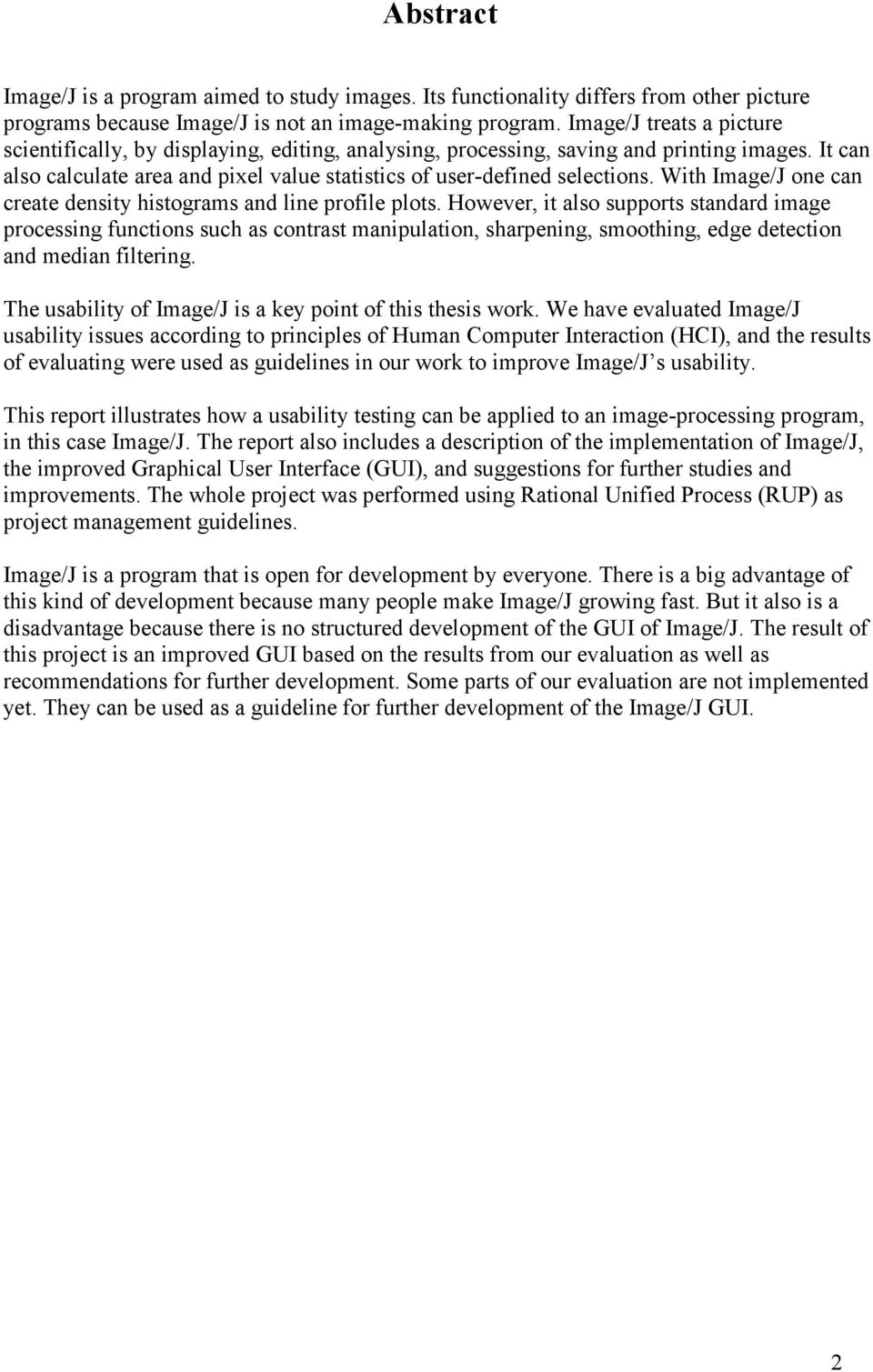
2 Abstract Image/J is a program aimed to study images. Its functionality differs from other picture programs because Image/J is not an image-making program. Image/J treats a picture scientifically, by displaying, editing, analysing, processing, saving and printing images. It can also calculate area and pixel value statistics of user-defined selections. With Image/J one can create density histograms and line profile plots. However, it also supports standard image processing functions such as contrast manipulation, sharpening, smoothing, edge detection and median filtering. The usability of Image/J is a key point of this thesis work. We have evaluated Image/J usability issues according to principles of Human Computer Interaction (HCI), and the results of evaluating were used as guidelines in our work to improve Image/J s usability. This report illustrates how a usability testing can be applied to an image-processing program, in this case Image/J. The report also includes a description of the implementation of Image/J, the improved Graphical User Interface (GUI), and suggestions for further studies and improvements. The whole project was performed using Rational Unified Process (RUP) as project management guidelines. Image/J is a program that is open for development by everyone. There is a big advantage of this kind of development because many people make Image/J growing fast. But it also is a disadvantage because there is no structured development of the GUI of Image/J. The result of this project is an improved GUI based on the results from our evaluation as well as recommendations for further development. Some parts of our evaluation are not implemented yet. They can be used as a guideline for further development of the Image/J GUI. 2
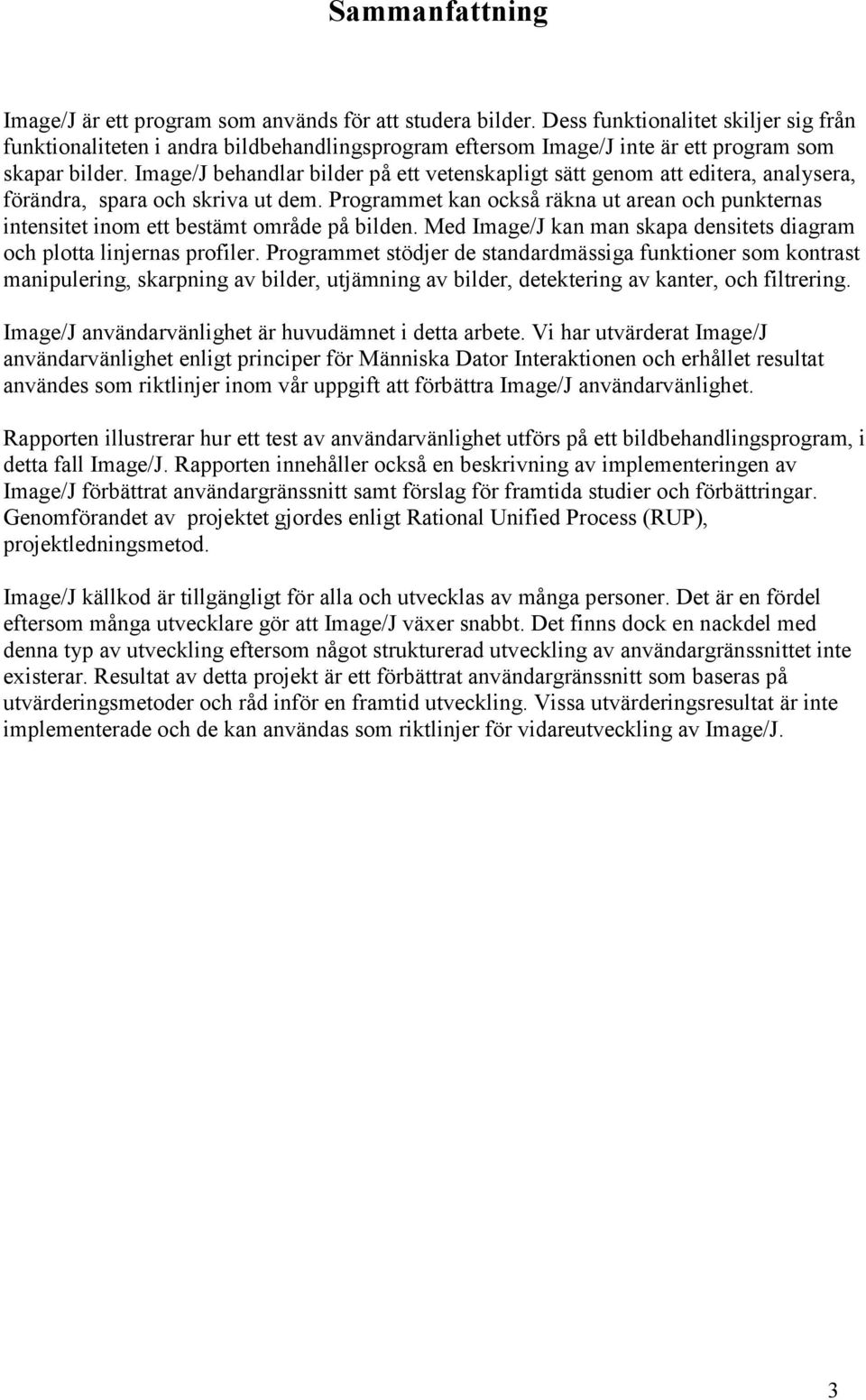
3 Sammanfattning Image/J är ett program som används för att studera bilder. Dess funktionalitet skiljer sig från funktionaliteten i andra bildbehandlingsprogram eftersom Image/J inte är ett program som skapar bilder. Image/J behandlar bilder på ett vetenskapligt sätt genom att editera, analysera, förändra, spara och skriva ut dem. Programmet kan också räkna ut arean och punkternas intensitet inom ett bestämt område på bilden. Med Image/J kan man skapa densitets diagram och plotta linjernas profiler. Programmet stödjer de standardmässiga funktioner som kontrast manipulering, skarpning av bilder, utjämning av bilder, detektering av kanter, och filtrering. Image/J användarvänlighet är huvudämnet i detta arbete. Vi har utvärderat Image/J användarvänlighet enligt principer för Människa Dator Interaktionen och erhållet resultat användes som riktlinjer inom vår uppgift att förbättra Image/J användarvänlighet. Rapporten illustrerar hur ett test av användarvänlighet utförs på ett bildbehandlingsprogram, i detta fall Image/J. Rapporten innehåller också en beskrivning av implementeringen av Image/J förbättrat användargränssnitt samt förslag för framtida studier och förbättringar. Genomförandet av projektet gjordes enligt Rational Unified Process (RUP), projektledningsmetod. Image/J källkod är tillgängligt för alla och utvecklas av många personer. Det är en fördel eftersom många utvecklare gör att Image/J växer snabbt. Det finns dock en nackdel med denna typ av utveckling eftersom något strukturerad utveckling av användargränssnittet inte existerar. Resultat av detta projekt är ett förbättrat användargränssnitt som baseras på utvärderingsmetoder och råd inför en framtid utveckling. Vissa utvärderingsresultat är inte implementerade och de kan användas som riktlinjer för vidareutveckling av Image/J. 3
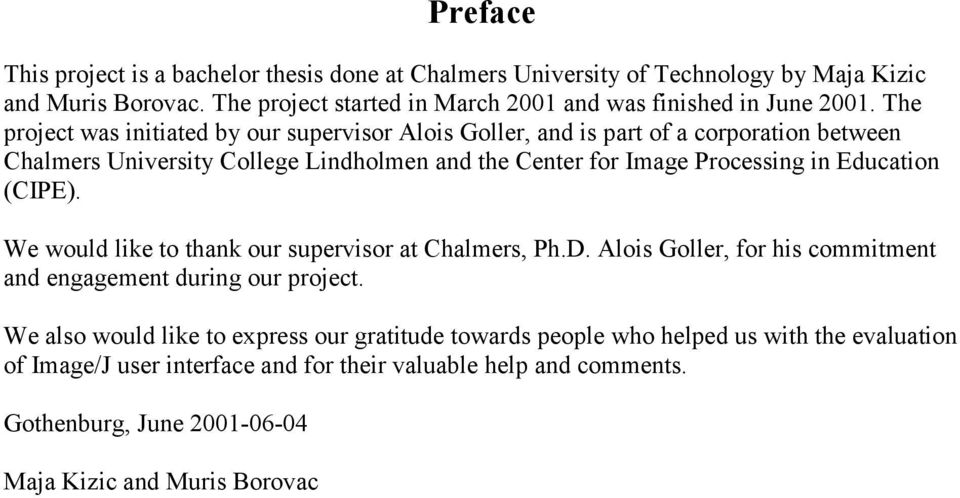
4 Preface This project is a bachelor thesis done at Chalmers University of Technology by Maja Kizic and Muris Borovac. The project started in March 2001 and was finished in June The project was initiated by our supervisor Alois Goller, and is part of a corporation between Chalmers University College Lindholmen and the Center for Image Processing in Education (CIPE). We would like to thank our supervisor at Chalmers, Ph.D. Alois Goller, for his commitment and engagement during our project. We also would like to express our gratitude towards people who helped us with the evaluation of Image/J user interface and for their valuable help and comments. Gothenburg, June Maja Kizic and Muris Borovac
5 Table of Contents 1. Introduction About Image/J About CIPE Task Work process Usability Engineering Background Usability Inspection Methods Usability Testing Image/J usability testing methods and results Heuristic evaluation Cognitive Walkthrough Paper-and-Pencil Test Thinking Aloud The analyses of the evaluations methods Recommendation for changes in Image/J...17 All menu items are active Changes in Image/J Image/J code structure Result Visibility of the Main Window Save and Save As Order in menu bar (Scion Image) The function zoom out in toolbar Ask for saving information when crating a new image Help function AWT versus Swing Conclusions and Outlook...28 References...29 Appendix A...30 Project Plan...30 Appendix B...33 Paper and Pencil test...33 Thinking Aloud test...34 Thinking Aloud: Comments on the test results
6 1. Introduction Many programmers concentrate rather on functionality than on the program s usability. One may think that the program s functionality is imperative. But what happens when other people use the program? It is hard to guess what other people can or cannot do, so the bitter test of any program is the usability test. It is a common occurrence that a user underestimates the whole program because the program is not easy to use. The key word of this thesis is usability and its application in reality. Our overall task was to evaluate usability of an image processing software (Image/J), and then to improve it. 1.1 About Image/J Image/J is a program which purpose is to enable picture processing. There are several types of software aimed to manipulate images. Some programs are made to change an image by adding different features to it. Those programs are widely used by designers and other artists. Image/J on the other hand is a program that can by described as a tool used in scientific areas, e.g. medicine. Researchers want to measure the size of different parts and organs to make various conclusions. Image/J allows them to analyse their images in such a way. This is an example of Image/J s range of uses but it can be used in many other science fields e.g. physics. Image/J can display, edit, analyse, process, save and print 8-bit, 16-bit and 32-bit images and can create Stacks - series of images presented in one window. It can calculate pixels, distance and angles, area and pixel value. Furthermore, it supports many standard image processing functions, including contrast enhancement, density profiling, smoothing, sharpening, edge detection, and other filtering functions. [1] Besides the obvious advantages with Image/J as an image processing software there is one great concept behind its development worth mentioning. Image/J is open source and many people participate in the development. Image/J was designed with an open architecture that provides extensibility via Java plugins. The plugins can be developed using Image/J's built in editor and a Java compiler, which makes it possible to write code that solves almost any image processing or analysis problem. The development of Image/J is orchestrated by its creator Wayne Rasband at the Research Services Branch, National Institute of Mental Health, Bethesda, Maryland, USA. [2] 6
7 1.2 About CIPE CIPE, the Center for Processing in Education is a non-profit organization formed in Its mission is to promote the use of visualization technologies for innovative educational, and other professional, applications. CIPE conducts workshops and develops instructional materials that use image processing and Geographic Information Systems (GIS) technologies as platforms for teaching about science, mathematics and technology. CIPE is organization that uses Image/J in its work to teach. Moreover, CIPE produces instructional materials designed for technological education courses. [3] 1.3 Task Our task is to evaluate and change the GUI 1 of the Image/J program. The main idea behind this project is to make Image/J easy to use. Our task is roughly divided into two parts: The first part is a research and evaluation of Image/J. This part of the work covers HCI (human computer interaction) studies and its practice applications on our problem. Image/J is evaluated against metrics commonly used in HCI. This includes performing several tests and its results are used as a basis for further improvement of the Image/J GUI. The second part of the project is the implementation of the changes in the program. This includes analysing the source code and identifying GUI classes and afterwards changing the GUI according to the requirements of CIPE and our own findings. The current implementation is UNIX-like with many windows floating around. CIPE asks for a more Windows-like environment. Furthermore, the menu items should be replaced to conform to other image processing software like NIH image or Scion Image. The task included one additional part. That is to implement another functionality and integrate Image/J into a multimedia HTML structure but this is out of project scope due to the time limit. 1.4 Work process We have chosen to use some elements of RUP (Rational Unified Process). RUP is a Software Engineering Process. It provides a disciplined approach to assigning tasks and responsibilities within a development organization. The Rational Unified Process is an iterative and controlled process. RUP is an appropriate methodology for realization of large projects but we use somewhat simplified RUP guidelines for our project. The project is divided in four phases. We reduced the number of iterations to one for each phase because it was more appropriate for our ten-week project. 1. Inception Phase This is a first phase according to RUP and ran for two weeks. The goal of this phase is to learn Image/J s functions and features as well as getting all necessary information about human computer interaction (HCI). 1 GUI graphical user interface 7
8 2. Elaboration Phase Elaboration is a three weeks long phase. During this time we did Image/J user interface evaluation, put together results of the evaluation and made a list for recommended changes in Image/J. 3. Construction Phase During this phase we implemented the changes of the user interface. This was a three weeks long phase. 4. Transition Phase This is the last phase of the project. Our supervisor examines the result. The final report is being written and we give an oral presentation. According to our project plan this phase should last for two weeks, but we had to extend this phase by one week because of delays in writing the report. The detailed description of the workflow is presented in the project plan in appendix A. 8
9 2. Usability Engineering The first part of the project was evaluation of the user interface. It is done according to HCI principles. This chapter gives background information about HCI and evaluation methods relevant to this project. The findings of the evaluation are discussed and recommendations for improvements are given. 2.1 Background What is HCI? Human-computer interaction is a discipline concerned with the design, evaluation and implementation of interactive computing systems for human use and with the study of major phenomena surrounding them. [4] Computers are now part of almost every aspect of modern life, which means that many people without extensive computer knowledge are using computers. This requires systems with advanced GUI. The link between man and computer is what HCI is about, whether one designs a new system or evaluates an existing one. HCI takes some aspects of disciplines like psychology, ergonomics 2, cognitive science, computer science and software engineering. In spite of its broad spreading, HCI provides with theoretical information and a set of practical procedures. More detailed information about HCI can be found in [5, 6, 7]. The part of HCI that our project deals with is usability engineering. This includes different methods for GUI evaluation, which analyse overall systems characteristics. The usability is measured against the following attributes (from [8], page 33): 1. Learnability: ease of learning for novice users. 2. Efficiency: steady-state performance of expert users. 3. Memorability: ease of using system intermittently for casual users. 4. Errors: error rate for minor and catastrophic errors. 5. Subjective Satisfaction: how pleasant system is to use. The methods we used can be divided into two method groups: 1. Usability inspection - Inspection of interface design based on analysis and judgement rather than experiment Heuristic Evaluation: A small set of evaluators examines the user interface and judges its compliance with recognised usability principles. Cognitive Walkthrough: A task-oriented walkthrough based on a formal cognitive model of user behaviour. 2 Ergonomics the study of work and working conditions in order to improve people s efficiency. 9
10 2. Usability testing - Empirical testing of interface design with representative users. Paper-and-Pencil Test: Test users shown aspects of interface on paper and answer questions. Thinking Aloud: Test users verbalise thoughts while performing test tasks. There is an additional method group Inquiry. Evaluators gather information about what users think about the system by talking to them, and observing them using the system in real work. Such methods are inapplicable to us due to lack of experienced users who actually use Image/J in their real work. 2.2 Usability Inspection Methods In this group consists of methods that are done by evaluators (in this case us). This is cost effective and fast way to evaluate usability. Heuristic Evaluation A small set of evaluators, in our case two, examines the user interface, in specific several dialogs, and judges its compliance with recognised usability principles. The user interface is tested against 10 principles as described in [8] on page 43: 1. Minimalist Design Less is more the dialog should not contain irrelevant information because it is distracting from relevant information. 2. Speak the Users Language The system should speak the users language, with words, phrases and concepts familiar to the user, rather than system-oriented terms. Follow real-world conventions, making information appear in a natural and logical order. 3. Recognition rather than Recall Make objects, actions, and options visible. The user should not have to remember information from one part of the dialogue to another. Instructions for use of the system should be visible or easily retrievable whenever appropriate. 4. Consistency Users should not have to wonder whether different words, situations, or actions mean the same thing. Follow platform conventions. 5. Feedback The system should always keep users informed about what is going on, through appropriate feedback within reasonable time. 6. Clearly Marked Exits Users often choose system functions by mistake and the functions should be canceled in a controlled way like "emergency exit" to leave the unwanted state without having to go through an extended dialogue. Support undo and redo. 10
11 7. Accelerators Accelerators -- unseen by the novice user -- may often speed up the interaction for the expert user such that the system can cater to both inexperienced and experienced users. Allow users to tailor frequent actions. 8. Good Error Messages Error messages should be expressed in plain language, indicate the problem, and suggest a solution. 9. Error Prevention Even better than good error messages is a careful design, which prevents a problem from occurring in the first place. 10. Help and Documentation Even though it is better if the system can be used without documentation, it may be necessary to provide help and documentation. Any such information should be easy to search, focused on the user's task, list concrete steps to be carried out, and not be too large. Cognitive Walkthrough This is a task-oriented walkthrough to analyse systems learnability 3. Many people prefer to explore a system and learn its features by trying to perform different tasks without reading documentation or manuals. The Cognitive Walkthrough is a method to determine how easy it is for novice user to learn the system s features. The concept is to define a characteristic user and what use he/she has from the system. Then, based on those assumptions, evaluators try to perform different tasks. 2.3 Usability Testing In the Usability Testing approach, representative users work on typical tasks using the system, and the evaluators use the results to see how the user interface supports the users to do their tasks. Paper-and-Pencil Test This test shows the first impression the user gets, and it is useful in early stages of system design. For example, the evaluator shows the sketch of an interface and asks the test user to describe what he/she expects the system to do. Thinking Aloud Test users are presented with a list of tasks to perform. While doing each task the test user tells what he/she thinks, expects to happen and continuously gives opinion about the system that is tested. 3 Learnability is one of the attributes used to measure the usability of GUI. 11
12 2.4 Image/J usability testing methods and results This section describes the results and the way that the methods are used for the evaluation of Image/J. The methods we have used are somewhat simplified especially the formal usability testing with representative users. By simplified we mean that the methods are adapt to scope of our project. The Thinking Aloud method is performed with four people and that is not enough to obtain sufficient of information Heuristic evaluation The heuristic evaluation is preformed based on the ten principles described in the previous section. We preformed the evaluation separately and afterwards we compared resultants. The results are presented below and as a summary of the two separate evaluations. 1. Minimalist Design Many unused buttons in the tool bar. Unnecessary large text area. Windows that are created can block/cover menu and toolbar. The toolbar is placed above the text area and suggests that those two have to be used together. 2. Speak the Users Language Image type and files suffixes are not user friendly for novice users. Especially when the user must choose a file type in order to save an image, or convert the image type for some other reason. The name stack is misleading. Writing text in an image is complicated. (First, the user must create a rectangular selection, then write text and finally press the fill command in the menu to make the changes permanent.) 3. Recognition rather than Recall The program demands certain knowledge about image processing software. Hard to remember where a functions lies. No default suffix visible when saving a new image. 4. Consistency Save and save as have somewhat different functions than users expect (Function Save is same as Save As except for the default suffix). Generated diagrams do not have a clear connection to the image they represent. If the user closes the window before saving the file the warning dialog appears. The order of buttons Don t Save, Cancel and Save on the warning dialog are inconsistent with other Windows applications. The status bar is used to indicate an ongoing process, and it is also used as area to describe toolbars functions. 12
13 5. Feedback Feedback is presented with the status bar and progress bar. A process can last longer than the status bar indicates. A histogram that is generated does not have a name connection with an immediate image. The menu items that cannot be used are not disabled (instead the user gets an error message when trying to use them). The marker/cursor is not disabled or changed in appearance when a process is in progress. 6. Clearly Marked Exits Redo does not exists Undo works one-step back. 7. Accelerators Using two shortcuts for same command (e.g. save: C and CTRL + C ). The menu item window shows a list of all opened files, and it can be used to activate a window. But there is no structure, which would help users to identify windows that are connected in some way. No record of most recently used files. 8. Good Error Messages Analyze particles: Error message is not displayed directly. The user must first write additional values in a pop-up menu. Threshold: Ambiguous and unclear instructions in the error message. Most of the error messages do not tell possible solutions. 9. Error Prevention When a user creates a new image, all changes can be lost if he closes the file without saving it. Undo works one step back. If the user changes an image several time there is no possibility to do undo command for every change that is made. The user can undo last command or retrieve the image as it is last saved. 10. Help and Documentation Does not exist Cognitive Walkthrough In section 1.1 we mentioned that Image/J is mostly used in science but there is a possibility that Image/J would be introduced as learning tool in high schools. We used the Cognitive Walkthrough method in order to determine Image/J s learnability based on the high school 13
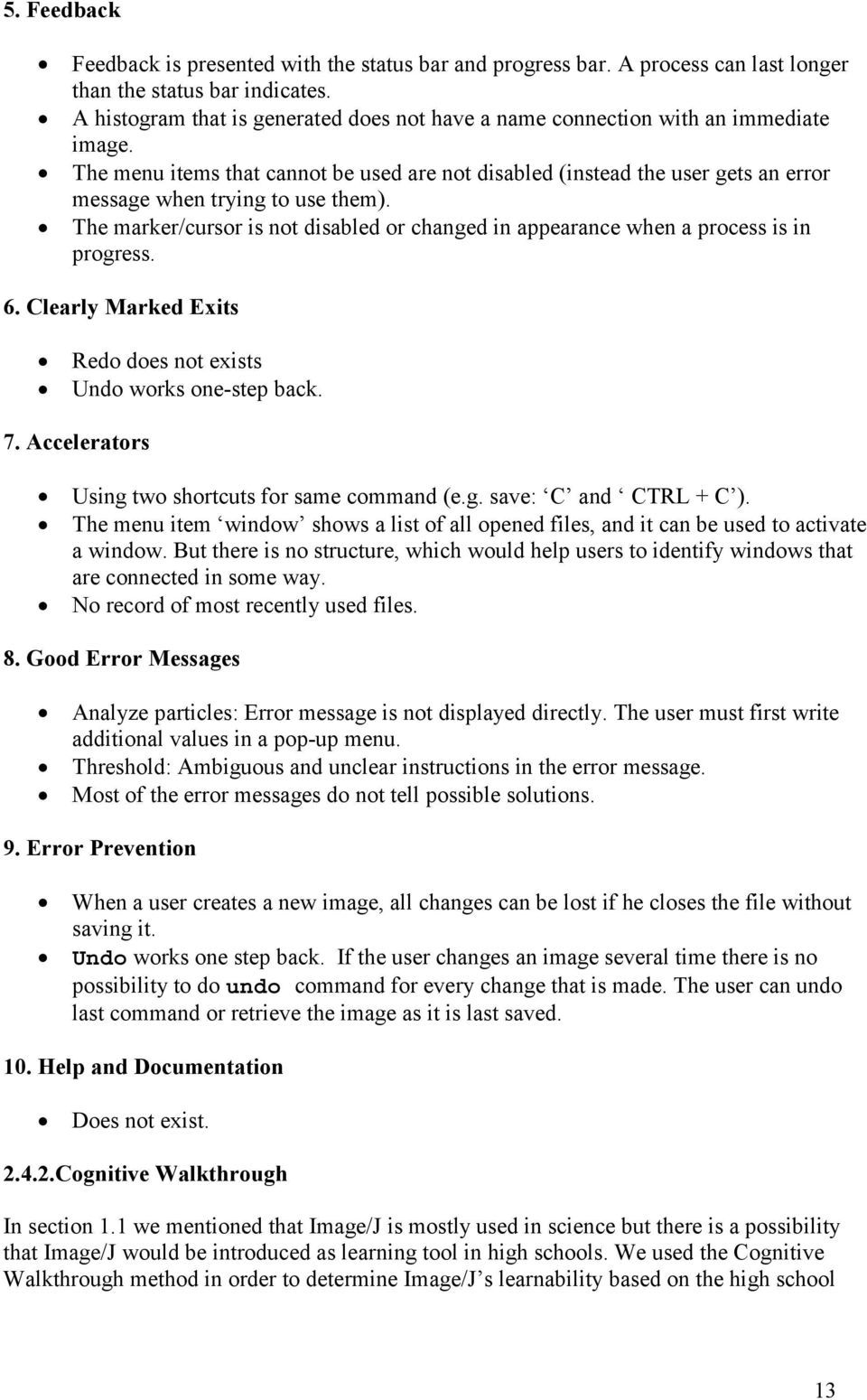
14 student s point of view. We started with simple tasks like opening, saving and editing files and later explored more complex features in Image/J. We came to the following conclusions: 1. It is hard to manage many opened files. 2. The user must have knowledge about the image file format to use most of the functions in the Image, Process and Analyze menus. This is expectable for the most advanced functions in Image/J but this is also true for the some simple functions like Save As and New in the menu File. 3. The order of the menus in the menu bar is confusing because it was hard to find functionalities even though we used them before. It was hard to find well-known functions like Adjust Brightness/Contrast. 4. There is possibility to create a new image, which can be edited, e.g. users can paste image or text into it. The problem is if one closes the image. There is no warning that all information will be lost. 5. The user may need to open several files. The files are placed unorganised on the screen, which decreases the usability. As one may notice, there are not many results from the Cognitive Walkthrough method. This is because this method was done after Heuristic evaluation and after we had read Image/J s documentation on web page. We as evaluators were influenced by the results from the previous evaluation and were not able to detect most of the problems that a typical user might Paper-and-Pencil Test The purpose of this test was to evaluate Image/J s menu bar and the order of the menus and the menu items. As shown in Appendix B1 the picture of the main window of Image/J was presented to four people and the list of different functions that Image/J does. The test users were asked to write the menu they thought the function belonged next to each function. Table2.1 presents results of the test. The first column shows the name of the functionality in Image/J, the next four columns show if the test users guessed correctly and the last column indicates the right answer. Question Person1 Person2 Person3 Persion4 Right answer Open R R R R File Quit R R R R File Select All R R R F Edit Fill F F F F Edit Draw F R F F Edit Add noise R F F R Process/AddNoise Brightness/ R R F F Image/Adjust contrast Restore R F R R Edit selection Measure F F F R Analyse 14
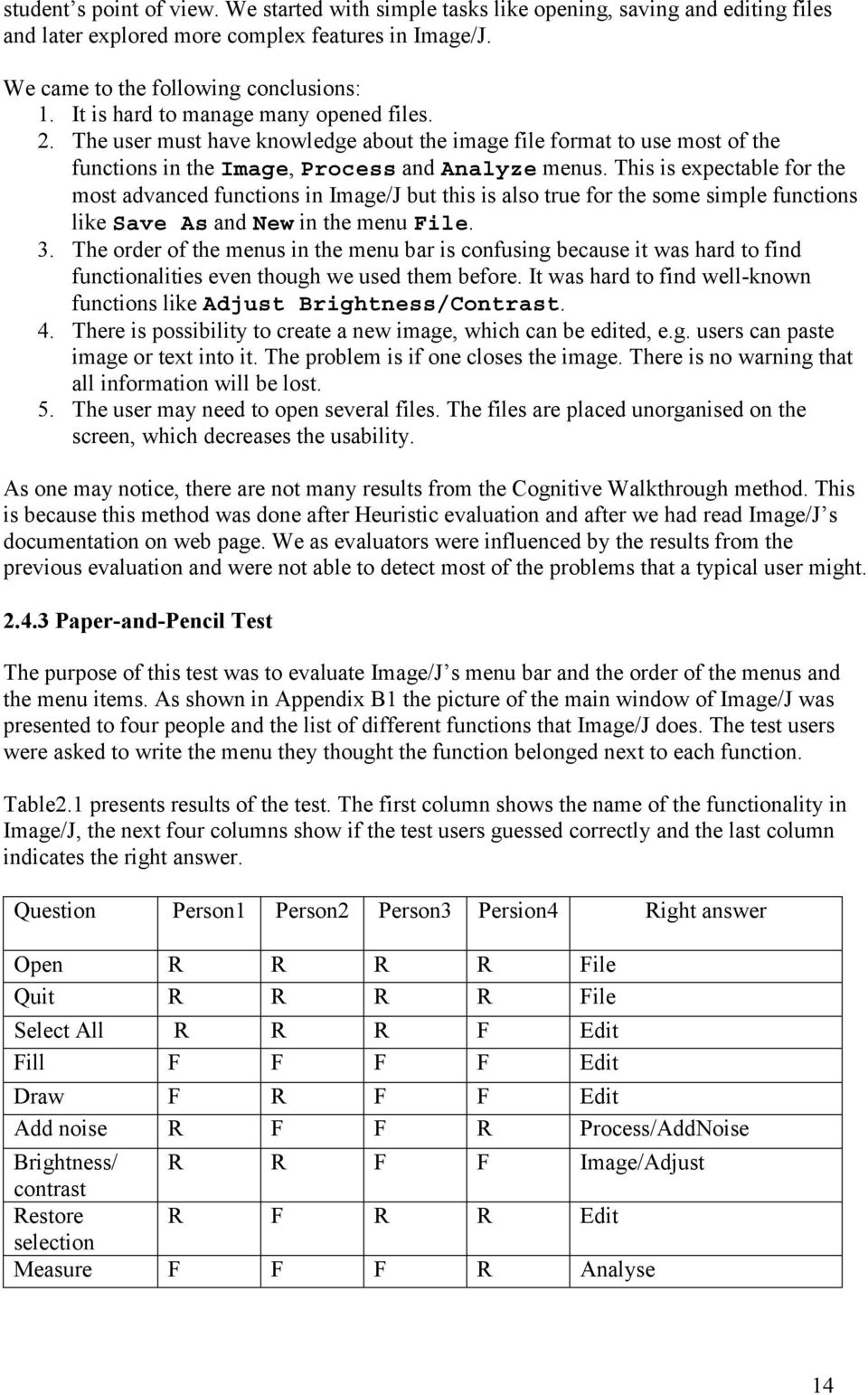
15 Histogram R R R F Analyse Duplicate F F R F Image Rotate R F R F Image Find edges F F F F Process Save x y F F F F Analyze/Tools coordinate Convolve R Missing R R Process/convolve data Calibrate F R R F Analyze About ImageJ R R R R Help Shadows F F F F Process Compile and F F R F Plugins run Math F F R F Process Stack/add slice F F F F Image/Stack/AddSlice Table 2.1: Results of Paper and-pencil test Thinking Aloud The problems that are presented here are found during thinking aloud-test. We divided them into two categories. The first one presents serious problems in the user interface and the second category are problems that are not serious but annoying. The result is presented in Table 3.2. The tasks had different degrees of difficulty; e.g. the user was asked to open a file and to manipulate image according to given instructions. While doing those assignments we made notes and afterwards analysed data. A part of notes is presented in Appendix B3 - Thinking Aloud: Comments on the test results. The problems that are presented here were found during the thinking aloud-test. We divided them into two categories. The first one presents serious problems in the user interface, and the second category are problems that are not serious but annoying. The problems that are considered serious are problems that prevented majority of test users to perform the tasks. The result is presented in Table 2.2. Problem Category Description number 1 Serious This problem concerns the layout of the main window. All new files end up over or under the main window, which makes it hard to find commands or a specific image if many files are opened. 2 Serious Text area is too large and it is very confusing for users. All users get impression that is possible to write and draw on it. 15
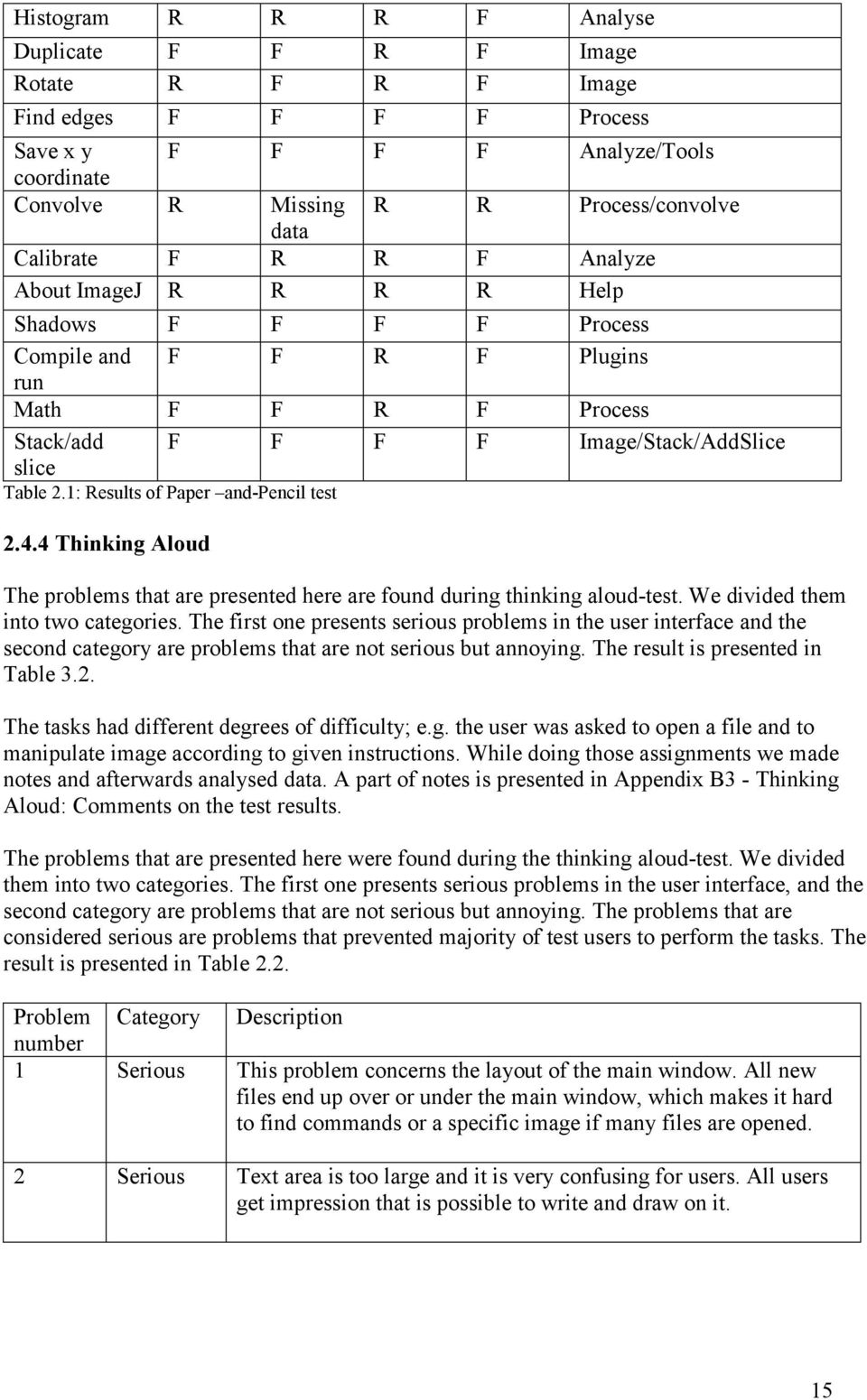
16 3 The toolbar is located over the text area and a user has the feeling that it is used to manipulate the text area and not an image. All users tried to find functionalities in the menu bar for the tasks that required using the toolbar. 4 Save / Save as are very well defined functions but the Image/J version of those functions are partly changed. All test users chose the well known file formats jpeg or gif. 5 User must write suffix when saving a new image, otherwise the image type suffix is not added. 6 Image types and suffix options are not easy to understand for novice users. To create a new image the user must choose file format and all test users chose the default values because none of them new what options means. 7 Menu bars items are not naturally distributed (especially confusing are Image, Process, and Analyze). All test users complained about it. 8 The progress bar gives feedback but it does not work always. 9 Serious Some error messages are insufficient, ambiguous, and the words used to describe the problems are too technical. (referring to image type) 10 Serious The help function does not exist. 11 Serious Using right mouse button to zoom out an image (without any reference to it) is not user-friendly. Three test users could not find this functionality. 12 Serious Error prevention. When creating a new image, a user can loose all data if he/she accidentally closes the window. 14 The white text area suggests that it is possible to write on it. 15 Serious Writing text in an image is too complicated. (Sometimes does not even work). None of the user preformed this task successfully. Table 2.2: Problems found in the Image/J using empirical testing of interface design with representative users. The results were obtained when four people separately tested Image/J using the questionnaire as presented in Appendix B2. The user profile is presented in Table
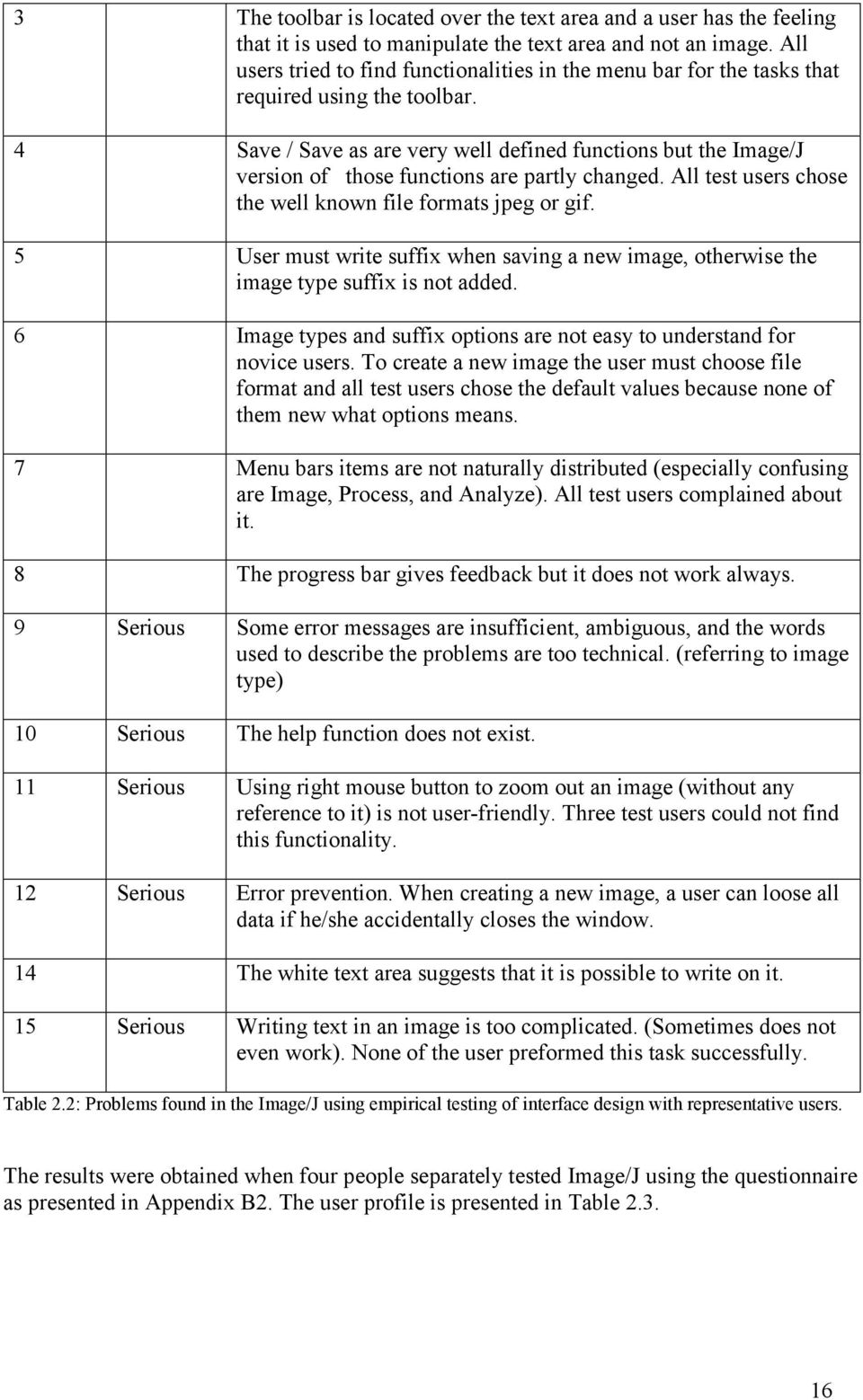
17 Characteristics Range Frequency Distribution Age years 3 persons Education level Secondary school 1 Bachelors 2 Masters 1 Education major Computer Science Other 2 2 Computer experience All users OS experience Windows All users Learning style Table 2.3: The user profile trial and error ask others read documentation All users None None The analyses of the evaluations methods We have used four different evaluation methods and results are presented above. Heuristic evaluation was the method that gave most results. Thinking Aloud Test was simplified and did not provide much new information. Thinking Aloud test would be much more efficient if it was done with more test users. We decided to use four test users. Paper-and-Pencil test was used specifically to test the menu bar. Heuristic test, Thinking Aloud and Cognitive Walkthrough pointed out the problem with many opened files and that is hard to understand image types and suffix options.the order of the menus in the menu bar is confusing according to all evaluation tests. However the problem with the writing text into an image was shown by Thinking Aloud test. The result from Think Aloud test was used to confirm the findings we got from Heuristic evaluation. 2.5 Recommendation for changes in Image/J This section presents a summary of the evaluation. After revising the results from the evaluation methods as discussed in the previous sections we extracted key issues which appear to be most important to improve Image/J GUI: Menus and toolbar are not always visible Image/J in its current 4 version has a main window consisting of the menu bar, toolbar and text area. If a user opens a file (i.e. an image), that image can be displayed over the main window and thus cover the menu and/or toolbar. Many opened files significantly decrease usability. Another problem is if a user maximises the main window that is enlarging the window size to the screen size. All opened files will become inaccessible because they will end up behind the main window, more precisely behind text area. Moreover, a user must minimize (iconize) all 4 By current version we mean Image/J before changes we implemented. That is version 1.23n 17
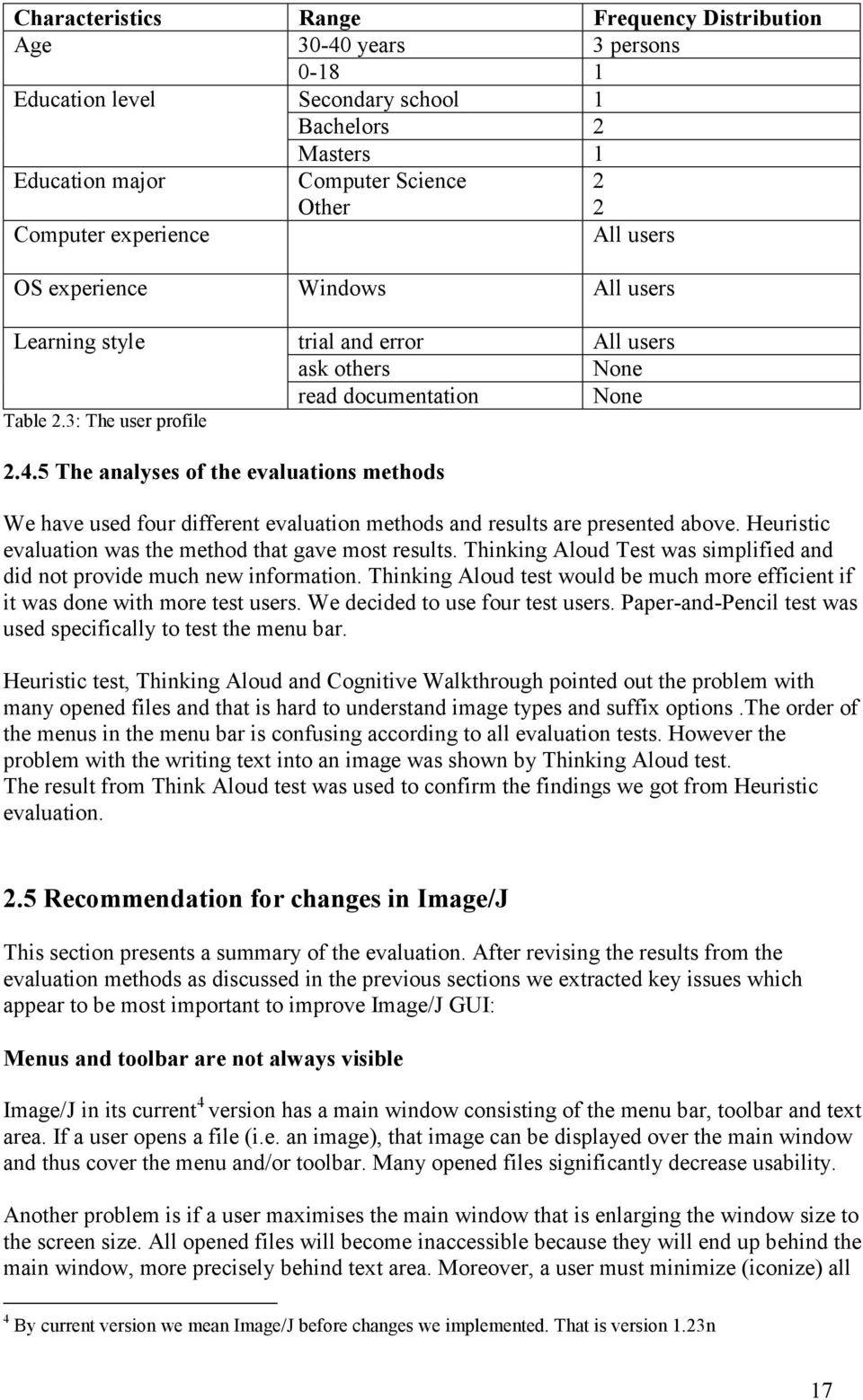
18 opened files manually, one by one, instead of being able to minimising all files automatically when minimising the main window. Our proposal is to remove the text area and create a frame that will act as a container for all opened files. That way the menu and toolbar are always visible and accessible and the problem of minimising and maximising the main window will be solved. Text area This is a follow-up to the previous point. The text area is large and visible even though there is no information displayed. Figure 2.1: The picture best illustrates first two points. The image is covering large part of the Image/J main window. Save and Save As Save and Save as are two very well defined functions and changing those decreases usability. In most applications Save as calls a dialog window and the user writes a name and chooses the file format under he/she wishes to save the file. The Save function works the same way for new files but for files that are opened and changed, Save saves the file without dialog window appearing. These two functions in Image/J are partly different than in other applications. In the current version of Image/J the user chooses Save as from the menu and then must chose a file format from the submenu. The submenu should be removed and choosing a file format should be done in the dialog window. The Save function is the same as Save as except that it offers the tiff format as default. We think that the function should be changed so that a file is saved automatically when a user chooses to save it, with exception when it is a newly created file. In that case the Save function should be the same as Save as. 18
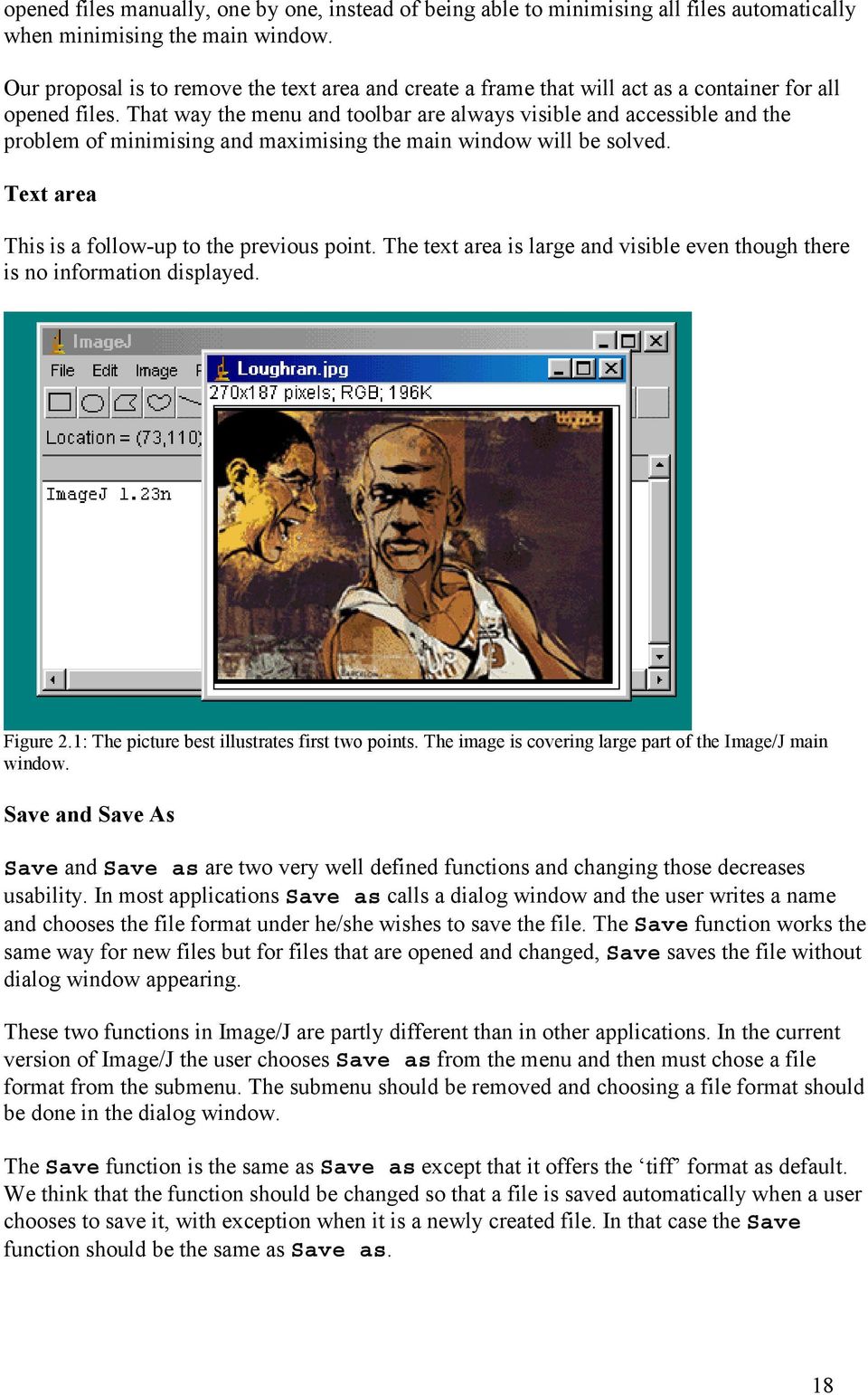
19 Viewing all opened files as a tree structure in a separate window One big disadvantage in Image/J is the placement of the opened files. This is especially a problem when the user has opened many files. There is no structure or connection between files that relate to each other. We propose a tree view of all opened files. Every new file would be placed under the root of the tree and all diagrams or any other file that has a connection with it will be placed under that file. This way a user can locate easily all files and many opened files would be much easier to handle. Figure 2.2: Illustration of the tree structure All menu items are active Regardless whether functions can or cannot be used, all menu items are always active. This results in many warnings or error messages. This aspect is especially important to novice users. All diagrams or any other file computed by some function should have the original name of the file or image in its title. The following example will illustrate this problem: A user has two images and makes two histograms, one for each image. Titles on those histograms have no explanation about which image they belong to. We think that the histograms should have names of the image they represent in its title. Change order in the menu between menu items. According to the Paper-and-Pencil test, menus and menu items are not categorized naturally. This is especially true in the menus Image, Analyse, Process. We suggest that all functions from menu Image that change the way an image is display should be moved to Edit e.g. the menu items Corp, Scale, Duplicate and Rotate. The menu item Stack has a submenu with 16 items and in our opinion it should be directly in the menu bar. 19
20 The way text is written in an image. To write text in an image the user presses the text tool from the toolbar. Then the user must make a selection on the image, write the text in the selected area and then use the command fill or draw from the menu edit to make the text remain on the image. This operation is too complicated and according to the Thinking Aloud test none of the people that tested Image/J have succeeded to perform this task. When the user makes a selection the text Replace me indicates that is possible to write on the image. The findings from the Thinking Aloud test indicate that a blinking marker is better signal for writing. We propose two alternatives to solve this problem. When a user chooses the text tool, a white area would be created in the image and a blinking marker would appear to indicate that it is possible to write. The text would remain on the image without using the fill command. If the user changes his/her mind, then the undo command in the menu should be used. The second alternative is to create a dialog window. The window has a text area that is used to write on it and two buttons, set and cancel. The text is entered on the image after the user pushes the set button. Add the functionality of reducing size of an image in the toolbar. To zoom into an image a user selects the magnifying glass tool in the toolbar and to zoom out a user must use the right mouse button. The right mouse button should be used as an accelerator (short cut) and not as the only access to the zoom-out functionality. A button for reducing an image s displaying size should be in the toolbar. Write the help function A help function does not exist. To write a complete help function is out of the scope of the project, but we think that a link to the Image/J web page in the program can be a temporary solution. 20
21 3. Changes in Image/J This chapter describes changes we have made to Image/J. First we will discuss Image/J s code structure and afterwards we discus and explain our decisions. Finally, we discuss differences between the AWT and Swing classes and illustrate why Image/J should be based on Swing. 3.1 Image/J code structure This is an overview of the class structure of Image/J and most parts are taken from the Image/J s tutorial [9]. The classes are grouped into packages and those packages are presented here with the classes they contain. This is not a complete documentation. Here, we only present classes that are relevant to Image/J s GUI, and that are necessary to understand the changes we made. Packet ij Image/Japplet: Image/J can be run as applet or as application. This is the applet class of Image/J. The advantage of running Image/J as applet is that it can be run (remotely) inside a browser. The biggest disadvantage is the limited access to files on the harddisk because of the Java applet security concept. Image/J: The main class of the Image/J application. This class contains the run method, which is the program s main entry point as well as the Image/J main window. Executer: A class for executing menu commands in separate threads (without blocking the rest of the program). IJ: A class containing many utility methods. ImagePlus: The representation of an image in Image/J. ImageStack: An ImageStack is an expandable array of images. WindowManager: This class manages the list of open windows. Packet ij.gui ProgressBar: A bar in the Image/J main window that informs graphically about the progress of a running operation. GenericDialog: A modal dialog that can be customized and called on the fly, e.g. for getting user input before running a plugin. NewImage: A class for creating a new image of a certain type from scratch. Roi: A class representing a region of interest (ROI) of an image. If supported by a plugin, it can process just the ROI and not the whole image. ImageCanvas: A canvas derived from java.awt.canvas on which an image is painted. ImageWindow: A frame derived from java.awt.frame that displays an image. StackWindow: An ImageWindow designed for displaying stacks. HistogramWindow: An ImageWindow designed for displaying histograms. PlotWindow: An ImageWindow designed for displaying plots. Packet ij.io This package contains classes for reading/decoding and writing/encoding image files. 21
22 Packet ij.measure Contains classes for measurements. Packet ij.plugin PlugIn: This interface has to be implemented by plugins, that do not require an image as input Packet ij.plugin.filter PlugInFilter: This interface has to be implemented by plugins, that require an image as input. Packet ij.plugin.frame PlugInFrame: A window class that can be subclassed by a plugin. Packet ij.process: Contains classes that process and convert images and stacs.. Packet ij.text This package contains classes for displaying text. The class diagram below presents Image/J GUI after changing the source code. The two new classes are added: TextWindowManager and PlugInFrameManager. The motivation for new classes is discussed in the next section. MessageArea Im ag ej ToolB ar (fro m g ui) IJ Menus ProgressB ar TextWindowM anager StatusB ar ImageWindowM anag er Executer TextWindow (f ro m Te x t) Te xt P a nel (fro m Text) ImageWindow (fro m g ui) Imag eplus PluginFrameM anager PlotWindow (fro m g ui) HistogramWindow PluginFrame (fro m Plug In) StackWindow (fro m g ui) Figure 3.1: The class diagram of the Image/J GUI 22
23 3.2 Result After the evaluation part of the project we decided what would be appropriate to change in Image/J due to the time limit. We decided the following to be primary tasks: Visibility of the Main Window This point is one of the major issues regarding the Image/J. As mentioned in the previous chapter, Image/J generates files presented in windows that can end up unorganised on the screen in relation with the main window that contains the menu and the toolbar. When the user opens a new file, e.g. an image, this file can cover the main window. There is also an opposite problem: the main window can cover an image. Our idea was to create a main window of the screen size that would contain all other generated files. But this design was abandoned because of the AWT component s nature. A more detailed discussion about AWT components and some of our ideas that have been abandoned comes later in this chapter. The solution to this problem was to remove the text area from the main window. The main window now consists of the menu bar and the toolbar, and it has a fixed size that cannot be changed. The text area is placed in a separate window and has the same function as before. The text area window cannot be closed because it is used to present results from various calculations. Figure 3.2 presents the look of the new Image/J. All files that are generated, e.g. by opening an image, are positioned so that they cannot end up over the main window or the text area unless the user moves them around the screen with the mouse. We have also solved the problem that appears when a user maximises the main window. Making the size of the main window unchangeable solves the problem of maximising it is simply not an option. Sometimes the user has the need to minimize (iconize) Image/J. This means that all files generated by Image/J should be minimised as well. This is solved with one existing class WindowManager and two new classes TextWindowManager and PluginFrameManager. WindowManager is used to control all opened images while the program is running. The new classes are very much alike WindowManager with the difference that they control all opened text windows and plugin windows respectively. Text windows are used to present data in form of text and plugin windows are windows where plugins can be written or extended. These three classes are used when the main window is minimised so that all other opened windows are minimised as well. These classes are also called in order to maximize all minimised windows. 23
24 Figure 3.2 The new Image/J s GUI Save and Save As When a user chooses the function the Save As a dialog window 5 should appear and the user can write a name under which he/she wishes to save the file and also choose a file type. This functionality exists in Image/J and our task was to implement a file filter so that only files types that Image/J supports are visible. However, this feature could not be implemented because Image/J is implemented with AWT components and the file filter does not work for the Windows operating system. Therefore the function Save As is the same as before. The function Save is changed as specified in the previous chapter. If the user opens a file, does some changes in the file and chooses Save, the file will be saved without dialog window appearing. This functionality works for tiff, jpg, gif, raw and txt files. If there is another file format or if this is a new image or if the image was loaded using a URL, the Save function is the same as Save As Order in menu bar (Scion Image) This change was desired by CIPE. We analysed the Scion Image menu bar and made changes in Image/J according to Scion Image. The menu Image was replaced with the menu Options. Some menu items from Image (duplicate, rotate, crop and scale are moved to Edit. The menu item Stacks is now placed directly in the menu bar. 5 Dialog window provides a GUI for navigating the file system 24
25 Figure 3.3: The new menu bar The function zoom out in toolbar The toolbar is presented in Figure 3.4. The appearance of the toolbar is not much changed: A new button has been added that represents zoom out and unused buttons are removed. The zoom in and the zoom out were accessible by the same tool button- Magnifying glass. The user had to press Magnifying glass and the left mouse button is used to zoom in and the right mouse button is used to zoom out. We separated those two functions and now there is the tool button for the zoom in and the button for zoom out. Zoom out Zoom in Figure 3.4: New toolbar Ask for saving information when crating a new image. User can create a new image by using command new in the file menu. When a new file is created and the variable changes in class ImagePlus is set to true this way the user cannot close the file without dialog window appearing Help function Creating complete help is out of scope of this project but we have created an extra menu item under the help menu, which opens Netscape and displays the Image/J s web page. 25
26 3.3 AWT versus Swing A comparison between AWT and Swing was not part of our thesis, but we encountered many problems with AWT during the implementation phase. Thus we think a comment on differences between AWT and Swing is in order. AWT and Swing are components that provide many standard GUI components such as buttons, lists, menus, and text areas, which you combine to create your program's GUI. The biggest difference between the AWT components and Swing components is that the Swing components are implemented with absolutely no native code6 and therefore they are slower. However, Swing components have more functionality than AWT. The Image/J GUI is implemented with AWT components. That is one major limitation in implementing all changes in GUI according to the HCI evaluation. One option is to translate all source code to Swing, but that would be outside of the scope of this project. There was also a strong recommendation from the Image/J development co-ordinator Wayne Rasband not to move to Swing. But we strongly recommend that Swing components should be used. To illustrate our point of view, we present a demo version of the Image/J GUI made with Swing components. Figure 3.5: The Image/J GUI with Swing components. 6 Native code - another programming language such as C 26
27 As Figure 3.5 shows, the window is divided into three parts. The first one has a tree structure, which is used as a file sorter. This way all opened files are easily accessible. The second part is a text area. It has mainly the same function as the text area in the current version of Image/J. It is used to present coordinates and other results from various calculations. Finally, the third part is used to present all opened images and other files. This is only a proposal for how Image/J can look when using Swing. Swing has many other suitable components that open many other design alternatives. Swing has multi-layer components that make it easier to design a GUI. They also automatically solve the problem of minimising and maximising windows. Moreover, Swing has a file chooser class that can implement file filter, which would solve the problem with implementing the function Save as as discussed in section For further information about Swing see [10]. 27
28 4. Conclusions and Outlook The usability is not just the look of the interface or selection of pretty colours; it is quality of dialog between the user and the application. Image/J is excellent software with many great features but the lack in the user interface decreases its usability. Based on the HCI guidelines, we have used four methods to evaluate Image/J GUI. These are Heuristic evaluation, Cognitive Walkthrough, Thinking Aloud and Paper-and-Pencil test. The result of the evaluations has been used as foundation for recommendation for changes in Image/J. Our recommendations are: Menus and toolbar should always be visible. Change the size of text area. Implement Save and Save As in the standard way. Change the order of the items in the menu. Add the functionality of reducing the size of an image in the toolbar. Write the help function. Deactivate all menu items that cannot be used. All diagrams or any other file computed by some function should have the original name of the file or image in its title. Show all opened files as a tree structure in a separate window. Change the way text is written in an image. We have at least partially implemented the first six points from the list. The rest can be used as a guideline for further improvements. The overall usability of Image/J could be improved considerably despite the limitations we had. The major limitation for implementation of all points listed above was time we had. Our project was limited to ten weeks. The second limitation was the nature of Image/J s source code. Image/J is implemented with AWT components, which restricts development of GUI. Our recommendation is to translate all the AWT components to Swing components, which at the same time offer more functionality. This change will accommodate the constant growth of Image/J s functionality. 28
29 References [1] Documentation, (Acc ) [2] ImageJ - Image Processing and Analysis in Java, ( Acc ) [3] Welcome to CIPE, (Acc ) [4] Curricula for Human-Computer Interaction, (Acc ) [5] Human-Computer Interaction, (Acc ) [6] Martin Helander, Thomas K. Landauer, Prasad V. Prabhu: Handbook of humancomputer interaction; Elsevier Amsterdam (1997) [7] Frank Maddix: Human-computer interaction theory and practice; Horwood New York (1990) [8] Keith Andrews: Hunam Computer Interaction;Lecture Notes, Graz University of Technology, (Acc ) [9] Bailer Werner: Writing ImageJ PlugIns A Tutorial; Fachhochschule Hagenberg, Austria; (Acc ) [10] Creating a GUI with JFC/Swing, (Acc ) 29
30 Appendix A Project Plan User interface - Image/J Objectives This project is part of a cooperation between Chalmers Lindholmen and CIPE, a nonprofitable organization that promotes computer-aided visualization as teaching and learning tool. One of the programs that they use is an image processing software called Image/J. The project s objective is to make changes in Image/J s user interface in order to make the software more useful to CIPE. The following points are included: Evaluating the program against metrics commonly used in human computer interaction (HCI) Studying HCI literature and code analysis Implementation of user interface Integrate Image/J into multimedia HTML structure. Scope The project will be done in 10 weeks. It is our final thesis and must be done accordingly to the Chalmers Lindholmens rules for final theses. References This project is done according to the Rational Unified Process standard. It is based on a requirement specification made by Alois Goller. Phase Plan The project is divided in following way: The first step is to analyse Image/J functions and evaluate the user interface against metrics commonly used in human computer interaction (HCI). This part also requires studying of HCI literature and documentation of many test cases. The second part includes the code analysis, and during the third part we will make the necessary changes based on our findings. These three parts are the primary objectives of the project. The fourth part is to implement an additional functionality. That is to integrate Image/J into a multimedia HTML structure. The fourth part is a secondary objective and will be done if time allows. The work consists of four phases in accordance with RUP standard: Inception Phase During this phase we will provide a project plan and decide what documents to write. The analysis of Image/J s functions and features should be done as well as getting all necessary information about human computer interaction (HCI). We will talk to our supervisor. The milestone of this phase is to gather enough information about Image/J and HCI in order to continue with the next phase. 30
31 Elaboration Phase This phase consists of code analysis, user interface analysis and making decisions regarding the design model. We will produce Rational Rose documents (use case, class diagrams, sequence diagrams). We will make a proposal for the changes in Image/J that we think are appropriate. The milestone of this phase is a complete model design, which should be approved by our supervisor. We will meet with our supervisor and discus and motivate our design model. Construction Phase During this phase we will implement the changes of the user interface. The milestone of this phase is a functioning program with incorporated changes in the user interface. Transition Phase This is the last phase of the project. Our supervisor should examine the result and a possible change will be done. The final report will be written. The milestone of this phase is the complete final report and the approval of our supervisor. Schedules The project begins March 12, 2001 and should be done June 4, Timeline Week 11, 2001 (Inception Phase): Project plan and description of what documents to write. Talk to our project coordinator. Studying of HCI literature and documentation of tests cases. Studying of Image/J functions and features. Week 12, 2001 (Inception Phase, cont): Analyze Images/J user interface. Analyze Image/J code structure. Week 13, 2001 (Elaboration phase) Identifying and analyzing classes in Image/J that create user interface. Make decisions for changes based on the HCI principles. Week 14, 2001 (Elaboration phase, cont) Define primary use cases. Define new classes Make class diagrams Week 15 and 16, 2001 Easter holidays Week 17, 2001 (Elaboration phase, cont) Completing all necessary Rational Rose documents. Code change startup meeting Week 18, 2001 (Construction phase) Coding, testing, and updating of documentation. 31
32 Week 19, 2001 (Construction phase, cont) Coding, testing and updating of documentation. Evaluating design model. Week 20, 2001 (Construction phase, cont) Coding and testing. Week 21, 2001 (Transition Phase) Evaluation of the whole product. Time is allocated for possible changes in program. Writing the final report. Week 22, 2001 (Transition Phase, cont) Writing the final report. Examination (?). Releases The following documents will be produced: Project Plan Use case specification Use case realization specification Requirement specification Test plan Risk list Design model Source code Final report Resource plan There are two people working on this project full-time guided by Alois Goller, the project supervisor. Window98 is the work platform and JBuilder is used to develop the program code. The development tools are Rational Unified Process (RUP) and Rational Rose. Cost As this project is done as a part of our final thesis we have no budget. We are doing this project for a non-profitable organization and we do not get paid for the work. 32
33 Paper and Pencil test Appendix B Bilden visar Image/J utseende. Din uppgift är att försöka kategorisera funktionaliteter under den meny (file, edit, image ) du tycker de hör till hemma: Open Quit Select All Fill Draw Add noise Brightness/contrast Restore selection Measure Histogram Duplicate Rotate Find edges Save x y coordinate Convolve Calibrate About Image/J Shadows Compile and run Math Stack / add slice 33
34 Thinking Aloud test Testförslag 1. Öppna filer: Loughran.jpg, spiralhand.gif, copland.bmp. 2. Skapa en kopia av filen : Loughran.jpg genom att : Duplicera hela filen Markera en bit av bilden, kopiera biten och klistra biten i en ny blank fil som du skapar. Spara filerna med ett lämpligt namn. 3. Visa histogram av bilderna Loughran.jpg och spiralhand.gif, 4. Förstora bilden copland.bmp 4 ggr. 5. Förminska samma bild. 6. Det finns funktion för att analysera bildpartiklar. Den används för att Använd bilden copland.bmp för att utföra funktionen. Om ni får felmeddelande försöka att göra nödvändiga förändringar för att kunna fortsätta. 7. Gör samma sak med bilden Loughran.jpg 8. Öppna filen från URL 9. Rotera bilden 90 0 åt höger och gör tröskel bild av bilden från föregående uppgiften. 10. Gör operation smooth ( den används för att göra bilden suddig ) på bilden copland.bmp.jpg find edges ( den betonar starka förändringar i bildens färgintensitet ) på samma bild och sedan försök att få tillbaka den ursprungliga bilden. 34
35 11. Funktionen Measure används för att få information om area, färger och andra beräkningar av en bild. Använd denna metod och spara resultat i en text fil. 12. Försök att få bildens plot profile. (funktionalitet som analyserar bildens pixlar och presentera resultat i en graf) 13. Försök nu att hitta histogrammet för bilden spiralhand.gif. som du gjorde i uppgiften Skriv en text in i bilden Loughran.jpg och spara ändringar. 15. Det finns en funktion som används för att justera bildens kontrast och ljusstyrka. Den heter Brightness/Contrast. 16. Markera två punkter på en godtycklig bild med hjälp av markören. Försök att läsa av avståndet mellan dem. 35
36 Thinking Aloud: Comments on the test results (This is only one part of our notes we made during the Thinking Aloud test. It is considered to illustrate how the technique works rather than to give precisely all annotations we made). 1 Öppna filer: Loughran.jpg, spiralhand.gif, copland.gif, Test.doc. Person 1 Han öppnade huvud konsol över hela skärmen, sen minskade till en mittemellan nivå (ej default). Annars bra. Person 2 Förstorade huvud konsol genom att dra i kanten till en mellan storlek. Uppgiften gick bra. Person 3 Öppnar först hela fönstret. Konstigt meddelande. 2 Skapa en kopia av filen Loughran.jpg genom att : Duplicera hela bilden Person 1 Använder copy/paste från meny och försöker att klistra in i textarea. Använder Edit/Select All, försöker göra paste I en ny blank fil som han öppnar. Han har svarigheter att tolka felmeddelande eftersom bilden han vill kopiera är större än den nya filen. Efter att vi har påpekat att tita i kanten av bilden gör han de inställningarna för att kunna klistra bilden. Tror att filens suffix ( i vårt exempel jpg) är den inställning han skall ändra istället för RGB. Han klagar på missledande felmeddelande, behöver mer info om inställningar för en ny fil. Han missuppfattade programmets funktion, nämligen trodde han att det huvudsakligen används för att rita bilder. Han tänkte inte alls att titta efter kommandot Duplicate. Person 2 Försökte kopiera och sen klistra in i textare. Skapade en ny fil, försökte klistra in och fick felmeddelande. Tittade i File och Edit. Hon ändrade format efter att jag påpekar text i kanten av bilder, men förstår inte riktig RBG men inte som Person 1, hon tänkte inte på jpg suffixen. (Fick någonting konstigt två bilder i en) Försökte en gång till och lyckades. Person 3 Höger klickar efter copy och paste. Han trycket på copy och försöker att klistra i textarea. Han öppnar en ny fil men har problem att klistra i en mindre format. Han lyckas efter lite information från oss. (Vi påpekar information i bildens övre kant.) Markera en bit av bilden, kopiera biten och klistra biten i en ny blank fil som du skapar. Person 1 Efter att har fått så pass klar beskrivning av uppgiften klarar han det fort och lätt. 36
37 Person 2 Tittade i meny File och Edit. Upptäckte kommandot Duplicate.Hon tittar inte alls i toolbar. Efter ett tag märker hon beskrivning av toolbars enheter. Hon trodde att de används för att rita figurer. Hon utför uppgiften mha. Rektangulärmarkören från toolbar. Spara filerna med ett lämpligt namn. Person 1 Klagar på att inte finns default värden på filer när man väljer format i meny File/Save as. Han tror att Jpg = RBG Person 2 Använder Save as och undrar över fil förslag. Hon väljer samma som den bild hon kopierade. Person 3 Klagar på save/save as. 3 Visa histogram av bilderna Loughran.jpg och spiralhand.gif, Kommentarer: Person 1 Inga problem att utföra operationen. Han sa att huvud konsolen stör honom inte. Person 2 Stängde alla fönster som hyon inte behövde. Tittar i analyze och utför uppgiften.vet inte vilket är vilket histogram. Person 3 Gör uppgiften och sen stänger alla fönster. 4 Förstora bilden copland.bmp 4 ggr. Person 1 Han använde meny Image/Scale. Bilden förändras i storleken minnesmässigt. Visuellt är den likadan. Han märkte inte förändring och klagar på feedback. Sen försöker med kommandot Resize. Efter att jag har påpekat att det finns toolbar börjar han för första gången utforska den. Han kan inte se samband mellan bilden och toolbar. Till slut lyckades han göra uppgift. Han tittade flera ggr i meny Edit och Image efter förstoring resp. förminskning funktionen. Person 2 Stänger alla fönster som hon inte behöver innan hon börjar. Hon letar i Image/scale. Använder den och märker skillnaden i storleken minnesmässigt men det är inte det hon vill göra. Hon använder set scale, konstaterar att hon inte fattar den. Vi påpekar att hon kanske skall leta i toolbar. Hon lyckas hitta Magnifying glass. Person 3 Letar i meny. Använder ajustsize och fösrora 4 ggr mer pixlar. Han merker förändring i storleken (minnesmässigt). Fortsätter att leta i meny i Image, Analyze, Process. Hittar med vår hjälp. 37
38 5 Förminska samma bild. Person 1 Han använde höger musknapp på en gång men sa att det är konstigt att den funktionaliteten ligger i höger musknappen. Person 2 Tittar i Edit /Options. Hon försöker använda Resize (Size). Stängde filen och öppnade den igen för ett nytt försök.. Hon fortsatte att leta i menyer men lyckades inte förminska. 6 Det finns funktion för att analysera bildpartiklar. Använd bilden copland.gif för att utföra funktionen. Om du får felmeddelande försök att göra nödvändiga förändringar för att kunna fortsätta. Person 1 Inga problem att utföra operationen. Han förstår inte funktionen. Person 2 Stängde alla fönster (förutom huvud konsol). Öppnade filen copland.gif. Utförde uppgiften, men hade svårt att avgöra om filen i fråga var aktiv. 7 Gör samma sak med bilden Loughran.jpg Person 1 Han fick felmeddelande och lyckades omvandla bilden till 8-bit greyscale. Han kan inte omvandla till binary/threshold. Han försöker att hitta samma fil som heter samma men i binärt format(?). han gör tröskelbild efter att han fick förklaring vad detta är. Han kommenterar felmeddelande: Först att man skall omvandla till 8-bit gryscale, sen gör man inställningar och därefter felmeddelande att den måste vara thresholded or binary. Person 2 Fick felmeddelande och omvandlade till 8 bit greyscale. Andra felmeddelande (thresholh/binary) -> letade i Image/type men lyckades till slut med lite hjälp. 8 Öppna filen från URL Person 1 Inga problem att utföra operationen. Person 2 Började med att öppna Netscape men vi så att hon skulle använda programmet istället. Hon tittade i File/Open sen i Samples och sen hittar hon Import. Det gick bra med lite instructioner. 38
39 9 Rotera bilden 90 0 åt höger och gör tröskel bild av bilden från föregående uppgiften (storan.jpg). Person 1 Inga problem att utföra operationen. Han gjorde tröskelbild i den gående uppgiften. Person 2 Det gick fort och bra. Person 3 Första del gick bra sen letade han efter tröskel i meny Edit/type 10 Gör operation smooth ( den används för att göra bilden suddig ) på bilden copland.bmp.jpg find edges ( den betonar starka förändringar i bildens färgintensitet) på samma bild och sedan försök att få tillbaka den ursprungliga bilden. Person 1 Inga problem att utföra de första två uppgifterna. När han skulle få den ursprungliga bilden tillbacka kollar först i meny Edit för undo. Han konstaterade att den fungerar bara ett steg tillbaka, tittade i Image och de övriga menyer och ger upp. Person 2 Första uppgift: Tittar i Image och sen Process. Utför uppgiften. Andra: Hittar rätt och utför uppgiften Tredje: Försöker med undo kommandot. Tänker på en Reset funktion som kan finnas i Edit meny. Hon upptäcker förklaring om toolbars funktionaliteter (i statusbar).tittar i Image/Adjust och till sist stänger bilden. 11 Funktionen Measure används för att få information om area, färger och andra beräkningar av en bild. Använd denna metod och spara resultat i en text fil. Person 1 Inga problem att utföra operationen Mesure. För att spara använder save as/ measurments. Person 2 Inga problem att utföra operationen Mesure. För att spara använder save as/textimage. fråga Muris!!!! 12 Försök att få bildens plot profile. (funktionalitet som analyserar bildens pixlar och presentera resultat i en graf) Person 1 Han öppnar Process, sen Analyze, letar efter select (tror att man måste markera bilden ). Han letar hela tiden efter select kommandot i meny. Lyckades till slut. 39
40 Person 2 Fick meddelande att man måste markera bilden. Hon kollar menyer och sen försöker använda markören för selektion. Hon gör uppgift. 13 Försök nu att hitta histogrammet för bilden spiralhand.gif. som du gjorde i uppgiften 3. Person 1 Misslyckades totalt.(försökte att höger klicka) Person 2 Vi hoppade över uppgiften iom. att hon stängde histogrammen innan. 14 Skriv en text in i bilden Loughran.jpg och spara ändringar. Person 1 Han öppnar filen på nytt (stängde den någon gång) Kollar meny Edit, Image. Han upptäckter toolbar A och skriver in text. Försöker spara efteråt. Han märker inte alls att man måste använda fill kommandot för att göra skrivning gällande. Han klagar på save och save as kommandona. Han vill att save skall spara automatiskt befintlig fil som man förändrar. Han lyckades inte utföra uppgift. Person 2 Stänger fönsterna och tiitar först i meny ( fråga Muris!!!!!!!) Använder toolbar: använder select tool och markerar area i bilden. sen använder hon text tool men vet inte hur skall hon skriva (hon tror att det kommer en markör som visar att man kan skriva ) hon upptäcker Replace me text men vet fortfarande inte hur skall man skriva. Vet inte hur man sparar text och tror att text lagras så fort man skriv någonting, (använde inte fill kommandot). 15 Det finns en funktion som används för att justera bildens kontrast och ljusstyrka. Den heter Brightness/Contrast. Person 1 Utförde inte uppgiften, för att han inte hittade funktionen. Han tittade i meny först i process, sen analyze, sen image. Person 2 Efter att hon letat lite hittar hon Brightness/Contrast. Men påpekar att man skall har den tillgängligare. (kollar i Image först) 16 Markera två punkter på en godtycklig bild med hjälp av markören. Försök att läsa av avståndet mellan dem. Person 1 Gjorde inte uppgiften. Person 2 Tittar i Analyze/tools. Merkera två punkter med markören, trycker på Measure. Flera gånger trycker på SetMeasure 40
Adding active and blended learning to an introductory mechanics course
 Adding active and blended learning to an introductory mechanics course Ulf Gran Chalmers, Physics Background Mechanics 1 for Engineering Physics and Engineering Mathematics (SP2/3, 7.5 hp) 200+ students
Heuristisk utvärdering
 Interaction design, industrial design, design management, service design, information design, experience design, graphic design, furniture design, destination design, product design, ergonomics design,
Support Manual HoistLocatel Electronic Locks
 Support Manual HoistLocatel Electronic Locks 1. S70, Create a Terminating Card for Cards Terminating Card 2. Select the card you want to block, look among Card No. Then click on the single arrow pointing
Beijer Electronics AB 2000, MA00336A, 2000-12
 Demonstration driver English Svenska Beijer Electronics AB 2000, MA00336A, 2000-12 Beijer Electronics AB reserves the right to change information in this manual without prior notice. All examples in this
Writing with context. Att skriva med sammanhang
 Writing with context Att skriva med sammanhang What makes a piece of writing easy and interesting to read? Discuss in pairs and write down one word (in English or Swedish) to express your opinion http://korta.nu/sust(answer
Problem som kan uppkomma vid registrering av ansökan
 Problem som kan uppkomma vid registrering av ansökan Om du har problem med din ansökan och inte kommer vidare kan det bero på det som anges nedan - kolla gärna igenom detta i första hand. Problem vid registrering
Isolda Purchase - EDI
 Isolda Purchase - EDI Document v 1.0 1 Table of Contents Table of Contents... 2 1 Introduction... 3 1.1 What is EDI?... 4 1.2 Sending and receiving documents... 4 1.3 File format... 4 1.3.1 XML (language
6 th Grade English October 6-10, 2014
 6 th Grade English October 6-10, 2014 Understand the content and structure of a short story. Imagine an important event or challenge in the future. Plan, draft, revise and edit a short story. Writing Focus
Klicka här för att ändra format
 på 1 på Marianne Andrén General Manager [email protected] Sandbacka Park Högbovägen 45 SE 811 32 Sandviken Telephone: +46 26 24 21 33 Mobile: +46 70 230 67 41 www.isea.se 2 From the Off e project
Materialplanering och styrning på grundnivå. 7,5 högskolepoäng
 Materialplanering och styrning på grundnivå Provmoment: Ladokkod: Tentamen ges för: Skriftlig tentamen TI6612 Af3-Ma, Al3, Log3,IBE3 7,5 högskolepoäng Namn: (Ifylles av student) Personnummer: (Ifylles
http://marvel.com/games/play/31/create_your_own_superhero http://www.heromachine.com/
 Name: Year 9 w. 4-7 The leading comic book publisher, Marvel Comics, is starting a new comic, which it hopes will become as popular as its classics Spiderman, Superman and The Incredible Hulk. Your job
Preschool Kindergarten
 Preschool Kindergarten Objectives CCSS Reading: Foundational Skills RF.K.1.D: Recognize and name all upper- and lowercase letters of the alphabet. RF.K.3.A: Demonstrate basic knowledge of one-toone letter-sound
Schenker Privpak AB Telefon VAT Nr. SE Schenker ABs ansvarsbestämmelser, identiska med Box 905 Faxnr Säte: Borås
 Schenker Privpak AB Interface documentation for web service packageservices.asmx 2012-09-01 Version: 1.0.0 Doc. no.: I04304b Sida 2 av 7 Revision history Datum Version Sign. Kommentar 2012-09-01 1.0.0
Information technology Open Document Format for Office Applications (OpenDocument) v1.0 (ISO/IEC 26300:2006, IDT) SWEDISH STANDARDS INSTITUTE
 SVENSK STANDARD SS-ISO/IEC 26300:2008 Fastställd/Approved: 2008-06-17 Publicerad/Published: 2008-08-04 Utgåva/Edition: 1 Språk/Language: engelska/english ICS: 35.240.30 Information technology Open Document
Health café. Self help groups. Learning café. Focus on support to people with chronic diseases and their families
 Health café Resources Meeting places Live library Storytellers Self help groups Heart s house Volunteers Health coaches Learning café Recovery Health café project Focus on support to people with chronic
Make a speech. How to make the perfect speech. söndag 6 oktober 13
 Make a speech How to make the perfect speech FOPPA FOPPA Finding FOPPA Finding Organizing FOPPA Finding Organizing Phrasing FOPPA Finding Organizing Phrasing Preparing FOPPA Finding Organizing Phrasing
Kursutvärderare: IT-kansliet/Christina Waller. General opinions: 1. What is your general feeling about the course? Antal svar: 17 Medelvärde: 2.
 Kursvärdering - sammanställning Kurs: 2AD510 Objektorienterad programmering, 5p Antal reg: 75 Program: 2AD512 Objektorienterad programmering DV1, 4p Antal svar: 17 Period: Period 2 H04 Svarsfrekvens: 22%
Stiftelsen Allmänna Barnhuset KARLSTADS UNIVERSITET
 Stiftelsen Allmänna Barnhuset KARLSTADS UNIVERSITET National Swedish parental studies using the same methodology have been performed in 1980, 2000, 2006 and 2011 (current study). In 1980 and 2000 the studies
Quick Start Guide Snabbguide
 Quick Start Guide Snabbguide C Dictionary Quick Start Thank you for choosing C Dictionary and C-Pen as your translation solution. C Dictionary with its C-Pen connection will make translation easy and enable
Usability- användbarhet
 Usability- användbarhet Tekniker, metoder och annat vi måste känna till för att kunna använda oss av usability som ett framgångsrecept i design av IT & digitala medier. [email protected] Veckans
GeoGebra in a School Development Project Mathematics Education as a Learning System
 Karlstad GeoGebra in a School Development Project Mathematics Education as a Learning System Dé dag van GeoGebra Zaterdag 19 oktober 2013 GeoGebra Instituut Vlaanderen, Brussell 1 2 GeoGebra in a School
Module 1: Functions, Limits, Continuity
 Department of mathematics SF1625 Calculus 1 Year 2015/2016 Module 1: Functions, Limits, Continuity This module includes Chapter P and 1 from Calculus by Adams and Essex and is taught in three lectures,
2.1 Installation of driver using Internet Installation of driver from disk... 3
 &RQWHQW,QQHKnOO 0DQXDOÃ(QJOLVKÃ'HPRGULYHU )RUHZRUG Ã,QWURGXFWLRQ Ã,QVWDOOÃDQGÃXSGDWHÃGULYHU 2.1 Installation of driver using Internet... 3 2.2 Installation of driver from disk... 3 Ã&RQQHFWLQJÃWKHÃWHUPLQDOÃWRÃWKHÃ3/&ÃV\VWHP
Biblioteket.se. A library project, not a web project. Daniel Andersson. Biblioteket.se. New Communication Channels in Libraries Budapest Nov 19, 2007
 A library project, not a web project New Communication Channels in Libraries Budapest Nov 19, 2007 Daniel Andersson, [email protected] 1 Daniel Andersson Project manager and CDO at, Stockholm Public
EVALUATION OF ADVANCED BIOSTATISTICS COURSE, part I
 UMEÅ UNIVERSITY Faculty of Medicine Spring 2012 EVALUATION OF ADVANCED BIOSTATISTICS COURSE, part I 1) Name of the course: Logistic regression 2) What is your postgraduate subject? Tidig reumatoid artrit
3rd September 2014 Sonali Raut, CA, CISA DGM-Internal Audit, Voltas Ltd.
 3rd September 2014 Sonali Raut, CA, CISA DGM-Internal Audit, Voltas Ltd. Role and responsibility of Internal Audit Sharing of best practices Model of operation In conduct of audit assignment Other functions
Schenker Privpak AB Telefon 033-178300 VAT Nr. SE556124398001 Schenker ABs ansvarsbestämmelser, identiska med Box 905 Faxnr 033-257475 Säte: Borås
 Schenker Privpak AB Interface documentation for web service packageservices.asmx 2010-10-21 Version: 1.2.2 Doc. no.: I04304 Sida 2 av 14 Revision history Datum Version Sign. Kommentar 2010-02-18 1.0.0
Workplan Food. Spring term 2016 Year 7. Name:
 Workplan Food Spring term 2016 Year 7 Name: During the time we work with this workplan you will also be getting some tests in English. You cannot practice for these tests. Compulsory o Read My Canadian
Examensarbete Introduk)on - Slutsatser Anne Håkansson [email protected] Studierektor Examensarbeten ICT-skolan, KTH
 Examensarbete Introduk)on - Slutsatser Anne Håkansson [email protected] Studierektor Examensarbeten ICT-skolan, KTH 2016 Anne Håkansson All rights reserved. Svårt Harmonisera -> Introduktion, delar: Fråga/
Vässa kraven och förbättra samarbetet med hjälp av Behaviour Driven Development Anna Fallqvist Eriksson
 Vässa kraven och förbättra samarbetet med hjälp av Behaviour Driven Development Anna Fallqvist Eriksson Kravhantering På Riktigt, 16 maj 2018 Anna Fallqvist Eriksson Agilista, Go See Talents linkedin.com/in/anfaer/
FÖRBERED UNDERLAG FÖR BEDÖMNING SÅ HÄR
 FÖRBERED UNDERLAG FÖR BEDÖMNING SÅ HÄR Kontrollera vilka kurser du vill söka under utbytet. Fyll i Basis for nomination for exchange studies i samråd med din lärare. För att läraren ska kunna göra en korrekt
The Swedish National Patient Overview (NPO)
 The Swedish National Patient Overview (NPO) Background and status 2009 Tieto Corporation Christer Bergh Manager of Healthcare Sweden Tieto, Healthcare & Welfare [email protected] Agenda Background
Module 6: Integrals and applications
 Department of Mathematics SF65 Calculus Year 5/6 Module 6: Integrals and applications Sections 6. and 6.5 and Chapter 7 in Calculus by Adams and Essex. Three lectures, two tutorials and one seminar. Important
Användning av Erasmus+ deltagarrapporter för uppföljning
 Användning av Erasmus+ deltagarrapporter för uppföljning Internationaliseringsdagarna 2016 2016-11-02 Anders Clarhäll Participant Report Form Identification of the Participant and General Information (Motivation)
SWESIAQ Swedish Chapter of International Society of Indoor Air Quality and Climate
 Swedish Chapter of International Society of Indoor Air Quality and Climate Aneta Wierzbicka Swedish Chapter of International Society of Indoor Air Quality and Climate Independent and non-profit Swedish
Thesis work at McNeil AB Evaluation/remediation of psychosocial risks and hazards.
 Evaluation/remediation of psychosocial risks and hazards. Help us to create the path forward for managing psychosocial risks in the work environment by looking into different tools/support/thesis and benchmarking
Methods to increase work-related activities within the curricula. S Nyberg and Pr U Edlund KTH SoTL 2017
 Methods to increase work-related activities within the curricula S Nyberg and Pr U Edlund KTH SoTL 2017 Aim of the project Increase Work-related Learning Inspire theachers Motivate students Understanding
Stad + Data = Makt. Kart/GIS-dag SamGIS Skåne 6 december 2017
 Smart@Helsingborg Stadsledningsförvaltningen Digitaliseringsavdelningen the World s most engaged citizens Stad + Data = Makt Kart/GIS-dag SamGIS Skåne 6 december 2017 Photo: Andreas Fernbrant Urbanisering
MO8004 VT What advice would you like to give to future course participants?
 MO8004 VT2017 Answer Count: 7 1. What was the best aspect of the course? What was the best aspect of the course? Improvement of fortran programming skill, gain some knowledge from several phenomenon, improvement
Webbregistrering pa kurs och termin
 Webbregistrering pa kurs och termin 1. Du loggar in på www.kth.se via den personliga menyn Under fliken Kurser och under fliken Program finns på höger sida en länk till Studieöversiktssidan. På den sidan
Evaluation Ny Nordisk Mat II Appendix 1. Questionnaire evaluation Ny Nordisk Mat II
 Evaluation Ny Nordisk Mat II Appendix 1. Questionnaire evaluation Ny Nordisk Mat II English version A. About the Program in General We will now ask some questions about your relationship to the program
Kvalitetsarbete I Landstinget i Kalmar län. 24 oktober 2007 Eva Arvidsson
 Kvalitetsarbete I Landstinget i Kalmar län 24 oktober 2007 Eva Arvidsson Bakgrund Sammanhållen primärvård 2005 Nytt ekonomiskt system Olika tradition och förutsättningar Olika pågående projekt Get the
CVUSD Online Education. Summer School 2010
 CVUSD Online Education Summer School 2010 A New Frontier for Education This is an exciting time for CVUSD First opportunity for the Online US History course and second time for the Online Health course
Design för användbarhet
 Design för användbarhet» Användbarhetsdesign, användbarhetsn och utvecklingsprocessen. Bengt Göransson användbarhets [email protected] även avdelningen för Människa-datorinteraktion, Uppsala universitet
Grafisk teknik IMCDP IMCDP IMCDP. IMCDP(filter) Sasan Gooran (HT 2006) Assumptions:
 IMCDP Grafisk teknik The impact of the placed dot is fed back to the original image by a filter Original Image Binary Image Sasan Gooran (HT 2006) The next dot is placed where the modified image has its
8 < x 1 + x 2 x 3 = 1, x 1 +2x 2 + x 4 = 0, x 1 +2x 3 + x 4 = 2. x 1 2x 12 1A är inverterbar, och bestäm i så fall dess invers.
 MÄLARDALENS HÖGSKOLA Akademin för utbildning, kultur och kommunikation Avdelningen för tillämpad matematik Examinator: Erik Darpö TENTAMEN I MATEMATIK MAA150 Vektoralgebra TEN1 Datum: 9januari2015 Skrivtid:
How to format the different elements of a page in the CMS :
 How to format the different elements of a page in the CMS : 1. Typing text When typing text we have 2 possible formats to start a new line: Enter - > is a simple line break. In a paragraph you simply want
Isometries of the plane
 Isometries of the plane Mikael Forsberg August 23, 2011 Abstract Här följer del av ett dokument om Tesselering som jag skrivit för en annan kurs. Denna del handlar om isometrier och innehåller bevis för
Anders Persson Philosophy of Science (FOR001F) Response rate = 0 % Survey Results. Relative Frequencies of answers Std. Dev.
 Anders Persson Philosophy of Science (FOR00F) Response rate = 0 % Survey Results Legend Relative Frequencies of answers Std. Dev. Mean Question text Left pole % % Right pole n=no. of responses av.=mean
Översättning av galleriet. Hjälp till den som vill...
 Hjälp till den som vill... $txt['aeva_title'] = 'Galleri'; $txt['aeva_admin'] = 'Admin'; $txt['aeva_add_title'] = 'Titel'; $txt['aeva_add_desc'] = 'Beskrivning'; $txt['aeva_add_file'] = 'Fil att ladda
Quick-guide to Min ansökan
 Version 2015-05-12 Quick-guide to Min ansökan Before filling in the application To be able to fill in an application you need to create a user account (instructions on p. 3). If you have already created
A metadata registry for Japanese construction field
 A metadata registry for Japanese construction field LCDM Forum, Japan October 25 th -27 th - 2006 TAKEYA, Isobe LCDM Forum Secretariat Document No. GEC-2005-002 LCDM Forum, Japan LCDM Forum, Japan Non-profit
Om oss DET PERFEKTA KOMPLEMENTET THE PERFECT COMPLETION 04 EN BINZ ÄR PRECIS SÅ BRA SOM DU FÖRVÄNTAR DIG A BINZ IS JUST AS GOOD AS YOU THINK 05
 Om oss Vi på Binz är glada att du är intresserad av vårt support-system för begravningsbilar. Sedan mer än 75 år tillverkar vi specialfordon i Lorch för de flesta olika användningsändamål, och detta enligt
1. Compute the following matrix: (2 p) 2. Compute the determinant of the following matrix: (2 p)
 UMEÅ UNIVERSITY Department of Mathematics and Mathematical Statistics Pre-exam in mathematics Linear algebra 2012-02-07 1. Compute the following matrix: (2 p 3 1 2 3 2 2 7 ( 4 3 5 2 2. Compute the determinant
Mönster. Ulf Cederling Växjö University [email protected] http://www.msi.vxu.se/~ulfce. Slide 1
 Mönster Ulf Cederling Växjö University UlfCederling@msivxuse http://wwwmsivxuse/~ulfce Slide 1 Beskrivningsmall Beskrivningsmallen är inspirerad av den som användes på AG Communication Systems (AGCS) Linda
Kursplan. FÖ3032 Redovisning och styrning av internationellt verksamma företag. 15 högskolepoäng, Avancerad nivå 1
 Kursplan FÖ3032 Redovisning och styrning av internationellt verksamma företag 15 högskolepoäng, Avancerad nivå 1 Accounting and Control in Global Enterprises 15 Higher Education Credits *), Second Cycle
Viktig information för transmittrar med option /A1 Gold-Plated Diaphragm
 Viktig information för transmittrar med option /A1 Gold-Plated Diaphragm Guldplätering kan aldrig helt stoppa genomträngningen av vätgas, men den får processen att gå långsammare. En tjock guldplätering
Webbreg öppen: 26/ /
 Webbregistrering pa kurs, period 2 HT 2015. Webbreg öppen: 26/10 2015 5/11 2015 1. Du loggar in på www.kth.se via den personliga menyn Under fliken Kurser och under fliken Program finns på höger sida en
- den bredaste guiden om Mallorca på svenska! -
 - den bredaste guiden om Mallorca på svenska! - Driver du företag, har en affärsrörelse på Mallorca eller relaterad till Mallorca och vill nå ut till våra läsare? Då har du möjlighet att annonsera på Mallorcaguide.se
Bridging the gap - state-of-the-art testing research, Explanea, and why you should care
 Bridging the gap - state-of-the-art testing research, Explanea, and why you should care Robert Feldt Blekinge Institute of Technology & Chalmers All animations have been excluded in this pdf version! onsdag
Ett hållbart boende A sustainable living. Mikael Hassel. Handledare/ Supervisor. Examiner. Katarina Lundeberg/Fredric Benesch
 Ett hållbart boende A sustainable living Mikael Hassel Handledare/ Supervisor Examinator/ Examiner atarina Lundeberg/redric Benesch Jes us Azpeitia Examensarbete inom arkitektur, grundnivå 15 hp Degree
Boiler with heatpump / Värmepumpsberedare
 Boiler with heatpump / Värmepumpsberedare QUICK START GUIDE / SNABBSTART GUIDE More information and instruction videos on our homepage www.indol.se Mer information och instruktionsvideos på vår hemsida
District Application for Partnership
 ESC Region Texas Regional Collaboratives in Math and Science District Application for Partnership 2013-2014 Applying for (check all that apply) Math Science District Name: District Contacts Name E-mail
Läkemedelsverkets Farmakovigilansdag
 Swedish Medical Products Agency s Patient- and Consumer Advisory Board Brita Sjöström May 29, 2018 Patientrå[email protected] https://lakemedelsverket.se/patient-konsument-rad The vision of the Swedish Medical
Goals for third cycle studies according to the Higher Education Ordinance of Sweden (Sw. "Högskoleförordningen")
 Goals for third cycle studies according to the Higher Education Ordinance of Sweden (Sw. "Högskoleförordningen") 1 1. Mål för doktorsexamen 1. Goals for doctoral exam Kunskap och förståelse visa brett
Grafisk teknik IMCDP. Sasan Gooran (HT 2006) Assumptions:
 Grafisk teknik Sasan Gooran (HT 2006) Iterative Method Controlling Dot Placement (IMCDP) Assumptions: The original continuous-tone image is scaled between 0 and 1 0 and 1 represent white and black respectively
Kursplan. EN1088 Engelsk språkdidaktik. 7,5 högskolepoäng, Grundnivå 1. English Language Learning and Teaching
 Kursplan EN1088 Engelsk språkdidaktik 7,5 högskolepoäng, Grundnivå 1 English Language Learning and Teaching 7.5 Higher Education Credits *), First Cycle Level 1 Mål Efter genomgången kurs ska studenten
Datavetenskap. Beteendevetenskap MDI. Design
 Designprocessen 1 Datavetenskap Beteendevetenskap MDI Design Två betydelser The final solution/plan (e.g. proposal, drawing, model, description) or the result of implementing that plan in the form of the
The annual evaluation of the Individual Study Plan for PhD students at the Department of Biochemistry and Biophysics
 The annual evaluation of the Individual Study Plan for PhD students at the Department of Biochemistry and Biophysics Every year no later than January 31, the PhD student and her/his supervisor shall submit
Kursplan. NA3009 Ekonomi och ledarskap. 7,5 högskolepoäng, Avancerad nivå 1. Economics of Leadership
 Kursplan NA3009 Ekonomi och ledarskap 7,5 högskolepoäng, Avancerad nivå 1 Economics of Leadership 7.5 Higher Education Credits *), Second Cycle Level 1 Mål Studenterna skall efter genomgången kurs: kunna
Pharmacovigilance lagstiftning - PSUR
 Pharmacovigilance lagstiftning - PSUR Karl Mikael Kälkner Tf enhetschef ES1 EUROPAPARLAMENTETS OCH RÅDETS DIREKTIV 2010/84/EU av den 15 december om ändring, när det gäller säkerhetsövervakning av läkemedel,
Kursplan. JP1040 Japanska III: Språkfärdighet. 15 högskolepoäng, Grundnivå 1. Japanese III: Language Proficiency
 Kursplan JP1040 Japanska III: Språkfärdighet 15 högskolepoäng, Grundnivå 1 Japanese III: Language Proficiency 15 Higher Education Credits *), First Cycle Level 1 Mål Efter avslutad kurs ska de studerande
Measuring child participation in immunization registries: two national surveys, 2001
 Measuring child participation in immunization registries: two national surveys, 2001 Diana Bartlett Immunization Registry Support Branch National Immunization Program Objectives Describe the progress of
This exam consists of four problems. The maximum sum of points is 20. The marks 3, 4 and 5 require a minimum
 Examiner Linus Carlsson 016-01-07 3 hours In English Exam (TEN) Probability theory and statistical inference MAA137 Aids: Collection of Formulas, Concepts and Tables Pocket calculator This exam consists
SVENSK STANDARD SS :2010
 SVENSK STANDARD SS 8760009:2010 Fastställd/Approved: 2010-03-22 Publicerad/Published: 2010-04-27 Utgåva/Edition: 2 Språk/Language: svenska/swedish ICS: 11.140 Sjukvårdstextil Sortering av undertrikå vid
Rastercell. Digital Rastrering. AM & FM Raster. Rastercell. AM & FM Raster. Sasan Gooran (VT 2007) Rastrering. Rastercell. Konventionellt, AM
 Rastercell Digital Rastrering Hybridraster, Rastervinkel, Rotation av digitala bilder, AM/FM rastrering Sasan Gooran (VT 2007) Önskat mått * 2* rastertätheten = inläsningsupplösning originalets mått 2
FANNY AHLFORS AUTHORIZED ACCOUNTING CONSULTANT,
 FANNY AHLFORS AUTHORIZED ACCOUNTING CONSULTANT, SWEDEN HOW TO CREATE BLOG CONTENT www.pwc.se How to create blog content Fanny Ahlfors Authorized Accounting Consultant 5 Inbound Methodology Attract Convert
Syns du, finns du? Examensarbete 15 hp kandidatnivå Medie- och kommunikationsvetenskap
 Examensarbete 15 hp kandidatnivå Medie- och kommunikationsvetenskap Syns du, finns du? - En studie över användningen av SEO, PPC och sociala medier som strategiska kommunikationsverktyg i svenska företag
TFYA41-Thin Film Physics /Tunnfilmsfysik/
 1 (5) TFYA41-Thin Film Physics /Tunnfilmsfysik/ Sändlista Håkan Örman Torun Berlind Elin Önstorp Sandra Gustavsson Kostas Sarakinos Magnus Johansson Kurskod TFYA41 Examinator Kostas Sarakinos Kursen gavs
3 rd October 2017
 3 rd October 2017 Failures of Scaffold False work Failures Form work Bursting Trench Support Failure Hoarding Failures Can be expensive and result in fatalities and serious injuries Cardiff
LARS. Ett e-bokningssystem för skoldatorer.
 LARS Ett e-bokningssystem för skoldatorer. Därför behöver vi LARS Boka dator i förväg. Underlätta för studenter att hitta ledig dator. Rapportera datorer som är sönder. Samordna med schemaläggarnas system,
Sara Skärhem Martin Jansson Dalarna Science Park
 Sara Skärhem Martin Jansson Dalarna Science Park Sara Skärhem Martin Jansson Vad är innovation? På Wikipedia hittar man: En innovation är en ny idé, till exempel i form av en produkt, lösning, affärsidé,
Projektmodell med kunskapshantering anpassad för Svenska Mässan Koncernen
 Examensarbete Projektmodell med kunskapshantering anpassad för Svenska Mässan Koncernen Malin Carlström, Sandra Mårtensson 2010-05-21 Ämne: Informationslogistik Nivå: Kandidat Kurskod: 2IL00E Projektmodell
The Academic Career Path - choices and chances ULRIKKE VOSS
 The Academic Career Path - choices and chances ULRIKKE VOSS The Academic Path Professur söks i konkurrens 5llsvidareanställning D O K T O R S E X Postdoktor!dsbegränsad max 2 år enligt avtal Biträdande
Hållbar utveckling i kurser lå 16-17
 Hållbar utveckling i kurser lå 16-17 : Jag tillhör akademin / My position is in the School of Jag tillhör akademin / My position is in the School of Humaniora och medier / Humanities and Media Studies
Grafisk teknik. Sasan Gooran (HT 2006)
 Grafisk teknik Sasan Gooran (HT 2006) Iterative Method Controlling Dot Placement (IMCDP) Assumptions: The original continuous-tone image is scaled between 0 and 1 0 and 1 represent white and black respectively
RUP är en omfattande process, ett processramverk. RUP bör införas stegvis. RUP måste anpassas. till organisationen till projektet
 RUP är en omfattande process, ett processramverk RUP bör införas stegvis RUP måste anpassas till organisationen till projektet Volvo Information Technology 1 Även RUP har sina brister... Dåligt stöd för
Styrteknik: Binära tal, talsystem och koder D3:1
 Styrteknik: Binära tal, talsystem och koder D3:1 Digitala kursmoment D1 Boolesk algebra D2 Grundläggande logiska funktioner D3 Binära tal, talsystem och koder Styrteknik :Binära tal, talsystem och koder
En bild säger mer än tusen ord?
 Faculteit Letteren en Wijsbegeerte Academiejaar 2009-2010 En bild säger mer än tusen ord? En studie om dialogen mellan illustrationer och text i Tiina Nunnallys engelska översättning av Pippi Långstrump
Kursplan. MT1051 3D CAD Grundläggande. 7,5 högskolepoäng, Grundnivå 1. 3D-CAD Basic Course
 Kursplan MT1051 3D CAD Grundläggande 7,5 högskolepoäng, Grundnivå 1 3D-CAD Basic Course 7.5 Higher Education Credits *), First Cycle Level 1 Mål Studenten ska efter avslutad kurs ha inhämtat grunderna