
RADIONUCLIDES IN DRINKING
|
|
|
- Britt Olofsson
- för 10 år sedan
- Visningar:
Transkript

1 RADIONUCLIDES IN DRINKING WATER A SURVEY REGARDING MITIGATION MEASURES Caroline Karlsson Maj 2010 TRITA-LWR Degree Project ISSN X LWR-EX-10-07
2 Caroline Karlsson TRITA-LWR Degree Project c Caroline Karlsson 2010 Master Thesis Environmental Geochemistry and Ecotechnology Department of Land and Water Resources Engineering Royal Institute of Technology (KTH) SE STOCKHOLM, Sweden Reference should be written as: Karlsson, C (2010) Radionuclides in drinking water a survey regarding mitigation measures TRITA-LWR Degree Project 10-07, (91 p.)
3 Radionuclides in drinking water a survey regarding mitigation measures ACKNOWLEDGEMENTS First and foremost I would like to thank my supervisor Professor Jon Petter Gustafsson at KTH, for much valuable advice concerning this thesis. I would also like to thank my co-supervisor Kirlna Skeppström at the Swedish Radiation Safety Authority for all the support, feedback and help throughout this project. A heartfelt thanks to the Swedish Radiation Safety Authority (SSM) for funding this project. A sincere gratitude goes out to Britt Chow, Lars-Eric Svahn, Misse Wester and the KTH Postal office for all the help and advises I received during the survey part of the thesis, and not to forget all the people that took time to answer the questions in the survey. I would also like to acknowledge the teachers at the Department of Land and Water Resources Engineering, especially Associate Professor Joanne Robison Fernlund, for being such inspiring people through their love for their work. Finally, I would like to thank my family, relatives and friends for their support, laughs and advise I received throughout my educational years and the time in between. Caroline Karlsson Stockholm, May 2010 iii
4 Caroline Karlsson TRITA-LWR Degree Project iv
5 Radionuclides in drinking water a survey regarding mitigation measures ABBREVIATIONS, ACRONYMS AND GLOSSARY Activity Anemia Bq GAC Half-life Hemotopoiesis Hydroxyapatite KTH Leukopenia National Board of Health and Welfare Necrosis National Food Administration Nucleotide Radionuclide RO SGU SSI SSM Teratogenic TID Number of disintegrations per unit of time. Measured in becquerel (Bq). When the number of red blood cells or normal quantity of hemoglobin in the blood is less than normal. Becquerel. Unit for radioactive disintegration rate. 1 Bq = 1 disintegration/sec Granular Activated Carbon. Period of time it takes for a substance to decrease by 50% through, for example, radioactive decay. Development of blood cells. A calcium phosphate mineral with the formula Ca 5 (PO 4 ) 3 OH(s). Royal Institute of Technology. A condition when the number of white blood cells is lower than normal. Socialstyrelsen (SoS). Death of living cells or tissues. Livsmedelsverket (SLV). A subunit of DNA or RNA. Thousands of nucleotides in a long chain forms a DNA or RNA molecule. An atom that may undergo radioactive decay, giving rise to ionizing radiation. Reverse Osmosis. Geological Survey of Sweden. Swedish Radiation Protection Authority (Formerly). Swedish Radiation Safety Authority (Present). A chemical substance that can disturb the development of embryo and fetus. It can also cause birth defects. Total indicative dose. A radiation dose of atleast 0.1 msv/year is referred to as the Total Indicative Dose and is the threshold value for the amount of radiation dose received from all radioactive elements in water, both artificial and natural, except potassium-40, tritium, radon and its disintegration products. v
6 Caroline Karlsson TRITA-LWR Degree Project vi
7 Caroline Karlsson TRITA-LWR Degree Project SAMMANFATTNING Vattenförsörjningen till det svenska folket sker på två sätt, antingen via privata brunnar eller kommunala vattenledningar. Det vatten som distribueras kommunalt kontrolleras strikt med avseende på olika parametrar för att säkerställa ett säkert livsmedel. För de ca 2,5 miljoner svenskar som får sitt vatten från enskilda brunnar är kvalitetskontrollen deras eget ansvar. Enligt Socialstyrelsen är det rekommenderat att ta prov och analyzera sitt vatten vart tredje år och i vissa fall kan tätare provtagning förespråkas till exempel om brunnen lätt kan påverkas av yttre förhållanden. Många hushåll som tar prover på sitt brunnsvatten tar prover med avseende på mikrobiologiska parametrar eller kemiska- och fysikaliska parametrar. Vanligt är att man tar prover för en kontroll av de grundämnen som man vet kan finnas i höga halter eller är vanligt förekommande, till exempel järn, mangan, kalcium, bor, nickel, aluminium och bly. Radionuklider kan finnas i vatten och kan finnas i så höga halter att de kan orsaka kroniska skador hos den person som dricker det. Radon är den radionuklid, ur uran-238s sönderfallskedja, som är mest känt och vars negativa effekt på biologiska organismer såsom människan är väldokumenterade. Radon kan diffundera från vatten till luft och sedan ner i våra lungor när vi andas där en del av radonet sönderfaller till sina mer långlivade radondöttrar bly- 210 och polonium-210. Dessa radondöttrar emitterar alfa- eller betastrålning som kan skada eller döda celler i närheten av dessa ämnen. Detta kan tillslut orsaka så pass stora skador på cellerna att de antingen dör eller att dess del som har hand om celldelningen blir störd. Just fallet med störd celldelning brukar förknippas med cancer och det är det som anses som största problemet med radon i bostäder. Förutom radon kan man även konstatera att vatten kan innehålla uran, radium, bly-210 och polonium-210. Konsumtion av uran har påvisats orsaka förändrad njurfunktion. Radium är ett cancerogent ämne som vid intag absorberas till största delen i skelett och mjukdelar. Samma sak gäller för bly, nämligen att intag av detta ämne slutligen kommer att assimileras till största delen i kroppens skelett. Känsligheten för bly skiljer sig mellan könen. Kvinnor har visats vara mer känsliga för bly än män. Polonium som upptas i kroppen påvisas främst i lever, njurar och mjälte. För de människor vars vatten innehåller förhöjda halter av radionuklider finns det flera avskiljningsmetoder tillgängliga på marknaden. I vissa fall kan det vara lämpligt med en kombinering av avskiljningsmetod för att säkerställa optimal avskiljning av en radionuklid. Val av metod och konstruktionstyp ska alltid föregås av vattenanalys. Radon avskiljs lämpligast med luftning eller aktivt kol. Luftning fungerar genom att öka ytarean mellan vatten och luft. Genom en utökning av ytarean ökas diffusionshastigheten. Vid luftning är det viktigt att avleda radongasen som frigjorts ut ur bostaden. Aktivt kol fungerar genom att adsorbera radon ur vattnet och inte släppa tillbaka det. I detta fall kan ett annat problem uppstå, nämligen strålning från filtret då det radon som upptagits sönderfaller. Om det vatten som ska behandlas innehåller höga halter av partiklar som skulle kunna täppa till avskiljningsutrustningen och reducera avskiljningen kan det vara lämpligt med ett förbehandlingssteg, till exempel sedimentering eller filter, för att minimera mängden partiklar. Uran avskiljs lämpligast med jonbytare eller omvänd osmos. Jonbytare fungerar genom att den jon med störst affinitet byter plats med en annan jon som ursprungligen suttit fast på jonbytarmassans fixerade "jonbytarplatser". På detta sätt upptas den oönskade jonen ur vattnet och jonen som byts ut urlakas till vattnet. Genom att spola jonbytaren med en hög koncentration av ursprungliga jonen kan man regenerera jonbytaren, det vill säga förnya den. Radium avskiljs lämpligast med jonbytesteknik eller omvänd osmos. Bly-210 och polonium-210 avskiljs lämpligast med membranteknik som omvänd osmos eller nanofiltering. Omvänd osmos är en teknik som använder semipermeabla membran för filtrering. vii Detta
8 Radionuclides in drinking water a survey regarding mitigation measures membran tillåter bara molekyler av en viss storlek att passera igenom. Genom att applicera ett tryck på den sida av membranet som har hög koncentration, den sida som innehåller det oönskade ämnet, kan man få vattnet att passera genom filtret till den sidan med lägre koncentration och på så sätt erhålla ett mycket rent vatten. Detta kan dock innebära att vattnet blir så rent att det inte är hälsosamt att dricka varför en viss tillsats av salter kan behövas. Kemisk utfällning som reningsmetod är inte att förespråka för hushåll. Vid kemisk fällning krävs noga kontroll så att vattnet har optimalt ph-värde och att doseringen av kemikalier är rätt. Genom en enkätundersökning, som gick ut till de hushåll som tidigare deltagit i en undersökning utförd av Sveriges Geologiska Undersökning (SGU) och dåvarande Statens Strålskyddsinstitut (SSI), kunde man erhålla en övergripande syn på hur personer i Sverige med brunn, förhåller sig till provtagning i allmänhet, vilka radionuklider de känner till och om de använder någon form av reningsutrustning för att rena deras vatten. Radon var den radionuklid som flest personer kände till. Ca 53 % av alla hushåll provtar sitt vatten med avseende på radon. 49 % av hushållen kände till att uran och bly kunde finnas i vatten. Av alla hushåll sa ca 52 % att de visste att radium kan finnas i vatten. För polonium var resultatet 20 %. Enbart 17 % hävdade att de analyserade sitt vatten med avseende på polonium. När husållen tillfrågades vem som var provtagningsansvarig angav majoriteten dem själva. Provtagningsfrekvensen låg mellan varje år till vart tionde år. Många personer hävdade att de aldrig provtar sitt vatten. Ett antagande var att provtagningsfrekvensen inte skulle öka om den enskilde personen var ansvarig för provtagningen men en sådan korrelation kunde inte påvisas. Av de personer som svarade på frågan om de använde någon reningsutrustning, svarade ca 66,5 % nej och ca 31,2 % ja. Av de som svarade ja, renade majoriteten sitt vatten med avseende på järn och/eller mangan. Denna metod följdes sedan av radonavskiljare och jonbytesteknik med backspolning. Det var även vanligt förekommande att kombinera järn- och/eller manganavskiljning med antingen radonavskiljning eller jonbytesteknik med backspolning. viii
9 Radionuclides in drinking water a survey regarding mitigation measures ABSTRACT Water in Sweden is supplied to the public by municipal systems or private wells. The water supplied by the municipal systems is under strict control and must be sampled and analyzed regularly. For approximately 2.5 million Swedes relying on private wells the water quality control is solely their responsibility. The Swedish National Board of Health and Welfare recommends a water sampling and analysis for chemical, physical and microbiological parameters every third year and if necessary mitigation should be undertaken. Many rural households mitigate their well water due to high concentration of different elements exceeding the threshold values recommended by the Swedish National Board of Health and Welfare. For the households with high concentration of radionuclides in their well water there are efficient mitigation methods available such as ion exchange, reverse osmosis, aeration and activated carbon. A previous study was conducted in order to map the occurrence of radionuclides in wells across Sweden. That study was done by the former Swedish Radiation Protection Authority (SSI) and the Geological Survey of Sweden. The main purpose of this thesis was to follow up on that previous study and investigate the general knowledge about radionuclides in the rural households that had participated in the earlier study. Through a survey the households were asked to answer different questions regarding radionuclides and mitigation measures. Of approximately 780 initial households 173 households decided to participate. 81 % of the households did know that radon could be present in water and about 53 % stated that radon was a parameter they analyze their water for. Approximately 49 % of the households knew that uranium and lead can be present in water. About 52 % of the households stated that they knew that radium could be present in water. For polonium the results were 20 %. Approximately 31 % of the households mitigated their water and the most common mitigation measure was iron and/or manganese filters. The second most common method was radon removal ( 20 %). Iron was the parameter that the majority of the households analyzed their water for. 17 % of the households stated that they analyze their water for polonium. Only 2 % of the households sampled and analyzed their well water every third year as recommended. Some households stated that they never sample and analyze their water. A few of the households combined one mitigation measure with another where the most common combination was iron and manganese filter with either radon removal or ion exchange with backwashing. Water with high concentration of radionuclides generally comes from drilled wells and the numbers of households with drilled wells will most likely increase. This is because more people have started to move to rural areas due to infrastructural expansion and the more entrepreneurs have started to offer a drilled well service. Many households stated that they never sampled and analyzed their water or only sampled when they thought that there was something wrong with their water. But since the carcinogenic radionuclides are invisible, odourless and tasteless they cannot be determined and mitigated without sampling and analysis. Many households relying on visual parameters in order to determine when to sample might be exposed to high concentrations of radionuclides without knowing it. This indicates that there is a household need for easy and accessible information regarding radionuclides, mitigation methods and sampling recommendation. It is also important to inform the households of injunctions regarding filtermass disposal to avoid illegal dumping. Key words: Radionuclides; Drinking water; Household water; Survey; Private well; Mitigation measures. ix
10 Caroline Karlsson TRITA-LWR Degree Project x

11 Table of Contents ACKNOWLEDGEMENTS ABBREVIATIONS, ACRONYMS AND GLOSSARY SAMMANFATTNING ABSTRACT iii v vii ix 1. INTRODUCTION Problem statement Previous study and survey sampling approach RADIATION Different types of radiation Alpha radiation Beta radiation Gamma radiation RADIONUCLIDES IN WATER Radon Radon and geology Radon in water Health aspects of radon Uranium Uranium and geology Uranium in water Health aspects of uranium in drinking water Radium Radium in water Health aspects of radium in drinking water Lead Lead in water Health aspects of lead Polonium Polonium in water Health aspects of polonium in drinking water REMOVAL METHODS FOR RADIONUCLIDES IN WATER Radon removal Aeration Activated carbon Uranium removal Membrane filtration Chemical precipitation xi
12 4.2.3 Ion exchange Radium removal Lead removal Polonium removal METHODOLOGY Literature review Survey SURVEY RESULTS ANALYSIS AND DISCUSSION Sampling frequency Sampling responsibility What parameters are analyzed Radionuclides in water Mitigation of well water and what method is common Radionuclides in wells CONCLUSIONS FUTURE WORK LIMITATIONS 43 REFERENCES 45 OTHER REFERENCES 46 APPENDIX I - COVER LETTER 50 APPENDIX II - SURVEY QUESTIONS 52 APPENDIX III - SURVEY RESULTS 60 APPENDIX IV- LIST OF PARAMETERS 77 xii
13 Radionuclides in drinking water a survey regarding mitigation measures 1. INTRODUCTION Water is an important component in our daily life. We use it to shower, wash our clothes and to prepare and cook our food. We even use it in our industry in different processes. Because water is such an important aspect in our daily life we need to have clean and healthy water. In many households water is supplied through municipal systems. For those who live in rural areas the water is often taken from wells. Some water treatment plants barely need to treat the water in order reach the specification set for potable water. However municipally distributed water must be thoroughly controlled before it is released to the public. For those households that use wells as their water source there are water quality control regulations that need to be adhered to. The Swedish National Board of Health and Welfare recommends a water sampling and analysis to be carried out every third year. The problem with this is that many people might not know what to sample their water for. How many people ponder over the elements present in the water in their drinking glass? It may be assumed that the number of people who do is likely to be small. Some elements, such as iron, can change the color of the water. By using the senses of sight and taste many problems related to water quality can be prevented. However, some elements cannot be seen, tasted or smelled; a fact that can pose a health problem especially if some are carcinogenic for humans. Radon-222 or uranium-238 are example of radionuclides that may be hazardous if present in high concentrations. Radionuclides are considered carcinogenic for humans and that is why it is of considerable importance to analyze the water for constituents that may pose a potential health hazard. If it turns out that the water contains too high concentrations of radionuclides, proper mitigation measures should be undertaken. 1.1 Problem statement The main purpose of this thesis was to investigate the general knowledge about the occurence of radionuclides in rural household well water and whether any mitigation measures have been undertaken to reduce the concentration of radionuclides in drinking water, when found in high concentration. The following specific research questions were addressed: What types of mitigation measures are available on the market for the removal of radionuclides such as radon, uranium, lead- 210, radium and polonium-210? To what extent are mitigation measures used to remove radionuclides from drinking water, and what are the common techniques. What sampling frequency is used for the analysis of radionuclides in drinking water? 1
14 Caroline Karlsson TRITA-LWR Degree Project To what extent are households knowledgeable about radionuclides in drinking water and the health risk the latter may constitute? 1.2 Previous study and survey sampling approach The previous study was conducted by SSI and SGU during the year The purpose was to investigate and map the occurrence of radioactive elements and metals found in the water from private wells. The sampling was done in a random fashion throughout Sweden targeting mainly drilled wells. However dug wells in soil aquifers were also included in the study. The sampling density was increased when the bedrock and soils were known to have enhanced concentrations of radioactive elements. More details about selection of sampling points can be found in Ek et al, The sampling resulted in more than 1100 samples from 722 bedrock drilled wells, 46 dug wells and 10 springs. The study also showed that the radon-222 concentration in 8 % of the selected wells exceeded 1000 Bq/l. This is the current threshold value for radon stated by the National Board of Health and Welfare. The uranium concentration exceeded the recommended value of 15 µg/l in approximately 17 % of the wells. A uranium concentration in the water which exceeded 100 µg/l was determined in 2 % of the wells. One well in the county of Dalarna gave drinking water with a radiation dose of greater than 5 msv/year. A person who relies on drinking water with a uranium concentration that exceeds 100 µg/l will be subjected to a radiation dose of at least 0.1 msv/year. This value is referred to as the TID (Total Indicative Dose) (Ek et al, 2008). The selection of the households that received the survey was done by using the 780 households already investigated during the previous study. 2. RADIATION Many elements with large mass numbers are instable. The instability comes from the tension created in the nucleus, due to the large difference in the number of protons and neutrons. This tension gives rise to excess energy that is released in form of radiation. Different radioactive substances release their excess energy in different ways, either as a particle, an electromagnetic pulse or both. The process is called radioactive disintegration (Jönsson G, 1992; Wahlström B, 1996). There are four disintegration series where 238 U, 235 U, 232 Th are found naturally. The fourth disintegration serie Neptunium-237 is no longer found naturally (Kaye & Laby online, 2009; Wikipedia, 2009). A disintegration series depicts an elements journey from unstable to stable isotope. It describes the transformation from one element to another, the radiation emitted during transformation and how long it takes before half of the mass is transformed into the next element, the so called half-life. See Fig.1 that depicts the disintegration from uranium-238 ( 238 U) to stable lead-206 ( 206 P b). 2
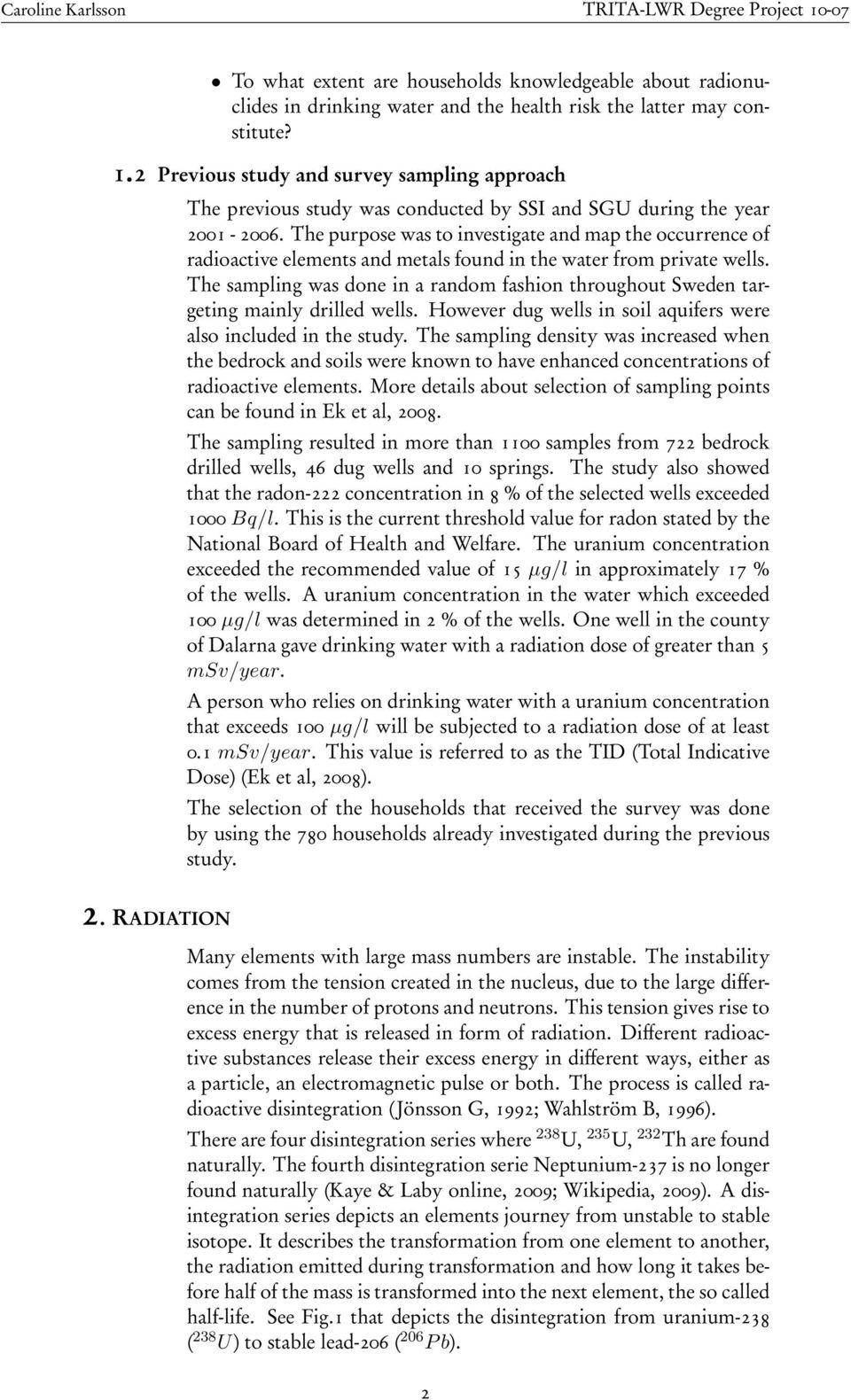
15 Radionuclides in drinking water a survey regarding mitigation measures Fig. 1: The decay chain for U-238, only the primary disintegrations are shown. Modied from SSI, As 238 U disintegrates it releases alpha radiation but because of the long half-life the activity is low. Radium-226 ( 226 Ra) is one of the disintegration products and its half-life is short (1620 years) compared to 238 U. As 226 Ra disintegrates it emits alpha radiation and creates a gaseous daughter, radon-222 ( 222 Rn). When 222 Rn disintegrates it creates both short-lived and long-lived radon daughters. The longlived radon daughters lead-210 ( 210 Pb) and polonium-210 ( 210 Po) has the ability to be stored in the human body. 238 U, 226 Ra, 222 Rn, 210 Pb and 210 Po are radionuclides that can be present in water and can, if the concentration is high, cause damage to the human body when consumed. 2.1 Different types of radiation Depending on how much energy that needs to be released and what element that releases it, the excess energy can be emitted as alpha, beta or gamma radiation, or a combination of them Alpha radiation Alpha radiation occurs when an element releases its excess energy in the form of an alpha particle, consisting of a nucleus of helium, 4 2 He. Alpha radiation can easily be stopped with a sheet of paper, skin or clothes. However if ingested it can cause problems (Wahlström B, 1996; A.I.C, 2007) Beta radiation Beta radiation is a process in which an electron is sent out from the radioactive isotope. The radiation can be stopped with a piece of wood (Jönsson G, 1992; A.I.C, 2007). 3
16 Caroline Karlsson TRITA-LWR Degree Project Gamma radiation Gamma radiation is a release of excess energy in form of an electromagnetic pulse. This is often due to the insufficient reduction in energy after an alpha or beta emission. The frequency is dependent on the amount of energy that needs to be released. To stop gamma radiation e.g. water, concrete or lead can be used. The thicknesses of these that are required are dependent on the energy of the gamma radiation (Jönsson G, 1992; A.I.C, 2007). 3. RADIONUCLIDES IN WATER 3.1 Radon This chapter will cover the radionuclides 238 U, 226 Ra, 222 Rn, 210 Pb and 210 Po. Radon is a disintegration product of radium, and the only disintegration product of both the uranium and thorium decay chain that is in gaseous form (CA.gov, 2009; Radonguiden, 2009). Radon-222 or simply radon is an isotope that can occur both in the ground and indoors. Radon-220 or thoron can be found in the ground where the element thorium is present. Because of the short half-life (55.6 seconds) of thoron it is not found in the indoor air at appreciable amounts since it cannot be transported long distances before it is disintegrated (Jönsson G, 1992). This is also the case for the radon isotope radon-219 or actinon which has a half-life of 3.92 seconds (TFD, 2009). There exist 18 isotopes of radon. Radon is monoatomic meaning that the gaseous molecule only consists of one atom. The characteristics of an inert gas imply that the radon atom is electrically neutral outwards. Although some observations have shown that the electric neutrality or the monoatomic characteristics are incomplete (Jönsson G, 1992). When radon disintegrates it creates the so called radon daughters, or specifically radioactive metal atoms (Radonguiden, 2009). These daughters emit either alpha, beta or both beta and gamma radiation (SSI, 2008). Since the radon progeny are not in the form of gas as their mother they will in general stay at the place where they were created. Radon daughter can be attached to aerosols found in the air or be unattached. Unattached means that the daughters are found in the air as independent atoms or ions that readily bonds to other molecules in the air. In the indoor air different particles can be found. These particles can be either dust, water and soot particles or simply air molecules and the term used for particles or droplets in the air is aerosol (Jönsson G, 1992; CDC, 2009a). The aerosols can stay a short or a long time in the indoor air, and the occurrence of the radon daughters is mainly determined by the quality of the indoor air (Jönsson G, 1992) Radon and geology Radon can be found ubiquitously in the ground, air and water. The ground is the primary source that contributes the most to the elevated 4
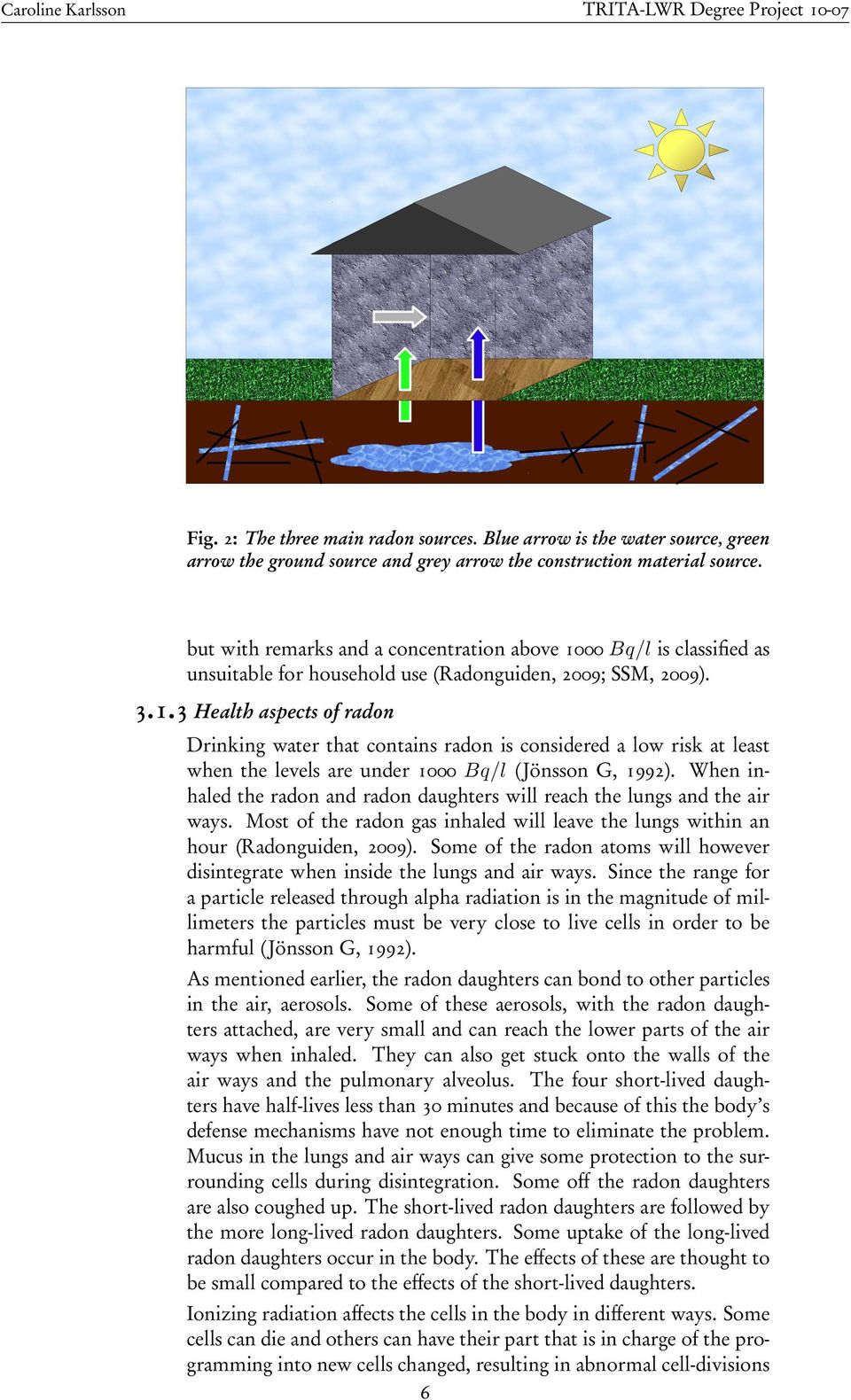
17 Radionuclides in drinking water a survey regarding mitigation measures radon levels indoors ( Jönsson G, 1992). Because of the short half-life of radon (3.823 days) its diffusion in large volumes is inhibited by time. The radon gas can only by the process of diffusion reach the ground surface from depths less than 5 meters. However with the help of flow radon can reach the ground surface from fractures in the bedrock or along different layers of soil types that is several meters underneath. Radon can also be transported sideways with the help of ground water as the water flows from one point to another. Transportation of radon from large depths must occur rapidly in order to reach the ground surface before disintegration. It is thought that the radon atoms attach themselves to other atoms or travel with other gases such as CO 2 and He up to the ground surface (Jönsson G, 1992). The process from which radon is exudated from a material is called exhalation and the material must contain 226 Ra. This process is not dependent upon where the material is located. The porosity and the granularity of the material will determine the efficiency of the exhalation. The radon gas leaves the material by using the pores and cracks in the material in order to reach the surface of the material. Water within a material will affect how well the radon gas can leave the material (Jönsson G, 1992). Areas with elevated uranium content within the rock types such as granite, pegmatite and alum shale will cause elevated levels of radon in that area. As the grain size of the uranium rich minerals becomes smaller the radon content increases. This is because the surface area of the grains will increase and result in a larger exhalation. Radon can reach the ground surface through weak zones e.g. zones with crushed material within the bedrock, see Fig.2. Eskers are a highly wanted geological formation due to the permeability which allows large quantities of water to be withdrawn. Many people get their household water from eskers, and when water is extracted from wells the radon can enter the dwelling from either the esker itself or from the water Radon in water Water withdrawn from soil layers and bedrock will contain radon. Surface waters such as lakes and inland waters rarely contain radon due to aeration and mixing. Water distributed municipally rarely contains high amounts of radon but there are exceptions (SSM, 2009). The highest radon concentration is found in wells where the water is drawn from bedrock and can be above 1000 Bq/l. Dug wells that take water from surrounding soil layers usually have low concentration of radon, normally between Bq/l in the water but these wells are however susceptible to other problems. When water is used, e.g. shower or drawn, the radon in the water shifts phases from the liquid phase to the gaseous phase, i.e. it intermixes with the indoor air. A rule of thumb is that a concentration of 1000 Bq/l in the water will contribute to the radon concentration in the indoor air with about 100 Bq/m 3. Water with a radon concentration greater than 100 Bq/l radon is classified as suitable 5
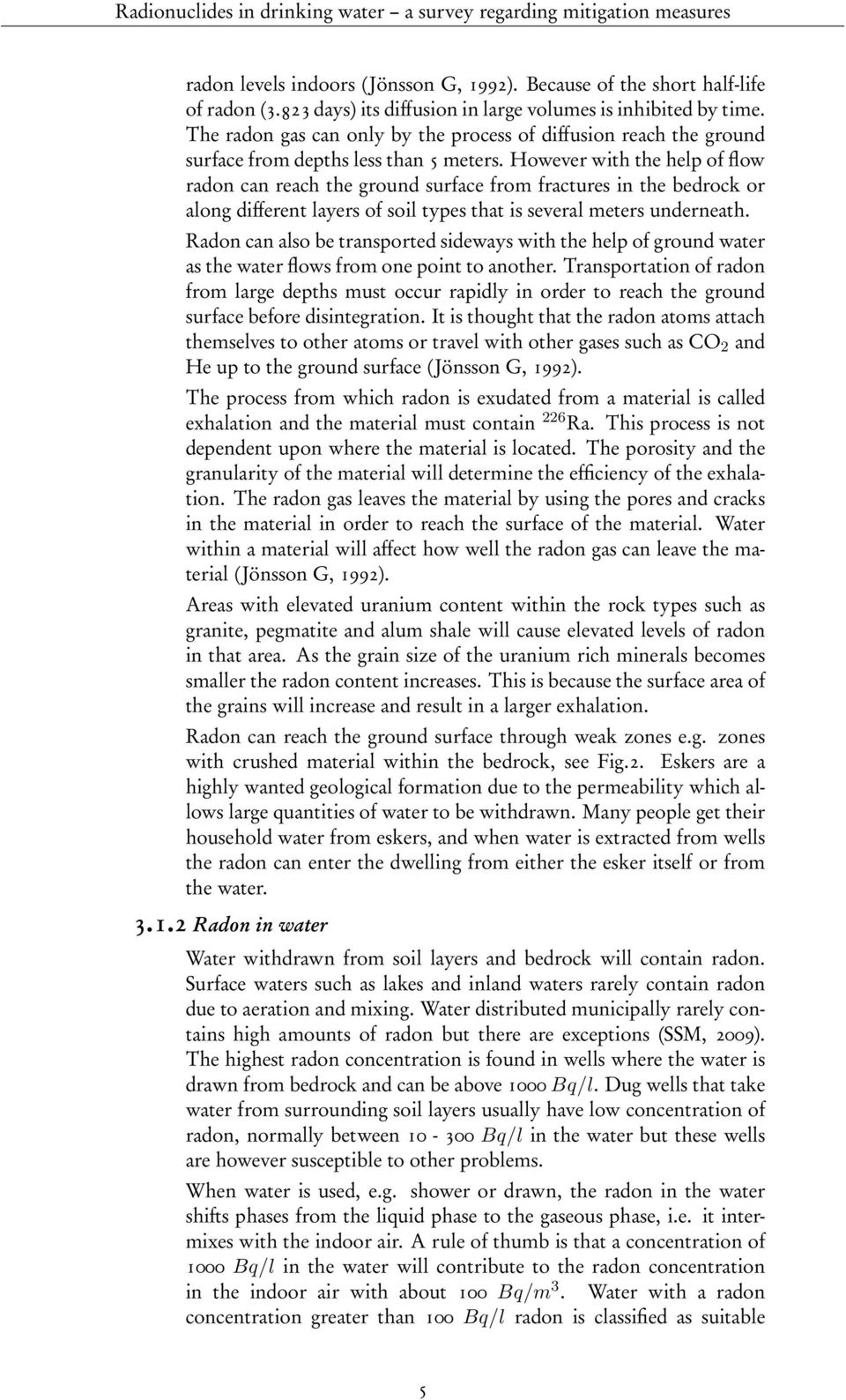
18 Caroline Karlsson TRITA-LWR Degree Project Fig. 2: The three main radon sources. Blue arrow is the water source, green arrow the ground source and grey arrow the construction material source. but with remarks and a concentration above 1000 Bq/l is classified as unsuitable for household use (Radonguiden, 2009; SSM, 2009) Health aspects of radon Drinking water that contains radon is considered a low risk at least when the levels are under 1000 Bq/l (Jönsson G, 1992). When inhaled the radon and radon daughters will reach the lungs and the air ways. Most of the radon gas inhaled will leave the lungs within an hour (Radonguiden, 2009). Some of the radon atoms will however disintegrate when inside the lungs and air ways. Since the range for a particle released through alpha radiation is in the magnitude of millimeters the particles must be very close to live cells in order to be harmful (Jönsson G, 1992). As mentioned earlier, the radon daughters can bond to other particles in the air, aerosols. Some of these aerosols, with the radon daughters attached, are very small and can reach the lower parts of the air ways when inhaled. They can also get stuck onto the walls of the air ways and the pulmonary alveolus. The four short-lived daughters have half-lives less than 30 minutes and because of this the body s defense mechanisms have not enough time to eliminate the problem. Mucus in the lungs and air ways can give some protection to the surrounding cells during disintegration. Some off the radon daughters are also coughed up. The short-lived radon daughters are followed by the more long-lived radon daughters. Some uptake of the long-lived radon daughters occur in the body. The effects of these are thought to be small compared to the effects of the short-lived daughters. Ionizing radiation affects the cells in the body in different ways. Some cells can die and others can have their part that is in charge of the programming into new cells changed, resulting in abnormal cell-divisions 6
19 Radionuclides in drinking water a survey regarding mitigation measures 3.2 Uranium and possibly cancer. Lung cancer is the main concern regarding radon and radon daughters. It takes time however to develop lung cancer, between years for adults subjected to radon and with a shorter time span for children (Jönsson G, 1992). The risk is greater the longer a person is subjected to radon and the higher the radon concentration is. The Swedish Radiation Safety Authority has estimated that approximately lung cancer cases in Sweden are caused by radon in our dwellings. Some tenths of these is thought to be caused by radon leaving the household water (Radonguiden, 2009; SSM, 2009). In nature uranium is found in 5 different valence states, +2, +3, +4, +5 or +6, and the tetravalent U(IV) and the hexavalent U(VI) form are the most common. The hexavalent form of uranium is usually associated with oxygen as a uranyl ion UO 2+ 2 (Health Canada, 2001; Ek et al, 2008). There are three naturally occurring uranium isotopes; 238 U, 234 U and 235 U (Ek B-M, 2005). Of those isotopes the predominant one is 238 U. The fractions in which these are present are as following 99.3 % ( 238 U), % ( 234 U) and 0.72 % ( 235 U) respectively. Although the fraction of 238 U is predominant it is the fraction of 234 U which is of importance. It is because the half-life of 234 U is the shortest (2.47 x 10 5 years); hence it is the activity that is of importance (Ek B-M, 2005). Because of its short half-life compared to the other isotopes 234 U will disintegrate faster and emit more alpha radiation compared to the others (UNEP, 1991) Uranium and geology Uranium can be found in the earth s crust and in many different chemical compositions, e.g. oxides and silicates. Minerals with high concentration of uranium are minerals such as uraninite, the oxidized or partly oxidized massive form of uraninite, pitchblende, coffinite, autunite and uranophane. Despite the high concentration of uranium these minerals are rare and mainly found in zones in the bedrock where uranium mineralization has occurred. Uranium can then be transported from one point to another due o hydrothermal alteration, weathering and erosion (Smedley el al, 2006). Sweden is considered to have less than 1 % of the global uranium assets (Schröder et al, 2009; SGU, 2010). Uranium is generally found in four main areas in Sweden. The first area is Arjeplog-Arvidsjaur-Sorsele with one uranium deposit and a group of more than 20 occurrences. The second uranium area is located in northern Sweden close to Åsele. The third uranium area is located north of Östersund. The last area is located in southern and central Sweden in the upper Cambrian and lower Ordovician sediments and along the border of the Caledonian mountain range (OECD et al, 2005). The rock types that primarily contain uranium are granite, pegmatite and syenite which are rich in silicic acids. Uranium can also be found in other rock and soil types. Sedimentary rock types usually have 7
20 Caroline Karlsson TRITA-LWR Degree Project low concentration of radioactive substances. However, alum shale can contain high amounts of uranium (Ek et al, 2008). The Billingen plateau mountain in southern Sweden has the highest uranium content found in the alum shale, tones or approximately 300 g/t. The total uranium content in Swedish bedrock is about half of the one found in the alum shale in Billingen (SGU, 2010). Although varying from location to location. An average is 2.3 g U/t soil. Soil types such as glacial till and coarse-grained glaciofluvial sediments usually have a uranium concentration that reflects the underlying bedrock (Ek B-M, 2005). Because of the poor water quality in general wells are not usually constructed in soils that contain alum shale (Ek et al, 2008). Natural deposits, emission from the nuclear industry, combustion of carbon and other fuels etc. can all increase the uranium content in our water supplies. Fertilizers that contain phosphate can also contain uranium. When fertilizers are spread on the field s uranium can leach out and enter the groundwater. If water with high concentration of uranium is ingested the chemical toxicity of the uranium becomes a concern. 1 µg of natural uranium has an activity of Bq (Health Canada, 2001; OECD et al, 2005) Uranium in water For the speciation of the uranium in water many factors are important. The hydrogeochemical conditions such as the ph value, redox potential, ion strength, mineralogy, complex forming capacity, available ligands and the total surface of the solid substance, will all determine the speciation of uranium (Öhlund F, 2007; Dässman E, 2008). The difference between the speciation in different conditions means that uranium can be dissolved at one location under oxidized conditions by erosion and enter the groundwater, or be deposited on fractures surfaces and mineral grains at another location as the conditions change to reducing conditions (Dässman E, 2008; Ek et al, 2008). Uranyl minerals are least soluble when the ph value is in the interval of 5 and 8.5. In order to control uranium mobility it is important to consider sorption rather than mineral preciptitation (Vaaramaa K, 2003). Other factors are water supply, CO 2 and O 2 in water, uranium content in bedrock, rate in which bedrock weathers or is dissolved, available ligands and adsorbing materials (Dässman E, 2008). The hexavalent form of uranium U(VI), is soluble and predominant in oxidized conditions. At low ph values the U(VI) form of uranium is found as a uranyl ion, the cation UO This cation can also be formed under aerobic conditions, when U(IV) is oxidized to U(VI) (Gustafsson et al, 2007; Dässman E, 2008). The uranyl ion UO 2+ 2 preferentially binds to oxygen ligands in aqueous solutions. These ligands can be inorganic anions such as CO 2 3, SO2 4, SiO(OH) 3, HPO 4 and NO 3, or organic molecules with an oxygen-containing functional group (Prat el al, 2009). It can also form complexes with fluoride; however the uranyl-fluoride-complexes are only important when the ph value is low. 8
21 Radionuclides in drinking water a survey regarding mitigation measures The formation of complexes with humic substances primarily occurs in water that has a ph value up to 6 or 7. When the ph value is approximately 4 or 5, the uranyl ion will bind strongly to humic and fulvic acids. The complexation to humic acids is dependent upon the ph value of the water (Dässman E, 2008). Maximal sorption of UO 2+ 2 on most natural colloidal materials occurs when ph is in the range of 5 to 8.5. This includes Fe(III) and Mn oxyhydroxides, zeolites, clay and organic matter. The ferric oxides and oxyhydroxides adsorb dissolved uranyl species, beginning at a ph value of 2 to 5 and increases up to a ph value between 5 and 8. Although varying with adsorbent, concentration and the composition of the solution. The adsorption of uranium onto ferric hydroxides and oxyhydroxides is small when the groundwater is highly alkaline (Vaaramaa K, 2003). This is because waters with ph values above 6 usually contain high concentrations of carbonate which will decrease the adsorption of uranium onto soil particles and increase the solubility of the uranium minerals (Vaaramaa K, 2003; Dässman E, 2008). Uranium is efficiently adsorbed onto clay minerals because of the large specific surface area and large cation exchange capacity; which in turn allows efficient adsorption onto the grains (Ek et al, 2008). As the ph value increases in the solution the uranyl ion UO 2+ 2 will begin to hydrolyze into UO 2 (OH) 2 which in turn will form strong complexes with dissolved organic matter and carbonate, see Table 1. (Gustafsson et al, 2007). Table 1: The table depicts the different species and complexes of uranium in groundwater as a function of ph. When ph is below 5 the most predominant specie is the uranyl ion. Because most natural waters contain carbonate, uranium can form the depicted carbonate complexes as the ph value increases (Ek B-M, 2005). ph Predominant specie Ion < 5 UO 2+ 2 Divalent cation UO 2 CO 0 3 Neutral molecule UO 2 (CO 3 ) 2 2 Divalent anion > 7.6 UO 2 (CO 3 ) 4 3 Tetravalent anion If the water contains sulphate and the ph value is around 5, the uranyl carbonate complexes compete with the sulphate but predominate when the ph value is above 6. The same applies for the uranyl phosphate complexes. These complexes are important to take in consideration in neutral waters because of the competition between the carbonate complexes and phosphate in this ph-range. The uranyl carbonate complexes UO 2 CO 0 3, UO 2(CO 3 ) 2 2 and UO 2 (CO 3 ) 4 3 predominate when the ph value is the range of 6 to 8. The species are determined by the concentration of carbonate and uranium in the water. When the ph value is above 7.5 the species UO 2 (CO 3 ) 2 2 and UO 2 (CO 3 ) 4 3 predominate. In the neutral ph-range the species of (UO 2 ) 2 CO 3 (OH) 3 is present. However the importance varies with the concentration of carbonate and uranium in the water. If the water is pure, meaning it is free of carbonate, the UO 2+ 2, UO 2OH + and UO 2 (OH) 0 2 is predominant at any given ph value. The uranyl ion also forms complexes with humates and 9
22 Caroline Karlsson TRITA-LWR Degree Project binds to the carboxyl (COO ) group in waters free of carbonate. If waters contains Ca 2+ and U(VI), the complexes Ca 2 UO 2 (CO 3 ) 0 3 and CaUO 2 (CO 3 ) 2 3 can form and recent research has shown that these complexes may be predominant (Dässman E, 2008; Prat et al, 2009). The tetravalent form of uranium, U(IV), is predominant under reducing conditions. It is found in solution as the uncharged species U(OH) 4, a strongly hydrolyzed form that binds to organic matter and to oxides. The U(OH) 4 can be precipitated as UO 2 (s) if the concentration of uranium in the solution is high enough (Gustafsson et al, 2007). In anoxic waters the uncharged species U(OH) 4 and its aqueous complexes predominate. When the ph value is below 4 the U(IV) may form complexes with fluoride. The uranous hydroxy complexes predominate when the ph value is higher. In waters that are not very alkaline the concentrations of uranous-hydroxy-complexes are usually low; due to the insolubility of the uranium ore minerals such as uraninite and coffinite (Vaaramaa K, 2003, Vaaramaa et al, 2003). Prat et al. (2009), discussed previous studies of theoretical speciation of uranyl in different biological media, which did not account for calcium-uranyl-carbonate complexes, CaUO 2 (CO 3 ) 2 3 and Ca 2 UO 2 (CO 3 ) 3 (aq). In their own study they considered uranyl, carbonate, calcium, sodium, magnesium or strontium when calculating the equilibrium constants. The water samples used were slightly alkaline. Analysis showed that higher concentration was obtained for HCO 1 3. The HCO1 3 partially dissociates at ph 8 to 9 into H + and CO 2 3. The CO2 3 anion was expected to be the most powerful ligand for the uranyl ion UO For hydrogen carbonate concentrations between 1 and 3.5 mm and given ph value, the hydrolysis of U(VI) was neglected. They also expected the carbonate complexes to overcome all other complexes given their solution conditions. Because of this the Ca 2+ content in the solution became one of the main speciation parameters. The relative concentration of the main complexes (UO 2 (CO 3 ) 4 3, CaUO 2(CO 3 ) 2 3 and Ca 2 UO 2 (CO 3 ) 3 (aq)) only varied with Ca 2+ concentration when equilibrium was achieved according to the equation: UO 2 (CO 3 ) nca 2+ = Ca n UO 2 (CO 3 ) 2n 4 3 (Eq. 1) Depending on the data sets they used in their modeling they found that the CaUO 2 (CO 3 ) 2 3 complex was either a minor species whatever the concentration of Ca 2+ is or a dominant species when concentration of Ca 2+ is between 0.01 and 0.5 mm. The UO 2 (CO 3 ) 4 3 and Ca 2 UO 2 (CO 3 ) 3 (aq) could both predominate. Previous studies assumed that uranium carbonate UO 2 (CO 3 ) 4 3 and uranium citrate UO 2 Cit 2 2 were more cytotoxic compounds. The previous studies also assumed that the Ca 2 UO 2 (CO 3 ) 3 (aq) and CaUO 2 (CO 3 ) 2 3 would behave as nontoxic or nonbioavailable chemical forms and if this was the case than these species would decrease the chemical uranium toxicity. The study of Prat et al. (2009), indicated that interactions with calcium are the most significant, and uranyl complex with magnesium and strontium could be neglected. 10
23 Radionuclides in drinking water a survey regarding mitigation measures Health aspects of uranium in drinking water Uranium primarily causes Nephritis (inflammation of the kidneys). It was shown in a study made in Finland that water with uranium levels of hundreds of microgram uranium per liter can have a small affect on the kidneys. In the guidelines given out by Health Canada, 2001, the health aspects of uranium were discussed and it was stated that the absorption of uranium through the gastrointestinal tract was dependent on many things; one factor was the solubility of the uranium complex. Previous food intake, the dose and the administration of oxidizing agents, e.g. iron (III) ion, will all affect the uranium absorption in the gastrointestinal tract. Uranium is absorbed by the gastrointestinal tract at an average of 1 to 2 %. Inside the body, uranium appears in the blood stream and primarily associated with red blood cells (Health Canada, 2001; Ek B-M, 2005). It is only a small part of the ingested soluble uranium (0.1 to 2%) that is transferred to the blood stream. Prat et al. (2009) writes about a model produced by the International Commission on Radiological Protection (ICRP) that shows that at least 98 % of the uranium that is ingested in a soluble form is removed from the body through the faeces. From the fraction of uranium that is absorbed into the blood stream, 66 % is eliminated in the urine within 24 hours and 12 to 25 % is stored in the kidneys. The bones will store 10 to 15 % and the soft tissue a lesser proportion. Some can also be found in the liver. According to Health Canada, 2001, a non-diffusible uranyl-albumin complex is formed when the uranium is transferred to the blood stream. This complex is in equilibrium with another complex namely the diffusible ionic uranyl hydrogen carbonate complex (UO 2 HCO + 3 ). Both of these complexes have an affinity for phosphate, carboxyl and hydroxyl groups. Because of this the uranyl compounds form stable complexes with proteins and nucleotides. In the bones the uranyl ion replaces the calcium in the hydroxyapatite complex of the bone crystals. When equilibrium is reached in the skeleton the uranium is removed through urine and faeces. The uranyl hydrogen carbonate complexes are stable and excreted through the urine when alkaline conditions prevail. These complexes will dissociate to a certain degree if the ph value is low. When this happens the uranyl ion can bind to proteins in the cells found at the tubular wall and cause defects. It is believed that these defects can be reversed if the exposure is reduced, but only as long as the exposure did not destroy a critical mass of kidney cells (Health Canada, 2001). There is also some evidence that tolerance against uranium in water can be developed. However it does not prevent chronic damage to the kidneys, as the new replaced cells will be different from the first kidney cells destroyed by the uranium. Animal testing have shown that by injecting or inhaling soluble compounds of high specific activity uranium isotopes or mixtures of different uranium isotopes, bone cancer can be induced. Ingestion of soluble uranium compounds that causes carcinogenic effects have not been reported. This is also the case for the insoluble compounds. 11
24 Caroline Karlsson TRITA-LWR Degree Project Radium A study based on Chinese hamsters showed that the genotoxic effects are probably caused by the binding of uranyl-nitrate to the phosphate groups in the DNA. There is a potential risk for radiotoxicity when natural uranium is ingested but not shown for animals and humans. The low specific activity of the uranium radionuclides is probably the cause (Health Canada, 2001). The World Health Organization (WHO) recommends a maximum uranium content in water of 15 µg/l. This value corresponds to an annual value of 0.1 µg/g kidney. If the uranium content in the drinking water is above 15 µg/l; it is recommended that uranium is removed. There is not a clear association shown regarding cancer risk, toxicity, clinical symptoms and chronic uranium exposure (Ek B-M, 2005; Prat et al, 2009). One of the disintegration products of both uranium and thorium is radium. Of the radium isotopes 226 Ra is the isotope with the longest half-life. Radium can be found in uranium ores such as pitchblende. Water can contain radium, but in low concentrations (USEPA, 2007; NE, 2009) Radium in water Radium is intractable and will only under certain conditions dissolve into solution e.g. very low ph values (Ek et al, 2008). Radium is present as a hydrated cation with oxidation state of 2+ in groundwater, but present as an uncomplexed Ra 2+ cation in low saline solutions. If waters are concentrated, radium can form weak complexes with sulphate, carbonate and chloride. Radium can be precipitated with these elements resulting in intractable carbonate and sulphate complexes. Another important aspect of radium in water is that radium can form neutral ion pairs with sulphates. This will then allow radium to be adsorbed efficiently onto different surfaces e.g. hydroxides such as iron and manganese. In general radium is efficiently sorbed onto secondary minerals with high cation exchange capacity (Vaaramaa K, 2000; Edsfeldt C, 2001; Vaaramaa et al, 2003) In alkaline waters with high carbonate concentrations and ph value above 10, the RaCO 3 (aq) complex is suggested to be significant. The insoluble RaSO 4 is not formed in natural waters due to the low concentration of radium in these waters. Radium can also be co-precipitated with barium as Ba(Ra)SO 4. Although the concentration of radium in waters will be reduced when it is co-precipitated with bariumsulphate, it is not a recommended mitigation method since the concentration of barium is easily exceeded. Because radium can be precipitated onto fracture surfaces the radon level in the water can increase (Vaaramaa et al, 2003; Ek et al, 2008; Vesterbacka et al, 2008). Fracture surfaces that have high content of iron hydroxides, calcite and clay minerals will assimilate radium. Radium can then be deposited onto fracture surfaces at the same time as the iron hydroxides and calcite, or be re-mobilized and deposited or adsorbed onto already 12
25 Radionuclides in drinking water a survey regarding mitigation measures deposited minerals. Clay is an efficient adsorber. Radium can be released from the surface of the iron hydroxide and calcite if the ph value decreases (Ek et al, 2008). If water contains radium and iron and/or manganese, radium will be efficiently adsorbed. Although both of these oxides are efficient adsorbers, it is the concentration of manganese that is of importance. Manganese fibers are about 40 times more efficient than iron treated fibers. However if the water is very saline radium will instead enhance its solubility (Vaaramaa et al, 2003). Water rarely needs to be mitigated because of high radium concentration. In the middle part of Sweden and the county of Dalarna levels above 0.5 Bq/l is common (Ek et al, 2008; Vesterbacka et al, 2008) Health aspects of radium in drinking water 3.4 Lead Because of the short half-life of 226 Ra (1620 years) compared to that of 238 U (4.5 x 10 5 years) it is a highly active and radiotoxic radionuclide. In the beginning of the 20th century radium was used in paint e.g. dials, because of its self-luminescent capabilities. Many dial painters suffered from anaemia, bone cancer and sores due to the radium exposure (NE, 2009). Radium, as a radon source, was used as a radiation source for treating malignant tumours. Radium is known to cause tumours in head, bones and nasal passages if ingested under a long period of time. Exposure to radium can cause illnesses such as anemia, acute leukopenia or necrosis of the jaw (USEPA, 2007). Radium can also be assimilated in plants and then eventually end up in the bone tissue of living organisms that feed on them (NE, 2009). 226 Ra is transported from the gastrointestinal tract to the blood and finally end up in the bone and soft tissue (Ek et al, 2008). Once inside the bones, the radium forms chemical bonds in the same way as calcium. This allows the body to absorb it into the bones, where the radium disintegrates causing the release of radiation that can degrade marrow and cause a defect on bone cells (The New York Times, 1998). The adsorption of 226 Ra is higher for children than for adults (Ek et al, 2008). Humans are most likely to be exposed to radium through the drinking water (USEPA, 2007). The lead isotope 210 Pb is a long-lived radon daughter and as it disintegrates into bismuth-210 it emits beta radiation (SSI, 2008). The chemical characteristics for 210 Pb are in general the same as the other lead isotopes. In nature 210 Pb can be found practically anywhere due to the disintegration of radon which is a natural occurring element in air (Enflo A, 1990). 210 Pb can be found in some sulphide minerals, granites rich in silic acids and dark colored shales (Ek et al, 2008) Lead in water The knowledge about the chemical forms of 210 Pb and behavior in water is limited. It is however known that lead in general do not dissolve easily in water (Vaaramaa et al, 2000; Ek et al, 2008). In groundwater lead is found as a divalent ion that forms different compounds through hydrolysis. 13
26 Caroline Karlsson TRITA-LWR Degree Project Lead is adsorbed or form complexes with different surfaces e.g. minerals, colloids and humic and fulvic acids in the water. The ph value will affect the solubility of lead in water. Lead is insoluble when the ph value is between 9 and 10 (Vesterbacka et al, 2008). Vaaramaa et al, (2000), did a study of different ion exchangers and the removal of different radionuclides in water. In that study they found that 210 Pb was removed efficiently by anion exchange resins. This indicated that 210 Pb is found in water in particles with anionic surface charge. Their study also confirmed that 210 Pb is not present in the water as metal cations (Vaaramaa et al, 2000; Ek et al, 2008). Because lead is adsorbed onto different particles the content of 210 Pb in water is low. If the water does have a high concentration of lead a reason could be that old lead pipes are corroding and releasing lead into the water. In the study conducted by SGU and SSI the median value of lead was 0.36 µg/l in the crude water received from bedrock wells. For earth wells the corresponding number was 0.56 µg/l. A threshold limit of 10 µg/l is set by the National Board of Health and Welfare (Socialstyrelsen, 2006). This threshold value was exceeded in 10 % of the bedrock wells (Rihs et al, 1997; Ek et al, 2008) Health aspects of lead 3.5 Polonium Health effects of the element lead is quite well known. 210 Pb is a natural element and can be found in food, water and air. When ingested the long half-life of 210 Pb allows it to be assimilated in the body, and primarily in the bone. A risk is that the nervous system and/or the hematopoiesis are affected. Foetus and young children are also more sensitive to lead exposure than adults (Enflo A, 1990; Ek et al, 2008). Of the amount of lead which is inhaled, approximately 29 % will reach the blood. When ingested about 10 to 20 % of the lead is absorbed by the gastrointestinal tract and 8 % will reach the blood stream. Of the part that is absorbed approximately 70 % will be assimilated in the bone and the rest in muscles, liver, blood, kidneys and spleen. Inside the bone 210 Pb is probably found inside the crystals of the hydroxyapatite. Because of this the disintegration products will stay inside the bone, and since the biological half-life of 210 Pb (10 to 15 years) is longer than the time it take for the bone to be replaced, 210 Pb will be reabsorbed in the new bone (Enflo A, 1990; Lenntech, 2009). Lead poisoning is indicated by neurological or teratogenic effects and the toxicity is induced by the reaction between the lead ions and the free sulfhydryl groups of proteins, i.e. enzymes are deactivated. There is also a difference between the genders when it comes to lead poisoning; women are generally more susceptible than men (Lenntech, 2009). Polonium is a scarce radioactive element. It is a disintegration product of uranium and thorium. The polonium isotope 210 Po is the second last disintegration product in the uranium-238 series, the last being stable lead ( 206 Pb) (CDC, 2009b; Cedervall B, 2006). 210 Po has a half-life of days and will emit alpha radiation during disintegration. 210 Po is considered to be one of the most hazardous radioactive materials known, but since it is an alpha emitter it is only 14
27 Radionuclides in drinking water a survey regarding mitigation measures a threat if inhaled or ingested (SSI, 2008; RSC, 2009). Only a part of a microgram is enough to kill a human being (Cedervall B, 2006) Polonium in water It is unusual to have high concentrations of 210 Po in water. In natural waters the speciation is highly complex, depending strongly on the composition of the water. The most stable oxidation state in solution is +4. In diluted acids polonium is easily dissolved, however it is only slightly soluble in alkaline solutions (Vaaramaa et al, 2003; Cedervall B, 2006). In slightly acidic and neutral environments polonium hydrolyses and forms PoO(OH) +, PoO(OH) 2 and PoO 2. PoO 2 3 is found in alkaline environments. PoO(OH) 2 has a tendency to form compounds with particles and colloids in water. The species Po 4+ is only found in solutions that are strongly acidic. Vaaramaa et al. (2003), found that polonium was bound to the biggest particles in the water or was dissolved when the water was of high quality. If the water was rich in iron the polonium was bound to smaller particles instead. As the manganese content in the water increased the particle size in the water increased which meant that polonium was found bound to large particles. When the content of minerals increased in the water polonium would bond to the smaller particles. It was believed that as the competing ions increased in the water the binding point s decreased. Polonium bonded to either large or small particles in the water or was dissolved in the water as the organic content of the water increased. When the water contained high levels of iron and manganese the polonium in the water would be mostly dissolved. In only iron rich water the polonium shifted between a dissolved state and a bound state. The same study found that the solubility of polonium did not increase when the water had high concentration of Fe, Mn and organic matter. The same applied to water with a high salinity. It has been reported that bacteria have influenced the concentration of polonium in waters. (Vaaramaa et al, 2003; Vesterbacka et al, 2008) Health aspects of polonium in drinking water When ingesting 210 Po approximately 50 to 90 % will travel through the gastrointestinal tract and out with the faeces. The amount that is absorbed by the body will enter the blood stream where it combines with the hemoglobin. 210 Po will also be concentrated in the soft tissue. The rest of the adsorbed 210 Po will be distributed in the body; approximately 45 % will be deposited in spleen, liver and kidney, and about 10 % will be deposited in the bone marrow. 210 Po is carcinogenic and can cause cancer. Smokers will be subjected to more 210 Po since tobacco assimilates 210 Po from the phosphate fertilizers used. Besides smokers the general public is exposed to 210 Po for instance through food and water (LANL, 2003; Cedervall B, 2006). 15
28 Caroline Karlsson TRITA-LWR Degree Project REMOVAL METHODS FOR RADIONUCLIDES IN WATER Radionuclides can be found in water and sometimes in such high concentrations that mitigation measures are recommended. Before a purchase of a removal unit the water should be sampled and analyzed (Ek B-M, 2005). Based on the result of the analysis, the best unit is the one that fits the chemical characteristics of the water and household needs. A new sampling and testing should be done after purchase and installation of the equipment to verify that the equipment is functional as specified. It is also important that the equipment has warranty and care instructions since all equipments needs to be cared for in order to function as meant to for a long time (Radonguiden, 2009; SSM, 2009). Many units can become costly if it turns out that they need more maintenance because the water that passes through them contains other substances that interferes with the unit. Units that are left unattended can worsen the water quality. This is especially important if filters are used for the removal of radionuclides. Mitigation methods that use filters can accumulate radioactive substances that transmit gamma radiation. Because of this it is very important that such methods that imposes a risk for accumulation is placed outside of the dwelling e.g. garage or a storage room located at a distance from the dwelling. It is also unnecessary to purchase a costly unit if the household need is only for a few weeks, e.g. holiday house, and where another method could be sufficient. Depending on the radionuclide and concentration in the water there are different methods available. Sometimes it is necessary to combine methods because one method is not efficient enough or if the method chosen affects other parameters in the water e.g. aeration which causes the precipitation of iron in the water. 4.1 Radon removal If the water contain substances such as iron, manganese and humus, which are removed by other mitigation methods it is important that the equipment used to remove radon is placed last in the chain. Filters used for removal of manganese, iron and for softening of the water are also used to protect equipment in the dwelling e.g. dishwasher, washing machine, plumbing etc. If the equipment used to remove radon is placed last in a chain of mitigation filters the maintenance would be kept low. When placed last it can also reduce the radon produced by the previous filter which might have accumulated radon and now act as a radon source (SGU, 2009; SSM, 2009). It is often necessary to remove lead and polonium from the water when the radon content in the water is above 1000 Bq/l. It is important to remove radon from all the water used in the household and not only a part of it, since radon is released into the air during showers, washing, tapping etc (Robillard et al, 2001; Vesterbacka et al, 2008). There are four different methods that can be used for radon removal in household water. Namely aeration, activated carbon, reverse osmosis and storage. Storage means that water is stored in a vessel and kept there until the radon has disintegrated. The methods mostly used are 16
29 Radionuclides in drinking water a survey regarding mitigation measures aeration and activated carbon filtration and these remove more than 90 % of the radon in the water (SGU, 2009; SSM, 2009). Water that enters the dwelling can be removed in two ways; either treated where it enters the dwelling "point-of-entry" or where it will be used "point-of-use" (Robillard et al, 2001). The point-of-use system is located at the tap and removes the substance when water is drawn. This method does not reduce the risk from inhaling radon that is released into the air from other sources except from the tap used for drinking purposes (Bobvila, 2009). The methods of aeration and activated carbon are methods that are classified as point-of-entry removal systems. These methods remove the radon before the water is used in the dwelling Aeration This method is based on the principal of creating a large surface area between water and air. By doing so the process of diffusion in which radon is released from the water and into the air is hastened. Other gaseous substances in the water such as carbon dioxide CO 2, hydrogen sulphide H 2 S and volatile organic compounds VOC are also removed by aeration giving a better taste and smell to the water. The oxygen content in the water is increased to almost 100 % during aeration (Vesterbacka et al, 2008). The ph value is also increased, by as much as 1.0 point (WPB, 2009). Aeration is not a suitable method for removal of other radionuclides since radon is the only one found in a gaseous form. When the radon concentration in the water is above 5000 Bq/l aeration is the most suitable method. It is also appropriate when large quantities of water is to be treated e.g. water treatment plants (Vesterbacka et al, 2008). Aeration can however cause side effects. The water temperature can increase during aeration causing bacteria growth. Metals in the water can precipitate during aeration. Because of this it is important that the equipment used to remove radon from the water is constructed is such a way that it inhibits a temperature increase and bacteria growth (SSM, 2009). At normal air pressure and a temperature of 10 C, the radon concentration in the air is three times greater than in the water. The radon concentration in the air is also in equilibrium with the dissolved radon in the water under these conditions. In order to remove more than 95 % of the radon about a tenfold amount of air is needed for a certain water volume. The aerator units can be installed in different ways depending on the amount of water that has to be treated and the available space (Vesterbacka et al, 2008). Aerators are usually installed near the well tank where the water first enters the house but after other water treatment systems such as softeners or neutralizers. Basement and other locations in and outside of the dwelling are suitable locations. The aerator causes some noise during operation that might result in an inconvenience. An aerator consists of a large metal or fiberglass tank where the incoming water from the well has air injected into it or where the water is 17
30 Caroline Karlsson TRITA-LWR Degree Project sprayed through a nozzle. This causes the difference in surface area between the water and the radon gas; and the dissolved radon in the water will be released into the air and removed (LSIM, 2009; WPB, 2009). By placing a pressure tank after the aerator, the pressure and temperature in the household water system will become more even. This way also reduces the wear and tear of the aerator (Radonett, 2009). An aerator can be used as a storage unit simultaneously as it aerates the water. It is also possible to aerate the water directly in the well. When water is sprayed through a nozzle it usually needs to be re-entered into the tank, meaning sprayed several times through the nozzle in order to increase the removal efficiency. Aerators can be constructed so that the water is sprayed into a shallow tray with tiny holes in the bottom, and as the water flows over the tray air is sprayed through the holes. The removal efficiency is almost 100 %. The down side is that this method uses a lot more air than the other systems (Robillard et al, 2001). Aerators that use packed columns works by letting the water pass through a thin film of inert packing material and the large surface area is created as the water passes through the column (Robillard et al, 2001; Vesterbacka et al, 2008). An air blower forces the radon back through the column and through a ventilation tube to the outside. When using packed columns it is important that the column is of appropriate height otherwise the removal efficiency can be too low. This method is not suitable when the radon content in the water is above the approximate value of 740 Bq/l (Robillard et al, 2001). Fig. 3, 4, 5, 6 describes different ways in which an aerator unit can be installed in a dwelling. Fig. 3: This type of installation uses a well pump that pumps the water from the well up and into the aerator unit. With this type of installation it is the pressure increasing pump that aerates and maintains the water pressure in the household pipes. Modified from Robillard et al,
31 Radionuclides in drinking water a survey regarding mitigation measures Fig. 4: This type of installation uses a well pump that pumps the water from the well up and into the aerator unit. After aeration the water is stored in the storage tank. When water is used in the household the pressure increasing pump will maintain the pressure in the water pipes in the household. Modified from Robillard et al, Fig. 5: This type of installation uses a well pump that pumps the water from the well up and into the aerator unit. The radon is removed through the ventilation tube. The pressure increasing pump is located inside the aerator unit. Modified from Robillard et al,
32 Caroline Karlsson TRITA-LWR Degree Project Fig. 6: This type of installation aerates the water directly in the well. A compressor presses air through the aeration nozzle. The water in the well is aerated and the dissolved radon is released into the air. Water is then pumped to the household by the well pump. Modified from Robillard et al, Many different factors can affect the efficiency of the aerator systems. One important factor is the design of the system (LSIM, 2009). The time in which the water is in contact with air, the surface area created between air and water and the temperature and pressure of the air and water, are factors that affects the removal efficiency. Removal efficiency is also affected by the relative shares between water and air in the tank, how well air is distributed through the water volume and the difference between the radon concentration in the water and air inside the tank (Vesterbacka et al, 2008). Aeration is suitable if: The water has high content of radon ( >5000 Bq/l) or if large volumes of water is to be treated. The water is corrosive since aeration causes an increase in ph value. The water contains hydrogen sulphide. Aeration can cause: Iron in the water to be precipitated as hydroxide. Manganese to be precipitated. Hard waters to increase the development of boiler deposits when the ph is increased. Bacteria to start to grow. 20
33 Radionuclides in drinking water a survey regarding mitigation measures Remember that: Benefits can be applied for in Sweden in order to remediate the radon concentration in the indoor air; if the radon concentration in the water causes the radon conconetration in the air to exceed the threshold limit of 200 Bq/m 3. The air used for aeration should be filtrated before use. Radon does not accumulate in the aerator. The cost for an aeration unit can be between and SEK. The most expensive is not always the best. All technical equipment needs maintenance. As long as the aerator is maintained, i.e. replace broken parts, remove sediment and dissolved solids before the aerator, the removal efficiency will not decrease with time Activated carbon Radon removal by activated carbon is an efficient way to reduce the radon content in the water if the content is less than 5000 Bq/l. This method can reduce the radon content in water by more than 90 %. Most often the reduction is close to 100 %. It is manufactured by either carbon, wood or coconuts. In order to activate the carbon, it is subjected to steam or chemicals (Vesterbacka et al, 2008; Vattensystem, 2009). The intention of activation is to create a large internal pore structure in the carbon. The efficiency of the activated carbon is based on the suitability to adsorb a certain substance and determined by the chemical and physical properties of the carbon. The pores in the carbon are in three different sizes. Pores with a radius of less than 1 nm are called micro-pores. Pores with a radius between 1 and 25 nm is called meso-pores and pores with larger radius than 25 nm is called macro-pores. When water passes through a bed of activated carbon, the particles in the water that adsorbed in the micro and meso pores (Hembryggning, 2009). Granular activated carbon or GAC is used to remove radon from water. This method is a point-of-entry method; it reduces the radon content in all the household water. The activated carbon units come, as the aerators, in different sizes, models and types depending on the need i.e. how much water that is to be treated, the radium concentration in the water and of course the manufacturer. The basic principal is however the same (Robillard et al, 2001; Vesterbacka et al, 2008). An activated carbon unit is a pressure vessel made out of metal or fiberglass. The tanks depending on need usually hold about 20 to 100 liters of activated carbon. As the water passes through the tank the radon is adsorbed onto the surface of the activated carbon (Vesterbacka et al, 2008; LSIM, 2009). After radon is adsorbed it will stay there until it disintegrates. It takes about three weeks before the filter of activated carbon is in equilibrium. When this happens the adsorption rate of radon onto carbon is equal to the release of radon by its disintegration. Equilibrium also implies that the radon is in equilibrium with the short-lived radon 21
34 Caroline Karlsson TRITA-LWR Degree Project daughters i.e. polonium-218, lead-214, bismuth-214 and polonium These daughters emit alpha, beta and/or gamma radiation. The problem with the usage of activated carbon is that the units can start to emit gamma radiation. This radiation can cause the dose rate from the surface of the filter and the close vicinity to become harmful. How high the dose rate will be is dependent on how much water is used and how much radon there is in the water (Vesterbacka et al, 2008). The radiation from the unit is however reduced with distance and the maximum radiation level occurs near the top of the carbon bed. Another problem with activated carbon is that if the water contains particles the filter can easily clog up and reduce the service life of the filter. These particles can also reduce the flow through the filter and cause a loss in water pressure (Robillard et al, 2001; LSIM, 2009). By installing a pre-filter the particles in the water can be removed before the water passes through the activated carbon unit. If the water contain more iron than 2 mg/l the activated carbon unit should be installed with a backwashing function (Vesterbacka et al, 2008). Although this can reduce the filter efficiency and temporarily increase the radon concentration in the water. GAC units are typically installed in the main water supply line and after other water conditioners such as water neutralizer or softener (Robillard et al, 2001; LSIM, 2009; WPB, 2009). Fig. 7 and 8 illustrates how the water can pass through an activated carbon unit. Fig. 7: This type of installation uses a well pump that pumps the water from the well up and through the pressure increasing pump. After that the water is pumped into the activated carbon unit. Water that has passed through the unit is distributed through the households water system. Modified from Robillard et al,
35 Radionuclides in drinking water a survey regarding mitigation measures Fig. 8: This type of installation uses a well pump that pumps the water from the well up and into the sedimentation filter. The sedimentation filter is used to remove particles in the water that might affect the removal of radon in the activated carbon unit. When the water has passed through the sedimentation filter it enters the activated carbon unit. The radon in the water is adsorbed by the activated carbon and then distributed to the households water system. Modified from Robillard et al, The efficiency of the GAC unit is dependent on: The radon level in the incoming water and how much water that is treated every day. The design of the unit and how much carbon that is used. How much particles the incoming water contains that disturbs the adsorption of radon onto the filter. Remember that: The units used for radon removal based on activated carbon should not be placed inside the dwelling or near the well, unless there is a possibility for shielded construction. Activated carbon units can accumulate radon daughters such as lead-214 and bismuth-214. These emit gamma radiation. The size of the GAC unit is dependent on the content of radon in the water. The lifetime of the activated carbon unit is dependent on the size of filter and the quality of the incoming water. Activated carbon removes some amounts of iron and humus in the water. The water should be tested every once in a while to ensure that the activated carbon is still functional. The activated carbon should be replaced every other or every third year depending in the size of the filter and the quality and usage of the filtrated water. 23
36 Caroline Karlsson TRITA-LWR Degree Project It is sometimes necessary to deposit the filter mass as a radioactive waste at a landfill. This is dependent on how much radon adsorbed; meaning higher radon content in the water will mean higher content of radon daughters accumulated in the filter. A GAC unit can remove uranium from the water. A GAC unit can remove some 210 Pb and radium from the water. 4.2 Uranium removal There are four ways in which uranium can be removed from water: ion exchange, chemical precipitation, adsorption and membrane filtration. However only two of these methods are appropriate for household use, namely the method of ion exchange or membrane filtration i.e. reverse osmosis Membrane filtration The idea behind membrane technology is that water is allowed to pass through a membrane which only allows certain molecules to pass (Fig. 9). The water is divided into two currents, one current that contains the molecules allowed through the membrane and one current that removes the rest of the molecules, i.e. membrane filtration divides the water into two parts, one clean part and one unclean part. The molecules allowed through the membrane are dependent on membrane characteristics such as material and tightness. The amount of water allowed through the membrane is also dependent upon the chemical potential differences across the membrane. This chemical potential difference can be the pressure or concentration differences between the two sides of the membrane. The chemical difference is also the driving force that transports water from one side to the other. There are however some problems that can occur during membrane filtration. One is concentration polarization and the other is fouling. Concentration polarization means that the dissolved substances that are not allowed through the membrane will be assimilated at the membrane surface. These assimilated substances will increase the osmotic pressure and in turn decrease the flux. The concentration of some substances can cause precipitation on the membrane. Concentration polarization is minimized by letting the water pass the membrane with a certain speed. Fouling means that the unwanted substances are built up around the membrane. It is minimized by choosing a membrane that does not adsorb molecules or particles found in the water, pre-filtration to remove the largest particles and by membrane maintenance. There are four types of membranes defined by their structure. Membranes can also be constructed by different types of materials (Vattenteknik, 2009a). Membrane type defined by structure: Homogeneous membrane: Homogeneous membranes usually have varying pore size. Some membranes can have straight pores of same diameter. Homogeneous membranes usually have a thickness of 5 µm or more in order to remove salts from the fluid. Because of the thickness the permeability of the membrane is low. 24
37 Radionuclides in drinking water a survey regarding mitigation measures Asymmetric membrane: Asymmetric membranes have the same selectivity as the homogeneous membranes but higher permeability. These membranes are constructed by a very thin active layer (0.1 to 2 µm) which is transcended into a more porous structure. This porous structure functions as a supportive layer and where the diameter of the pores increases towards the bottom. The thin active layer can either have pores or be impenetrable. Composite membrane: Composite membranes are membranes composed of an ultra thin layer (0.025 to 0.05 µm) of one material and a porous supporting layer of another material. Sometimes a middle layer is used to bind the ultra thin layer with the supportive layer. Dynamic membrane: Dynamic membranes are constructed either by a thin layer of a neutral material, or by letting an ion exchange material precipitate inside the pores of a supportive matrix. These membranes can be generated and regenerated in situ. Osmosis is based on the diffusion through the membrane meaning that the water will try to attain the same concentration on both sides. The clean water will pass through the membrane to the unclean water. A separation of molecules is allowed and where the molecules are of same size (Callidus, 2009; Vattenteknik, 2009a). By applying pressure to the crude water the osmotic pressure is reversed which allows the crude water to be filtrated through the semi-permeable membrane (Howstuffworks, 2009). This process is called reverse osmosis (RO). For RO it is important that the membrane is not hydrophobic and tolerant of free chlorine that may be present in the water. Membranes used in RO practically remove everything from the water resulting in distilled water. By drinking distilled water the body s salt content can be disturbed. This is however prevented if salts are added to the filtrated water (Ek B-M, 2005; Vattenteknik, 2009a). There is a possibility to use ion exchange membranes. These membranes have ionic groups, such as sulfonate (SO 3 ), carboxylate (COO ) and phosphonate (PO 3 H ), on them which allows the membrane to choose what ions are let through the membrane (Answers.com, 2010). Another membrane filtration technology is nanofiltration. The basics of this technology resemble the one for RO. The difference is that nanofiltration primarily removes divalent ions and larger molecules. This results in a less distilled water. The advantage with nanofiltration is that because only some salts are removed, the water will not be as corrosive as it would have been if all the salts were removed as in the case with RO (Processvatten, 2010). Uranium, lead and polonium can be removed from water by membrane filtration such as reverse osmosis and nanofiltration (Vesterbacka et al, 2008). 25
38 Caroline Karlsson TRITA-LWR Degree Project Fig. 9: The process of Reversed Osmosis. By applying presure on the crude water the osmotic pressure is reversed. This allows the water to pass through the membrane from a side of high concentration to a side of low concentration Chemical precipitation In order to remove a substance from solution by chemical precipitation a specific chemical is added. This chemical will saturate the solution with respect to a particular substance and the result is transference between the states of substance, from dissolved to unsoluble. This precipitation can then be removed by either sedimentation or filtration. Chemical precipitation requires strict control, optimum ph and chemical dosage, and maintenance of the unit. Because of these requirements chemical precipitation is not suitable for private household use. Öhlund F, (2007), stated that uranium can be precipitated with chemicals such as iron(ii)sulphate (FeSO 4 ) or aluminum sulphate (Al 2 (SO 4 ) 3 ) These chemicals have been known to remove between 70 and 95% of the uranium in the water. However this is dependent on the conditions of the crude water, meaning that changed conditions can reduce the removal rate. By precipitating dissolved iron uranium can be removed. When iron is oxidized from Fe 2+ to the more intractable form Fe 3+ which is precipitated for instance as an amorphous Fe(OH) 3, the Fe(OH) 3 can adsorb negatively charged uranium complex in the water. 26
39 Radionuclides in drinking water a survey regarding mitigation measures Precipitation of uranium by using metal salts is dependent upon the ph value when bicarbonates are present in the water (Öhlund F, 2007; Vesterbacka et al, 2008) Ion exchange Ion exchange is the process in which ions with the same charge can be exchanged between a solution and an insoluble solid that is in contact with the solution. This process can also occur between two immiscible solvents. In that case one of the solvents would contain a material that is soluble and that has immobilized ionic groups. Ion exchange used for water purification purposes have fixed ionic sites where mobile ions, with the same charge as the unwanted ion, are attached. When the water travels through the filter material, the unwanted ions with higher affinity for the fixed sites than the already localized ions, will displace these ions and exchange place. The ions that were first localized at the exchange sites will be released into the water (Fig. 10) (Öhlund F, 2007; Answers.com, 2010). This process is reversible, meaning that by the process of regeneration the ions that were released into the water can become attached to the exchange places again. Before regeneration is done the resin is flushed back which makes the resin a bit looser and removes some of the sludge that can be attached to it. Regeneration is accomplished by using a solution with high concentration of the ions that were attached at the exchange places from the beginning. By doing so the ion exchange resin will be renewed. This process is however not an infinite process, a regeneration can remove approximately 96 % of the ions exchanged (Öhlund F, 2007; Vattenteknik, 2009b). This indicates that ion exchange resins sooner or later must be discarded. Nowadays ion exchange resins are created synthetically by using organic polymers with divinyl benzene. The divinyl benzene is used to create a cross-linkage. In order to create a resin that will exchange ions, special components are inserted to the polymer molecule that will bind either cations or anion. By inserting groups such as -SO 3 H, -COOH or -N(CH 2 COOH) 2 into the polymer a cation exchange resins is created. An anion exchange resin can contain groups such as -N(CH 3 ) 3 OH, -N 2 CH 3 OH or -NH(CH 3 ) 2 OH. A selectivity table depicts the affinity for a certain ion. The higher the affinity is for a particular ion the more it will be depicted to the left in the table. All ions depicted to the left of the originally attached ion at the fixed sites will be removed from the water. The saturation of a resin will occur from the right to the left, meaning that the ion least sought after will be saturated first. The exchange is also determined by the relationship between all the different ions in the water. There are four types of ion exchange resins separated under two major groups. The major groups are cation and anion exchangers. These can be separated into strong and weak exchangers. Because of the complete dissociation in strong acid or base ion exchangers, the resins can be used to remove ions at any given ph value without reduced capacity. The weak acid or base exchangers are only partly dissociated meaning that it will only work in a given ph-interval (Öhlund F, 2007; Åbo Akademi, 2010). 27
40 Caroline Karlsson TRITA-LWR Degree Project Cation exchange resins: Are often charged with hydrogen ions or sodium ions, meaning that these resins will exchange cations in the water for H + or Na +. The strong acid cation exchangers often have exchange group of -SO 3 H and the weak acid cation exchangers often have exchange group of -COOH. The weak acid cation exchangers are only functional in neutral and alkaline solution. The difference between strong acid cation exchangers and weak cation exchangers is that the functional group is different resulting in a changed affinity for a particular ion. A selectivity table will in that case have a changed order. Weak acid exchange resins have higher ion exchange capacity than strong acid cation exchange resins (Vattenteknik, 2009b). Anion exchange resins: Are often charged with hydroxide ions or chloride ions and will exchange the anions in the water for SO 2 4,OH, or Cl. The strong base anion exchangers often have exchange group of -N(CH 3 ) 3 OH and the weak base anion exchangers often have exchange group of -NH 2 CH 3 OH or -NH(CH 3 ) 2 OH. The weak base anion exchangers are only functional in neutral and acid solutions and the resin is composed of functional alkaline groups that are capable to react with acids. This means that weak base anion exchangers should be used to remove acids rather than anions (Vattenteknik, 2009b) The neutrality between the electrons is maintained by the exchange sites in the resin; every exchange site will bind a certain amount of charged ions. All exchange resins can however be destroyed by strong oxidant. It is possible to use one or more ion exchange units with different resins in a series. This will allow a resin to remove the ions that were released into the water from the previous resin. Mixed bed ions exchangers can be used to remove both anions and cations from the water. If the water is acidic, ph value around 5, an aminophosphonate resin is recommended. But since most waters have higher ph value it is recommended to use a strong base anion exchange resin instead for the uranium removal. If the ph in the groundwater varies extensively a mixed bed ion exchanger with both an aminophosphonate resin and a strong base anion exchange resin is suitable. The removal efficiency is practically 100 % for both these resins given that they are used under appropriate ph values. (Vaaramaa et al, 2000; Vesterbacka et al, 2008; Vattenteknik, 2009b; Åbo Akademi, 2010). If the water contains more than 1 mg/l of uranium it is best to treat the whole water by a point-of-entry method. This is also preferable when the water contains manganese, iron or humic substances. The units should be supplied with a backwashing mechanism used once a week. A unit without backwashing can be appropriate when the water does not contain much of other harmful substances. There is also a possibility to use a point-of-source method for uranium removal. The 28
41 Radionuclides in drinking water a survey regarding mitigation measures Unwanted anion Exchanged anion Or Ion exchange resin Unwanted cation Exchanged cation Fig. 10: The figure illustrates how an ion exchange unit can look like. The unit contains a resin either for anion exchange or cation exchange purposes. When used to exchange anions, the resin will have positively charged fixed ionic sites. Th unwanted anion with highest affinity will exchange place at the sites and the exchanged anion will be released back into the solution. If the unit is used to remove cations the principal is the same. The difference is that the fixed ionic sites are negatively charged instead. Modified from Öhlund F, removal efficiency of these methods is dependent on concentration of uranium and the rate of which the water is drawn. An increase of the salt content in the water can cause uranium to be released from the ion exchangers (Vesterbacka et al, 2008). 4.3 Radium removal Even though radium is scarce it can be found in water. An efficient mitigation measure is precipitation with barium sulphate. This however causes the content of barium in the water to increase and exceed its threshold limit. Methods that need chemicals in order to function are not suited for households use since they require much attention. Ion exchange is however an appropriate mitigation measure for households that needs to remove radium from their water. Strong organic cation resins remove radium from water of more than 95 %. Resins in the hydrogen or sodium form can also be used. Because of the oxidation state of radium the ion exchange will be rapid. Another mitigation measure is sorption. Sand filters treated with manganese are the only sorption method that can be regenerated. This regeneration is done by using an acid. Sorption without the possibility for regeneration can be done with activated carbon, barium sulphate, activated aluminum oxide or manganese dioxide (Vesterbacka et al, 2008). 29
42 Caroline Karlsson TRITA-LWR Degree Project Lead removal If the well water has a radon content above 1000 Bq/l or if the threshold limit of lead is exceeded, mitigation measures in order to remove lead should be taken. But because of the varying chemical forms of lead and its possibility to bind to particles in the water, it is difficult to find one method that works at all times and with constant removal efficiency. Ion exchange and activated carbon can be used to remove lead from water but these methods only remove a part of the lead. The method that is considered the most reliable regarding lead removal from water is membrane filtration and the removal efficiency of RO is more than 95 %. Chelating resins in ion exchangers will form complexes with lead. Lead is efficiently removed from the water when it is bound to smaller particles. But when lead is bound to smaller particles such as mineral colloids or organic colloids, the ion exchangers and activated carbon have a hard time removing them. Strong organic resins and zeolites are believed to adsorb lead in soluble form. Activated aluminium oxide has better removal efficiency, more than 90%, compared to filters that works by ion exchange (< 90%). Chemical precipitation is also a method for removing lead from water. The removal efficiency is dependent on the chemical used. Iron and lime precipitation have shown to remove more than 95 % of the lead in water. It is possible to improve the removal efficiency by using activated carbon as a next step after chemical precipitation (Vesterbacka et al, 2008). But as mentioned before, chemical precipitation is not a suitable mitigation measure for households. This is especially important if there are young children that can come in contact to the removal unit and the chemicals. 4.5 Polonium removal Polonium is basically removed from water the same way as lead. The most reliable way is to use membrane technology such as reverse osmosis or nanofiltration (sections and 4.4). 5. METHODOLOGY This study was to follow up on the previous study conducted by SGU and SSI (Ek et al, 2008), by asking the households through a survey, several questions related to household well water sampling, mitigation measures and radionuclides. The project consisted of two different parts; a literature review and a survey. 5.1 Literature review Literature was mainly found on the Internet. The KTH database was used as well as libraries. Mainly articles and reports regarding radionuclides in water from Nordic countries were used, since the geological conditions are almost the same. Books were found at public libraries and the library at the Swedish Environmental Protection Agency (Naturvårdsverket). 30
43 Radionuclides in drinking water a survey regarding mitigation measures 5.2 Survey The questions asked in the survey were selected in collaboration with the supervisors. It was important to formulate the questions without difficult technical words so that people without a background in a technological field could also participate. Before it was sent out to the households the survey was sent to an expert in risk communication at KTH for advice and ideas. The households received the survey followed by a cover letter where the purpose of the survey was stated and contact information if they had any questions. The survey was also available online, meaning that they could type in a link address and reply instantly. Those who preferred sending in a paper questionnaire could use the pre-stamped envelope that came with the survey. The pre-stamped envelope was included to ensure that they would not abstain from answering because of the cost for a stamp. The objective of the survey was to investigate the general knowledge about radionuclides and if the households mitigated their drinking water. The selection of the households that received the survey was done by using the households already investigated during the previous study. From approximately 780 property descriptions, 517 addresses were received by purchasing the addresses from a company given the descriptions of properties. The survey was also available in a web based format, meaning that the households had the possibility to answer the questions online. They were also given two deadline dates where the web survey could be answered for an additional two days. The survey and accompanying letter can be seen in appendix I and II. 6. SURVEY RESULTS Of those 517 households that were sent the survey; 59 households turned out to be unknown addresses. From the remainder, answers were received from 173 households with wells. There were also 5 households that had changed water source from private well to municipally distributed water. Some of these households also called to inform of the change and that they would not be able to participate in the survey. Despite this they were asked to send in the survey with a short description as to why they changed water source. However none of them wrote if they had already informed of the change when and if they had called. This resulted in an uncertainty regarding how many of the households called but also sent in the survey. The received number of calls was 4 and the number of surveys sent in with an inscription of type "municipally distributed water" was 5. The option of answering online did not attract many of the households, only 7 households decided to answer online. Detailed results from the survey can be seen in appendix III. The following is a selection where the results from the questions regarding radionuclides are shown. 31
44 Caroline Karlsson TRITA-LWR Degree Project Question 6: How often do you sample and analyze your well water? Fig. 11: Sampling frequency. The staples in the diagram show the number of households and corresponding percentage. The large numbers 1 to 6 corresponds to the number in the legend. The majority of the households chose the option "Other". This option gave them the possibility to write freely and will be referred to from now on as the "write freely option". A majority of those that chose the "write freely option" wrote that they did not sample their water at all. Question 7: Who is responsible for sampling your well water? Fig. 12: Sampling responsibility. 32
45 Radionuclides in drinking water a survey regarding mitigation measures The results showed that the majority selected the "write freely option". A number of households wrote that SGU was responsible for their sampling. The rest said that their well had never been tested, did not answer or stated some other company or their municipality. Question 8: What parameters are analyzed? Table 2: The analyzed parameters. Parameter Number of households Percentage (%) ph Alkalinity Fluor (F) Iron (Fe) Manganese (Mn) Calcium (Ca) Radon (Rn) Uranium (U) Polonium (Po) Radium (Ra) Lead (Pb-210) Other parameters The majority of the households analyze their water for iron (Fe). Of the stated radionuclides, radon (Rn) is predominant. Almost the same number of households analyze their water for lead (Pb) and radium (Ra). Only 30 households stated that they have their water analyzed for polonium. The households that chose the "write freely option", wrote either that they did not analyze their water or stated many other parameters not listed in the survey such as chloride, arsenic, strontium, boron etc. 33
46 Caroline Karlsson TRITA-LWR Degree Project Question 9: Did you know that radon can be present in water? Fig. 13: Knowledge about the presence of radon in water. Approximately 81% of the households did know that radon could be present in water. Question 10: Which of the following radionuclides have you heard can be present in water? Fig. 14: Radionuclides in water. 34
47 Radionuclides in drinking water a survey regarding mitigation measures Approximately the same number of households knew that uranium, lead-210 and radium can be present in water. About 20 % of the households knew that polonium could be present in water. Question 11: Is any type of mitigation unit used for cleaning your drinking water? Fig. 15: Mitigation measures in the households. From the diagram it can be noticed that the majority of the households did not mitigate their water. 66 % of the households did not mitigate their water and 31 % of the households did. 2 % of the households did not know if they mitigated their water or not. Question 12: What mitigation measure is used by those households that do mitigate their water? Fig. 16: Mitigation measures used in the households. 35
48 Caroline Karlsson TRITA-LWR Degree Project The majority of the households use iron and/or manganese filter to mitigate their water. The second most common mitigation measure was radon removal, followed by ion exchange with backwashing. The households that chose the "write freely option" did not know what type of mitigation measure they have or combined one mitigation measure with another. 7. ANALYSIS AND DISCUSSION From the questions selected in the results, the following is an analysis based on the questions. 7.1 Sampling frequency When it comes to water that is for household use there are different rules and regulations depending on how the water is delivered and how much. There are different authorities in Sweden that are responsible, depending on how much water is delivered and who the recipients are. If water is delivered by water treatment plants or wells and is delivered to more than 50 people or provides with more than 10 m 3 per day, it is the National Food Administration (Livsmedelsverket) that is responsible for the water quality. The same applies to water used in municipal operations. If the water quantity is less than 10 m 3 per day or provides to less than 50 people, the general guidance values regarding drinking water issued by the National Board of Health and Welfare are to be followed. The difference between the two is that wells or water treatment plants that provide water to more than 50 people are strictly controlled. In the other case it is up to the well owner to maintain the water installation; well, pumps, etc. and undertake necessary analysis of the well water. If the water is of poor quality, perhaps endangering human health, the Swedish environmental and health regulatory authority at the municipality can demand actions to be taken in order to mitigate the water (Socialstyrelsen, 2006). According to different companies that provides sample kits, the cost for water analysis can be between 200 SEK and up to approximately 1000 SEK depending on which parameters to be analyzed. The samples could be analyzed for microbiological parameters, chemical and physical parameters, or all of them. A household supplied with municipal water must pay for the amount of water that they use. Households with wells do not have to pay for the amount used but must pay for water analysis. The municipal water fees are high compared to the cost for analysis. Many municipalities offer discounts for water sampling and analysis when the control is performed by them. Despite this many well owners disregards water sampling. In the survey approximately 11 % of the households sampled and analyzed their water on a regular basis within one year. Approximately 19 % of the households did not know how often they sampled their water. About 68 % of the households wrote that they controlled their water on a somewhat regular basis or that they did not control the water at all. A few of these households also mitigated their water by 36
49 Radionuclides in drinking water a survey regarding mitigation measures aeration, iron and manganese filter or by ion exchange with backwashing. Approximately 6.5 % of the households sampled their water every tenth year. Most of the owners of drilled wells had chosen this option. Some of the households wrote that they were in a SGU control program and that their water was sampled every tenth year. The rest of the households had either irregular sampling pattern, did not know when they sampled or did not answer the question at all. This can become a problem since iron and manganese filters can accumulate uranium, radium and radon daughters causing an increase in gamma radiation from the filter. The radon concentration in the water could also increase if the filters are saturated and used together with an aerator unit. Some households wrote that they never analyze their water unless they were in a scientific survey, when they felt the need or when they had a suspicion that something was wrong with their water. A few households stated that they would appreciate sampling as long is it was free of charge. This indicates that costs may be an issue. There might be many well owners that disregards water analysis because of the cost. The comments written by a few of the households indicate that they base their judgment on the things that can be seen, i.e. that the parameters they use to control their water quality must be clearly visible. These visible parameters can be parameters such as turbidity, color and texture. The sense of smell and taste can also help to indicate if there is a problem with the water. But since radon cannot be smelt, tasted or seen, many households that base their judgment solely on the sense of sight and smell can consume water with high concentration of radon. This can in the long run cause cancer that could have been avoided if proper mitigation measures had been taken earlier on. A problem with irregular sampling frequency, especially for dug wells, is that it is hard to identify the cause if the water is affected. An example of this can be the construction of a new dwelling. The residents really like their green and thriving garden. In order to remain that way they use more pesticides than necessary which migrates to the groundwater. The same groundwater is used in another household which cannot sense the presence of the pesticides. And because this household does not sample their well water on a regular basis they would not know the time span in which the water was contaminated. They would therefore not be able to claim money for the remediation. If water is sampled regularly, households would have a better knowledge of the elements present in their water, the respective concentrations and fluctuations. This could in the long run be helpful if the water quality is deteriorating or if the dwelling changes ownership. 7.2 Sampling responsibility It was assumed that the well owners responsible for their own sampling would not sample regularly. The reasoning for this is that they might not be objective about their water quality and how often it needs to be sampled. They might base their judgement on their previous sampling results or their neighbors results. It could also be con- 37
50 Caroline Karlsson TRITA-LWR Degree Project tributed by the lack of control of sampling and analysis and the time between sampling in general. In order to investigate how many households that sampled frequently and was in charge of their own sampling, the number of households that had stated that they were responsible for their sampling was separated from the total number of households. An additional separation was made based on the households that had stated a regular sampling frequency (Fig. 17). Fig. 17: The selection of households that sampled frequently and were responsible themselves for the sampling. Approximately 40 % of the households stated that they were responsible for their own sampling. However only 19 % of the households stated that they were both responsible for the sampling and that they did so frequently. Since the number of households is low it is difficult to establish a statistical correlation. However there was an indication that the sampling responsibility did not increase the sampling frequency. A reason could be that it is difficult to know how and when to sample. Since most information are found on the Internet and sometimes hard to find many households might not be able to find the requested 38
51 Radionuclides in drinking water a survey regarding mitigation measures information. This could lead to them neglecting the sampling as long as the water looks, smells and tastes fine. One comment was that the previous house owner took care of the sampling. A problem with this is that the new owner might not know how to sample their water, how often it should be done or how to get in contact with accredited laboratories. It is also possible that the new owner believes that the water is fine because the previous owner otherwise would have undertaken mitigation measures. It can also be a problem if the water is of high quality. This could cause a false security in the households, possibly causing the person in charge of the sampling to believe that it is unnecessary because of the results from the previous analysis. Only 19 % of the households stated that they were both responsible for their sampling and that they do it frequently. This indicates that many households might not sample regularly despite the fact that the responsibility lies on them. Easy and accessible information that households can reach without much searching could possibly increase sampling in households in general. 7.3 What parameters are analyzed Well water should be analyzed every third year with respect to parameters such as fluoride, chloride, ph, calcium, magnesium, and iron etc. This analysis should also include microbiological parameters such as E.coli and the number of micro-organisms present at 22 C. The list of parameters that should be checked every third year is found in appendix IV. The National Board of Health and Welfare have also another list with parameters that should be analyzed more often. However it is not stated how often this analysis should occur. The third year list with parameters that should be controlled regularly includes parameters such as arsenic, cyanide and radon. However uranium and radon are the only radionuclides present on that list. In the survey the households were asked to check off the parameters that they analyze their water for. A few households sent in their previous protocol and asked if there was something wrong with their water. This even though the parameters that exceeded the threshold limits were highlighted in the analysis protocol sent to them. Many people might not know how to interpret an analysis protocol causing a recommendation of mitigation not to be taken. As seen in Fig. 12, most of the households control their water for iron which is a common problem. Iron in water can cause discoloration, smell and bad taste. It can also clog pipes. The second parameter is ph. The ph value should be between 6.5 and 9 according the third year list in the regulations. A low ph value can cause corrosion of pipes leading to an increase of metals in the water. When the households are in charge of their sampling and sends in their samples directly to an accredited laboratory, they need to inform the laboratory what parameters the water should be analyzed for. This can be a problem for the households. Many households might ask to analyze their water for parameters that sound familiar, such as microbiological parameters, iron, fluoride and chloride. 39
52 Caroline Karlsson TRITA-LWR Degree Project Radionuclides in water When asked to check off what radionuclides they knew could exist in water, the majority selected radium, uranium and lead-210. About 20 % of the households selected polonium as a parameter they knew could exist in water and approximately 17 % of the households stated that polonium is a parameter that they analyze their water for. Approximately 81 % knew that radon was a radionuclide that can exist in water. About 31 % of the households were unaware of the presence of all those radionuclides. Some households might continue to analyze their water for the same parameters as they always have. Households that follows the third year list issued by the National Board of Health and Welfare will only include the radionuclides uranium and radon. Lead is also listed as a parameter water should be analyzed for. However it is not clear if this includes the lead isotope 210 Pb. If households base their sampling according to the lists provided by the National Board of Health and Welfare without further knowledge, the radionuclides radium and polonium will be disregarded since these radionuclides are not included in the lists. 7.5 Mitigation of well water and what method is common The survey that was sent out to the households contained a section on mitigation and the methods used. Results indicated that the majority of the households did not mitigate their water. However, about 33 % of the households did mitigate their water. Some of the households combined two or more mitigation measures. The most common mitigation measure is to use an iron and/or manganese filter. This method was followed by radon removal. Reverse osmosis and ion exchange without backwashing was not a common method. A few of the households that mitigated their water for radon also combined this method with another method, primarily the use of an iron and manganese filter. One household combined radon removal with the removal of uranium. The households that only used iron and manganese filters changed their filter between four times per year up to every fifth year. A few households did not change filters.they stated that they added more filter material mass as it was consumed. Ion exchange with backwashing was used by 16 % of the households. It was also popular to combine ion exchange with an iron and/or manganese filter. A problem with ion exchange with backwashing is that the backwashing might malfunction. This was the case for two households out of 54. Backwashing requires water to function properly implying that the well needs to produce sufficient water for both household use and backwashing. The effectiveness of the ion exchange can be affected by backwashing. Backwashing can however reduce the maintenance needed by washing out particles that otherwise could have clogged filters and/or pumps. 7.6 Radionuclides in wells According to Rozenberg H, (2009), about wells provide 2.5 million Swedes with water. Of those wells, 60 % are bedrock 40
53 Radionuclides in drinking water a survey regarding mitigation measures wells. In the same article it was stated that dug wells have about three times greater risk for having water that is unsuitable, meaning that the water should not be used. About 11 % of the drilled wells provided water that was considered unsuitable. However these percentages are not based on radionuclides in the water but on microbiological parameters (Rozenberg H, 2009). Dug wells (as compared to drilled wells) are often shallower and wider which makes them more susceptible to external influences. One influential factor is precipitation which can increase the risk for microbiological growth in the water. Another one is the presence of sewers from neighboring houses (Vi i villa, 2008; Rozenberg H, 2009). Drilled wells are better when it comes to microbiological growth, since they are protected by the surrounding bedrock and sometimes confining layers. It generally takes a long time before the water in the bedrock has changed due to different factors that occurred on the surface. However, one cannot say that drilled wells are better compared to dug wells; it depends on the parameters that are being analyzed. Arsenic, uranium, fluoride and manganese are chemical substances that are usually found in elevated levels in drilled wells. Because of the large depths of drilled wells, the withdrawn water is often oxygenfree resulting in a malodorous water due to the formation of hydrogen sulfide (a toxic gas) (Fisher Scientific, 2004; Socialstyrelsen, 2009). Hydrogen sulfide can be removed by aerating the water which turns the gas into sulfate (Aquacomplete, 2009). Another problem with drilled wells is radon. Radon can be found in elevated concentrations in water coming from drilled wells. The number of drilled wells is likely to increase in Sweden. A reason is that the infrastructure expands, giving more and more people the opportunity to live in rural areas but still be close to the city life. The expansion of the infrastructure is however not as extensive concerning municipal conduit systems, meaning that water most often have to be extracted from private wells when the houses are located far from a main city. Another reason is that more entrepreneurs have started to construct drilled wells (Vi i villa, 2008). As the number of drilled wells increases it is likely that the number of wells with high concentration of radionuclides in the water will increase. Therefore it is important to spread the knowledge about radionuclides in wells to the public. By doing so, many of the future households would have some knowledge about the potential threat of radionuclides and the mitigation measures available in order to reduce the concentration of radionuclides in their water. 8. CONCLUSIONS Radionuclides can be removed from water using different mitigation measures. The mitigation measures are however dependent on what radionuclide that is to be removed and if the water contains other substances that can interfere with the removal. Radon can be removed by aeration, reverse osmosis, storage or activated carbon. Aeration and activated carbon are the most common 41
54 Caroline Karlsson TRITA-LWR Degree Project methods and they both have a removal efficiency of more than 90 %. Uranium can be removed from the water by ion exchange, membrane filtration, adsorption technology and chemical precipitation. Since adsorbtion technology relies on filters for the removal it is regarded as an unsuitable mitigation measure due to the risk of increased radiation from the filter; caused by adsorbed uranium as it disintegrates. Chemical precipitation requires strict monitoring in order to work and is thus regarded as an unsuitable mitigation measure for households. For radium removal an appropriate mitigation measure is ion exchange. Lead and polonium are best removed by membrane filtration such as reverse osmosis. Approximately 31 % of the households mitigated their water and the most common mitigation measure was iron and/or manganese filters. The second most common method was radon removal ( 20 %). Iron was the parameter that the majority of the households analyzed their water for and about 53 % analyze their water for radon. About 17 % of the households stated that they analyze their water for polonium. 2 % of the households sampled and analyzed their well water every third year as recommended. Some households stated that they never sample and analyze their water. There was also no indication that the sampling frequency increased when the person in charge of the sampling also owned or used the well. The presence of radon in water was known by about 81 % of the households. However only about 49 % of the households knew that uranium and lead can be present in water. 52 % and 20 % of the households knew that radium and polonium could be respectively in water. Combination of one mitigation measure with another was done by a few of the households. The most common combination was iron and manganese filter with either radon removal or ion exchange with backwashing. 9. FUTURE WORK The large number of households with drilled wells was expected because of the previous study. It would therefore be interesting to see what households that did not participate in the previous study would answer if they received the same survey. The earlier study could have increased the awareness regarding radionuclides in water. A new survey could include questions regarding cost. The outcome of that survey could establish if there is a correlation between cost and sampling frequency. If it turns out that this is the case, and that many households disregard sampling because of the cost, the local municipality or the National Board of Health and Welfare for instance could consider offer subsidies to cover some of the expenses. These could for instance cover the sampling and analysis cost when fulfilling the recommendation of sampling frequency of every third year. The responsible authority should make sampling and analysis mandatory. If the households or certified laboratory reported the results to the responsible authority they would be able to establish a general idea 42
55 Radionuclides in drinking water a survey regarding mitigation measures about the radionuclide problem in their municipality, a specific part of Sweden or Sweden as a whole. The reported results could be stored in some sort of database, for example the already existing well database provided by SGU. By storing the results it would allow authorities or municipalities to see how many wells have elevated levels of some radionuclide, where the problem is worse, how many people could be affected and how many people in that area have some health problem that could be the result from the potential radionuclide in the water. In order to investigate radionuclide concentration related to health problems the stored data would have to be combined with some type of personal interview or survey. By making water sampling, analysis and reporting of the results mandatory by providing subsidies, many future health problems such as lung cancer could be avoided. Since Sweden is a country where the health care is subsidized by taxes, it would be interesting to analyze if the annual cost for cancer treatment in the health care system could be affected. Since more households in the future would get their water from drilled wells more households would have problems with high concentration of radionuclides in their water and most likely would have to mitigate. If there would be some type of campaign around the municipalities in order to increase the awareness, the number of mitigating households could increase even more. Based on the outcome of this survey the most used mitigation measure is the iron and/or manganese filter used either alone or combined with another method. If more households would use this type of mitigation measure and have elevated levels of radionuclides in their water, the number of contaminated filters could increase. Some might even increase to such an extent that the households would have to dispose the filters according to the Swedish Civil Contingencies Agency (Myndigheten för samhällsskydd och beredskap) injunction (SRVFS 2004:14) of transport of dangerous goods on the road (Östergren et al, 2005). For some households this could be an inconvenience resulting in disposal of their used filters in the forest or some other unsuitable place. Some might even be unaware of this injunction, which indicates not only the need for easy and accessible information regarding radionuclides, mitigation methods and sampling recommendations but also of injunctions. 10. LIMITATIONS The survey targeted only the households that were involved in the previous study by SGU and SSI. The household knowledge about radionuclides and mitigation measures could have increased after the previous study. The survey questions could have been interpreted in different ways. It is difficult to establish if the households answered a question because they actually did have a knowledge or if their knowledge was affected by a previous question. 43
56 Caroline Karlsson TRITA-LWR Degree Project Many households stated that they controlled all parameters, including radionuclides, during an analysis. But since many radionuclides need other measuring methods other than water sampling, it is not clear if the parameters are actually the parameters that they have analyzed or if they are parameters that they believe are being analyzed. Lack of explanations in the questionnaire that could have been helpful. This might have resulted in the "wrong" answer or no answer at all. Polonium-210 was written as polonium in the questionnaire. Therefore the knowledge about the actual isotope is limited. The questions regarding mitigation measures could have included an explanation as to how they work or a picture. Households that do mitigate their water might not know exactly which mitigation measure they use. It is not established if the household use aerators or activated carbon to remove radon since radon removal was the only alternative given in the questionnaire. The posiblity to select multiple answers should have been used more often. This would allow the households to be able to select for instance all the mitigation measures used and not just one. If a household did not answer a question in the paper questionnaire that the online questionnaire demanded in order to proceed, I personally had to chose an answer in order to fill in the rest of the answers. This could have been avoided if questions with multiple selection was used more often. 44
57 Radionuclides in drinking water a survey regarding mitigation measures REFERENCES Cedervall B Polonium - radiotoxicitet och andra egenskaper. Analysgruppen vid KSU. 5p. Dässman E Avskiljning av uran från dricksvatten med reaktiva filter. Examensarbete i markvetenskap, SLU. 89: 61 p. Edsfeldt C The radium distribution in some Swedish soils and its effect on radon emanation. Academic Dissertation, Royal Institute of Technology (KTH). 52 p. Ek B-M Uran i dricksvatten-nya rekommendationer. In: Journal Grundvatten. Sveriges Geologiska Undersökning (SGU). 1: Ek B-M, Thunholm B, Östergren I, Falk R, Mjönes L Naturligt radioaktiva ämnen, arsenik och andra metaller i dricksvatten från enskilda brunnar. SSI rapport. 15: 85 p. Enflo A Bly-210 som ett mått på expositionshistorien för radon - en litteraturstudie. SSI rapport. 06: 44 p. Gustafsson J-P, Jacks G, Simonsson M, Nilsson I Mark- och vattenkemi - Teori. Institutionen för mark- och vattenteknik, KTH. 148 p. Health Canada. Guidelines for Canadian drinking water quality: supporting documentation - Uranium* Ottawa: Federal - Provincial - Territorial Committee on Drinking Water. 10 p. Jönsson G Om radon - var, när, hur?. Studentlitteratur. 111 p. OECD, IAEA Uranium 2005: Resources, Production and Demand. Joint report by the OECD Nuclear Energy Agency and the International Atomic Energy Agency. 6098:294 Prat O, Vercouter T, Ansoborlo E, Fichet P, Perret P, Kurttio P, Salonen L Uranium speciation in drinking water from drilled wells in southern Finland and its potential links to health effects. Environmental Science & Technology. 43: Rihs S, Condomines M, Fouillac C U- and Th-series radionuclides in CO2-rich geothermal systems in the French Massif Central. Journal of Radioanalytical and Nuclear Chemistry. 226: Robillard P.D, Sharpe W.E, Swistock B.R Reducing Radon in Drinking Water. PennState university. F 135: 4 p. Rozenberg H Borrade brunnar klarar sig bäst. Journal Borrsv ängen. 2:21-25 Schröder B, Lindgren C, Petterson G, Wickert J, Persson L, Segerud P, Almberger T Europas uranförsörjning. Young Generation. 25 p. Smedley P.L, Smith B, Abesser C, Lapworth D Uranium occurrence and behaviour in British groundwater. British Geological Survey Commissioned Report, CR/06/050N. 66p. Socialstyrelsen Dricksvatten från enskilda brunnar och mindre vattenanläggningar. Socialstyrelsen : 112 p. 45
58 Caroline Karlsson TRITA-LWR Degree Project UNEP (United Nations Environment Programme) Radiation- Doses, Effects, Risks. Blackwell publishers. 89 p. Vaaramaa K Physico Chemical forms of natural radionuclides in drilled well waters and their removal by ion exchange. Academic Dissertation, University of Helsinki. 62 p. Vaaramaa K, Lehto J, Ervanne H Soluble and particle-bound 234,238 U, 226 Ra and 210 Po in groundwaters. Radiochimica Acta. 91:21-27 Vaaramaa K, Lehto J, Jaakkola T Removal of 234,238 U, 226 Ra, 210 Po and 210 Pb from drinking water by ion exchange. Radiochimica Acta. 88: Vesterbacka P, Turtiainen T, Hämäläinen K, Salonen L, Arvela H Metoder för avlägsnande av radionuklider från hushållsvatten. STUK rapport. A225: 103 p. Wahlström B Förstå dig på strålning. Sellin & Partner Bok och Idé AB. 132 p. Öhlund F Uran i dricksvatten - litteraturstudie om reningsmetoder samt pilotförsök med jonbytesteknik. Examensarbete i markvetenskap, SLU. 80: 43 p. Östergren I, Åkerblom G, Ek B-M Mätningar av naturlig radioaktivitet i och från filter vid några vattenverk. SSI Rapport. 14: 19 p. OTHER REFERENCES A.I.C. (2007). Kärnfysik. Published February Retrieved January from the A.I.C Internationella akademin för total mänsklig kultur website: vetenskaper/naturvetenskap/karnfysik.asp Answers.com. (2010). ReferenceAnswers - Ion exchange. Publication date unknown. Retrieved January from the Answers.com website: Aquacomplete. (2009). Filterguiden - Våra vanligaste vattenproblem och hur de åtgärdas. Publication date unknown. Retrieved November from the Aquacomplete website: Bobvila. (2009). Reducing radon in your drinking water. Publication date unknown. Retrieved December from the Bobvila website: Radon_in_Your_Drinking_Water-Miscellaneous_Plumbing- A1927.html CA.gov. (2009). Radon. Publication date unknown. Retrieved December from the State of California Department of Conservation website: cgs/minerals/hazardous_minerals/radon/pages/index.aspx Callidus. (2009). Vattenrening med Omvänd osmos. Publication date unknown. Retrieved December from the Callidus website: _osmos_fakta_webb.pdf 46
59 Radionuclides in drinking water a survey regarding mitigation measures CDC. (2009a). Aerosols. Published April Retrieved October from the Centers for Disease Control and Prevention - Na tional Institute for Occupational Safety and Health NIOSH web site: CDC. (2009b). Polonium FAQs. Publication date unknown. Retrieved November from Centers for Disease Control and Prevention - National Institute for Occupational Safety and Health NIOSH website: fallon/polonium_faqs.pdf Fisher Scientific. (2004). Säkerhetsblad Vätesulfid. Published March Retrieved April from the Fisher Scientific website: Hembryggning. (2009). Aktivt kol - Rening av alkohol. Publication date unknown. Retrieved December from the Hembryggning website: Howstuffworks. (2009). How does reversed osmosis work?. Publication date unknown. Retrieved December from the Howstuffworks website: Kaye & Laby Online. (2009) The radioactive series and their precursors. Publication date unkown. Retrieved October from the Kaye & Laby online website: uk/atomic_and_nuclear_physics/4_6/4_6_2.html LANL. (2003). Polonium. Published December Retrieved December from the Periodic Table of the Elements at Los Alamos National Laboratory website: elements/84.html Lenntech. (2009). Lead (Pb) and water. Publication date unknown. Retrieved December from the Lenntech Water Treatment Solutions website: lead/lead-and-water.htm LSIM. (2009). Removing radon from water using aeration and garnular activated carbon. Publication date unknown. Retrieved December from the Life Streams Internatinal Mfg. Co. website: water.htm NE. (2009). Radium. Publication date unknown. Retrieved December from the NE - Nationalencyklopedin website: whole article=true Processvatten. (2010). Nanofiltrering. Publication date unknown. Retrieved February from the Processvatten website: Radonett. (2009). FAQ - Svar på dom vanligaste frågorna ställda till oss sedan Publication date unknown. Retrieved October from the Radonett website: htm 47
60 Caroline Karlsson TRITA-LWR Degree Project Radonguiden. (2009). Det här är radon. Publication date unknown. Retrieved October from the Radonguiden website: RSC. (2009). Polonium-210: a deadly element. Publication date unknown. Retrieved December 20 from the Royal Society of Chemistry website: January/Polonium210.asp SGU. (2009). Radon, radium och uran i brunnsvatten. Publication date unknown. Retrieved December from the Geological Survey of Sweden (SGU) website: samhalle/grundvatten/brunnar/radon-brunnsvatten.html SGU. (2010). Uran. Publication date unknown. Retrieved January from the Geological Survey of Sweden (SGU) website: html Socialstyrelsen. (2009). Dricksvattenkvalitet i enskilda brunnar. Publication date unknown. Retrieved October from the Socialstyrelsen website: vatten/dricksvatten/dricksvattenkvalitet SSI. (2008). Sönderfallskedja för det naturligt förekommande uran-238 med de huvudsakliga sönderfallen. Published January Retrieved September from the formerly Swedish Radiation and Protection Agency SSI website: Radon_PopSondKedja.html SSM. (2009). Radon. Publication date unknown. Retrieved September from the Swedish Radiation Safety Authority website: TFD. (2009). Actinon. Publication date unknown. Retrieved October from TheFreeDictionary by Farlex website: thefreedictionary.com/actinon The New York Times. (1998). A Glow in the Dark, and a Lesson in Scientific Peril. Published October Retreived January from the New York Times website: library/national/science/100698sci-radium.html USEPA. (2007). Radionuclides (including Radon, Radium and Uranium). Published November Retrieved November from the USEPA website: radionuc.html Vattensystem. (2009). Aktivt kolfilter. Publication date unknown. Retrieved December from the Vattensystem website: Vattenteknik. (2009a). 4.4 Membranteknik. Publication date unknown. Retrieved December from the Vattenteknik website: Vattenteknik. (2009b). 4.3 Jonbytesteknik. Publication date unknown. Retrieved December from the Vattenteknik website: B00-93A1-F5F53AE6477E/0/jonbytesteknik.pdf 48
61 Radionuclides in drinking water a survey regarding mitigation measures Vi i villa. (2008). Borrad brunn ger tryggare vattenförsörjning - men ingen garanti för att vattnet smakar gott. Published March Retrieved December from the Vi i villa website: -ingen-garanti-for-att-vattnet-smakar-gott. aspx Wikipedia. (2009). Sönderfallskedja. Published November Retrieved December from the Wikipeda website: http: //sv.wikipedia.org/wiki/s%c3%b6nderfallskedja WPB. (2009). Radon in water - information. Publication date unknown. Retrieved December from the WPB Enterprises Inc. Website: information.html Åbo Akademi. (2010). Kapitel 10 - Jonbytesanalys. Publication date unknown. Retrieved January from the Åbo Akademi website: 10-Jonbytesanalys.pdf 49
62 Caroline Karlsson TRITA-LWR Degree Project APPENDIX I - COVER LETTER 50
63 Hej! Mitt namn är Caroline Karlsson och jag går Civilingenjörsprogrammet Samhällsbyggnad på Kungliga Tekniska högskolan i Stockholm. Som en del av min examen genomför jag ett examensarbete som handlar om metoder för avskiljande av radioaktiva nuklider i dricksvatten. Detta arbete utförs på uppdrag av Strålsäkerhetsmyndigheten (SSM) och jag har därför vänt mig till er då detta hushåll tidigare deltagit i en undersökning mellan år för dåvarande Statens strålskyddsinstitut (SSI) och Sveriges geologiska undersökning (SGU). Denna enkätundersökning kommer vara ett underlag för mitt arbete och svaren kommer att behandlas anonymt. I rapporten kommer enbart det sammanställda resultatet presenteras och personliga uppgifter som namn, adress och fastighetsbeteckning kommer inte att tas med. Frågorna i denna enkät behandlar områden såsom hushållets storlek, brunnskonstruktion, reningsutrustning mm, totalt 27 antal frågor och ställs för att kunna följa upp hur ni upplever att det gått sedan förra undersökningen. Dessa frågor kan även besvaras genom att använda någon av nedanstående länkar som går till den webbaserade enkätundersökningen. Möjligheten till att svara via webbenkäten stängs den 13 dec Pappersversionen med svar skickas in med det förfrankerade kuvertet senast den 11 dec Kortlänk till undersökningen: Direktlänk till undersökningen: Hoppas att ni kan ta er tid och svara på dessa frågor då det är en viktig del i mitt arbete. Skulle det råda några oklarheter vad gäller frågorna eller syftet av denna undersökning kan jag i första hand kontaktas på nedanstående mobilnummer eller e-postadress. Tack på förhand Caroline Karlsson Mob.nr: e-post: [email protected] Övrig kontakt på KTH Övrig kontakt på SSM Jon Petter Gustafsson Kirlna Skeppström Universitetslektor, docent Utredare, miljöövervakning och joniserande strålning E-post: [email protected] E-post: [email protected] Tel.nr: Tel.nr:
64 Caroline Karlsson TRITA-LWR Degree Project APPENDIX II - SURVEY QUESTIONS 52
65 Enkätundersökning gällande radionuklider 1. Vilken kommun bor du/ ni i? _ Här följer några frågor om din brunn där syftet är att få en uppfattning om vilken typ av brunn du/ ni har, hur gammal den är, hur ofta provtagning sker samt vilka parametrar som undersöks. 2. Hushållet har en: (Välj ett av nedanstående alternativ) Bergborrad brunn, dvs en brunn borrad i berg där vatten hämtas från berggrunden. J ordbrunn, dvs en brunn anlagd i jord och där vatten hämtas från jordlager. 3. (Om J ordbrunn, fråga 2). Vilken av följande typer är brunnen: Grävd brunn. Spetsbrunn, dvs ett rör med en perforerad spets i botten som slås ner i vattenförande jordlager, vanligen sand och grus. Filterbrunn, dvs vattenintag genom slitsade plaströr eller rostfria stålrör. Källa, dvs ur marken framrinnande vattensamling. Vet ej vilken typ av jordbrunn hushållet har. 4. Under vilket decennium gjordes brunnen? (Välj ett av nedanstående alternativ) Vet ej Annat: 5. Hur djup är brunnen? (Välj ett av nedanstående alternativ) 1
66 Enkätundersökning gällande radionuklider Mellan 1-10 m Mellan m Mellan m Djupare än 50 m Vet ej hur djup brunnen är. 6. Hur ofta kontrolleras vattenkvaliteten i brunnen? (Välj ett av nedanstående alternativ) 1 gång/år 2 ggr/år 4 ggr/år 4 ggr/år + 1 st utökad analys Vet ej Annat: 7. Vem sköter provtagningen av ert dricksvatten? (Välj ett eller flera av nedanstående alternativ) J ag/vi själva Serviceavtal med leverantör som levererade hushållets reningsutrustning Serviceavtal med annan än leverantör som levererade hushållets reningsutrustning Vet ej Annat: 8. Vilken/ vilka av följande parametrar kontrolleras? (Välj ett eller flera av nedanstående alternativ, fler alternativ på andra sidan) ph Alkalinitet Fluor (F) J ärn (Fe) Mangan (Mn) Kalcium (Ca) Radon (Rn) Uran (U) Polonium (Po) 2
67 Enkätundersökning gällande radionuklider Radium (Ra) Bly (Pb-210) Övriga parametrar 9. Radon förknippas vanligtvis i samband med blåbetong och markradon. Visste du att det även kan finnas i dricksvatten? (Välj ett av nedanstående alternativ) J a Nej 10. Vilka av följande ämnen har du hört kan finnas i vatten och kan vara skadligt? (Välj ett eller flera av nedanstående alternativ) Uran (U) Bly (Pb-210) Radium (Ra) Polonium (Po) I nget av dessa ovan 11. Används någon form av reningsutrustning för att rena dricksvattnet? (Välj ett av nedanstående alternativ) J a. (Gå vidare till fråga 12) Nej. (Gå vidare till fråga 25) Vet ej. (Gå vidare till fråga 25) Följande frågor besvaras endast om du svarade Ja på fråga 11. Här följer några frågor reningsutrustningen i hushållet där syftet är att få en uppfattning om vilken reningsmetod som används, hur ofta filter byts samt om förväntningarna på utrustningen uppfyllts eller inte. 12. Vilket av följande reningsutrustningar används? (Välj ett av nedanstående alternativ) 3
68 Enkätundersökning gällande radionuklider Radonavskiljare J onbytesteknik med backspolning J onbytesteknik utan backspolning J ärn- och manganfilter Omvänd osmos (RO) Kolfilter Vet ej Annat 13. Hur ofta byts filtermassan ut? (Välj ett av nedanstående alternativ) 1 gång/år 2 ggr/år Vartannat år I nte alls Har ingen filtermassa i reningsutrustningen Vet ej Annat 14. Vem ansvarar för filterbytet? (Välj ett eller flera av nedanstående alternativ) J ag/vi själva Serviceavtal med leverantör som levererade hushållets reningsutrustning Serviceavtal med annan än leverantör som levererade hushållets reningsutrustning Vet ej Annat: 15. Vad gör du/ ni med den förbrukade filtermassan? (Välj ett av nedanstående alternativ) Lämnar själv på deponi Ansvarig för filterbytet sköter återlämnandet Vet ej Annat: 4
69 Enkätundersökning gällande radionuklider 16. Har du/ ni haft problem med filterutrustningen? (Välj ett av nedanstående alternativ) J a Nej Vet ej 17. (Om J a, fråga 16) Vad för typ av fel? (Välj ett eller flera av nedanstående alternativ) Fel inställt Backspolning som inte fungerar I gentäppta filtermassor Felaktig reningsutrustning för ändamålet Svår att underhålla Annat: 18. Har du/ ni fått byta reningsmetod? (Välj ett av nedanstående alternativ) J a Nej Vet ej 19. (Om J a, fråga 18) Vilken metod bytte du/ ni från? (Välj ett av nedanstående alternativ) Radonavskiljare J onbytesteknik med backspolning J onbytesteknik utan backspolning Omvänd osmos (RO) J ärn- och manganfilter Kolfilter Annat: 5
70 Enkätundersökning gällande radionuklider 20. (Om J a, fråga 18) Vilken metod bytte du/ ni till? (Välj ett av nedanstående alternativ) Radonavskiljare J onbytesteknik med backspolning J onbytesteknik utan backspolning Omvänd osmos (RO) J ärn- och manganfilter Kolfilter Annat: 21. Hur kom du/ ni i kontakt med leverantörer av reningsutrustningar? (Välj ett eller flera av nedanstående alternativ) Annons i tidning Reklamblad från leverantörer Kontaktade själv Blev rekommenderad Annat: 22. Har förväntningarna på er reningsutrustning uppfyllts? (Välj ett av nedanstående alternativ) J a Nej Vet ej 23. (Om J a, fråga 22) Vilka uppfylldes? (Välj ett eller flera av nedanstående alternativ) Minskade halten/ halterna till den rekommenderade gränsen/ gränserna Enkel att installera Lätt att underhålla Tar litet utrymme Tystgående Annat: 6
71 Enkätundersökning gällande radionuklider 24. (Om Nej, fråga 22) Vilka förväntningar uppfylldes inte? _ Till sist lite bakgrundsfrågor: 25. Hur många personer består hushållet av? Fler än Hur många i hushållet är under 18 år? Fler än Om det är något mer du anser skulle vara till hjälp så skriv gärna ner det här: _ 7
72 Caroline Karlsson TRITA-LWR Degree Project APPENDIX III - SURVEY RESULTS 60
73 2 Hushållet har en: Antal Procent 1. Bergborrad brunn, dvs en brunn borrad i berg där vatten hämtas från berggrunden ,02% 2. Jordbrunn, dvs en brunn anlagd i jord och där vatten hämtas från jordlager ,98% Totalt ,00% 3 Om du har en jordbrunn, vilken av följande typer är brunnen: Antal Procent 1. Grävd brunn 12 63,16% 2. Spetsbrunn, dvs ett rör med en perforerad spets i botten som slås ner i vattenförande jordlager, vanligen sand och grus. 4 21,05% 3. Filterbrunn, dvs vattenintag genom slitsade plaströr eller rostfria stålrör. 0 0,00% 4. Källa, dvs ur marken framrinnande vattensamling. 0 0,00% 5. Vet ej vilken typ av jordbrunn hushållet har. 3 15,79% Totalt ,00% 4 Under vilket decennium gjordes brunnen? Antal Procent ,77% ,59% ,98% ,78% 5. Vet ej 5 2,89% 6. Annat: 20 11,56% Totalt ,00% 4 Under vilket decennium gjordes brunnen? 6. Annat: Någon gång på 40-talet tror vi 1960 talet ej besvarad 1960 Byns vatten Vet ej, 1800-talet eller början på 1900-talet troligen 20- eller 30 tal talet 1902 Ej besvarat talet
74 5 Hur djup är brunnen? Antal Procent 1. Mellan 1-10 m 13 7,51% 2. Mellan m 5 2,89% 3. Mellan m 47 27,17% 4. Djupare än 50 m ,69% 5. Vet ej hur djup brunnen är. 4 2,31% Totalt ,00% 6 Hur ofta kontrolleras vattenkvaliteten i brunnen? Antal Procent 1. 1 gång/år 19 11,11% 2. 2 ggr/år 2 1,17% 3. 4 ggr/år 1 0,58% 4. 4 ggr/år + 1 st utökad analys 0 0,00% 5. Vet ej 32 18,71% 6. Annat: ,42% Totalt ,00% 6 Hur ofta kontrolleras vattenkvaliteten i brunnen? 6. Annat: har aldrig gjort vart 10:e år ca vart annat år kontrolleras ej regelbundet Lämnade vattenprov till Oskarshamns Kommun på 80talet, undersökts via SGUpå 2000talet. Ej regelbundet Har kontrollerats 2 ggr på 8 år Har kontrollerats 2 ggr på 8 år 3 gånger under 26 år Aldrig 2009 Aldrig, om vi inte råkar hamna i en vetenskaplig undersökning Ingen kontroll utom den som gjorts av SGU Var 10 år 5-10 år Kontrolleras ej 1 gång/5år År 1986,1994, Har ej kontrollerats Senast SGU Troligen 2005 Provtagning Aldrig 1 gång /10 år Var 10:e år, senast 2004 Aldrig 2007 Aldrig, så länge vattnet ser Ok ut Aldrig Har bara kollat en gång efter installation + 1 gång för 2 år sedan Vart 3:e år Kontinuerligt under förbrukning Ingen 3 ggr under 45 år 5-6 ggr sedan 1979
75 Prov har tagits endast vid begäran från SSi eller SGU. Senaste prov Totalt 3 tillfällen sen start 1975 ca gång/10 år SGU 2004,1998,2008,2009 pga hög järnhalt 1 gång/10 år 1 gång om behov skulle uppstå Vid borrning + vid undersökning du nämnt analys utförd av SSI och SGU 4 ggr sedan 1976 Vid borrning, sedan av SGU 2 ggr Är inte kontrollerad sedan 13/ då SGU gjorde en undersökning. (Före det ej testad sedan brunnen borrades 1990) Tror jag! då vi övertog fastigheten Har endast papper på ovanstående undersökningar. Aldrig 3 ggr hittills Vattnet har ej testats Vattnet har testats 2 ggr Några års mellanrum Byns vatten SGU 4 ggr under 2005 Nästan aldrig. SGu gjorde en undersökning ggr sedan ggr på 30 år Provtogs i samband med filteranläggning /10 år sällan Mycket sällan vartannat år 3 ggr sedan brunnen borrades Gjort en gång den 13/ Har kontrollerats endast en gång 1 gång/3 år Vid misstanke om fel på vattnet 1 gång på 20 år ca vart 5:e år Ingen regelbunden kontroll 2 ggr SGU har kollat ca vart 10:e år Inte så ofta, har bott i 32 år och jag lever än 2 ggr sedan brunnen borrats 2006 vart 3-4 år inte så ofta ungefär vart 4:e år När vi beställer SGU:s kontrollgrupp Ej besvarad vart 6:e år sällan, troligen 2 ggr under 30 år Provtogs någongång av statsgeolog Britt- marie Ek. Vi fick aldrig reda på resultatet
76 Aldrig, om det inte vore för att vi blev uppsökta och kontrollerade. Har skett 2-3 gånger på 30 år- Vi fick ingå i en rikstäckande undersökning sällan vet ej, tidigare SGU länge sen sist Senast 2006 någon enstaka gång var 10:e år vattenkvaliteten kontrolleras inte på regelbunden basis 1977,1987,1989,2007 Har testats av SGU 3 ggr (stickprov samtliga parametrar) Då och då den har inte kontrollerats regelbundet vart 10:e år vart 3:e år 4 ggr på 30 år 4-5 ggr sedan brunnen borrades 1981 senast var 2005 har ej kontrollerats sedan SGU var här 2004 kontroll av SGI 1996 vart 4:e år 1 gång sedan och 2006 Vid installation av kalkfilter 1990 vid installation av kalkfilter 1990 senast 1989 en gång vid borrningstillfället, SGU prov vart 3:e år vart 5:e år ej besvarat Undersökt av SGU Av SGU vart 10:e år Vid behov ca vart 5:e år Vart 5:e år Vartannat år Aldrig 7 Vem sköter provtagningen av ert dricksvatten? Antal Procent 1. Jag/vi själva 70 40,46% 2. Serviceavtal med leverantör som levererade hushållets reningsutrustning 5 2,89% 3. Serviceavtal med annan än leverantör som levererade hushållets reningsutrustning 1 0,58% 4. Vet ej 17 9,83% 5. Annat: 80 46,24% Totalt ,00%
77 7 Vem sköter provtagningen av ert dricksvatten? 5. Annat: SGU Sker ej regelbundet SGU (1 gång) SGU (1 gång) Ingen SGU Uppsala Ej besvarad Ingen provtagning Har provats av (KTH?) Norrmejerier Ej besvarad Vännäs kommun SGU SGI SGU har utfört provtagningen Annat företag Inga andra än SGU:s undersökningar har gjorts SGU SGU Ingen Ej besvarad Senast SGU Oftast jag själv 1 vid start, 2 lev av rening och 3 SGU ca 2005 SGU SGU 2 ggr. ALcontrol lab. KM LABAB eget initiativ ingen SGU vid undersökningen + någon vid borrning 1979 av kommunen Egen brunn, jag vet inte 2 ggr av myndigheterna, 2 ggr av oss själva Statens vattenanalys SGU har inte testat vattnet ej besvarad SGU ej besvarad byns vatten SGU ej besvarad Vi har fått besök från ett labb i uppsala som gjort detta gratis SGI Statens geologiska SGU SGU SGU Via kommunens MHK SGU Ingen återkommande utförare SGU har varit en här från SGU, tror jag annars ingen SGU SGU Ingen
78 ingen SGU SGU SGU tagit prov endast då SGU har varit här ingen ingen slumpartad SGU ej besvarad tidigare SGU, länge sen sist olika ingen 2 ggr SGU +2 ggr vi själva SGU SGI Arla tidigare ägaren lät göra det SGU ingen SGU + kommunen ingen SGU senast 1989 Aldrig Kommun SGU Ej besvarad 8 Vilken/vilka av följande parametrar kontrolleras? Antal Procent 1. ph ,01% 2. Alkalinitet 71 41,04% 3. Fluor (F) 75 43,35% 4. Järn (Fe) ,47% 5. Mangan (Mn) ,12% 6. Kalcium (Ca) 96 55,49% 7. Radon (Rn) 92 53,18% 8. Uran (U) 68 39,31% 9. Polonium (Po) 30 17,34% 10. Radium (Ra) 64 36,99% 11. Bly (Pb-210) 63 36,42% 12. Övriga parametrar 74 42,77% Totalt 173
79 8 Vilken/vilka av följande parametrar kontrolleras? 12. Övriga parametrar har aldrig provats Massor av olika kemiska beteckningar Mikrobiologisk Minns ej, görs ej regelbundet Vet ej Fluorid Kontrolleras inte Ej besvarad Detta kontrollerades av SGU Ej besvarad Aluminium (Al), Magnesium (Mg), Kalium (K), Kadmium (Cd), Koppar (Cu), Kvicksilver (Hg), Krom (Cr), Nickel (Ni), Selen (Se), Silver (Ag), Vanadin (V), Zink (Zn), Klor (Cl) Ej besvarad Ej besvarad Ej besvarad Ej besvarad Ej besvarad Många flera kemiska parametrar Ej besvarad Ej besvarad Ej besvarad Ej besvarad Ingen Bor, natrium, magnesium, kaliumsulfat Cs04, klorid, fluorid, nitrat NO3, nitratkväve (NO3-N), kisel, fosfat Har bara resultatet av SGU undersökning, flera parametrar, se bifogad kopia (3) Vi testar hem resp. radon vartannat år Ej besvarad Enligt SGU:s lista Vet ej Kommer inte ihåg Ej besvarad Ej besvarad Vid 1A Ej besvarad Ej besvarad Ej besvarad Ej besvarad ej besvarad arsenik Ej besvarad Vet ej om uran och polonium ej besvarad Skickar med analysresultatet Ej besvarad Inget, brunnen ren Magnesium, Aluminium, Klor, Volfram, Krom, Kobolt, Nickel, Koppar, Zink, Arsenik, Strontium, Molybden, Kadmium, Barium, Thorium, Totalalfa, Totalbeta Na, Mg, Cl, V, Co, Ni, Cu, Zn, K, As, Sr, Mo, Cd, Ba, Th, Totalalfa, Totalbeta Ej besvarad mikrobiologisk analys Ej besvarad
80 vet ej Aluminium, vanadin, krom, kobolt, nickel, koppar, zink, arsenik, strontium, molybden, kadmium, barium, thorium, bor, natrium, magnesium, kalium, sulfat, Kloridnitrat, nitratkväve, kisel, fosfat, fostfatfosfor, konduktivitet ej besvarad Ej besvarad + många fler Allt som tänkas kan E-koli bakterier Vet ej mer än ph ej besvarad vet ej ej besvarad SGU kollade många parametrar ej besvarad ej besvarad ej besvarad Arsenik vet ej ej besvarad finns mera Bara provat en gång, främst nitrat Totalbeta, totalalfa, aluminium, vanadin, kobolt, koppar, zink, arsenik, strontium, molybden, kadmium, barium, thorium, bor, natrium, magnesium, kalium, konduktivitet, sulfat, nitrat, kisel, fosfat minns ej Ej besvarad Bakterier Enligt kopia 2004 Magnesium, Aluminium, Klor, Volfram, Krom, Kobolt, Nickel, Koppar, Zink, Arsenik, Strontium, Molybden, Kadmium, Barium, Thorium, Totalalfa, Totalbeta Ej besvarad minns ej minns ej minns ej minns ej minns ej minns ej Radon förknippas vanligtvis i samband med blåbetong och markradon. 9 Visste du att det även kan finnas i dricksvatten? Antal Procent 1. Ja ,92% 2. Nej 33 19,08% Totalt ,00% Vilka av följande ämnen har du hört kan finnas i vatten och kan vara 10 skadligt? Antal Procent 1. Uran (U) 84 48,55% 2. Bly (Pb-210) 85 49,13% 3. Radium (Ra) 90 52,02% 4. Polonium (Po) 35 20,23% 5. Inget av dessa ovan 53 30,64% Totalt ,00%
81 11 Används någon form av reningsutrustning för att rena dricksvattnet? Antal Procent 1. Ja 54 31,21% 2. Nej ,47% 3. Vet ej 4 2,31% Totalt ,00% 12 Vilket av följande reningsutrustningar används? Antal Procent 1. Radonavskiljare 11 20,37% 2. Jonbytesteknik med backspolning 9 16,67% 3. Jonbytesteknik utan backspolning 1 1,85% 4. Järn- och manganfilter 22 40,74% 5. Omvänd osmos (RO) 1 1,85% 6. Kolfilter 5 9,26% 7. Vet ej 1 1,85% 8. Annat 7 12,96% Totalt ,00% 12 Vilket av följande reningsutrustningar används? 8. Annat Ozonrening (Göingefilter spolning automatisk) Avkalkningsfilter + någongång ibland extra rening för järn med natriumhydrosulfit järnfilter och kalkfilter Partikelfilter partikelfilter, luftning av vattnet via hydrofor + avhärdarefilter + uranfilter Göingefilter Höja ph-värdet Tillsätter kalk vanligt björnfilter kalkfilter Hårt vatten kalkfilter kalkfilter 13 Hur ofta byts filtermassan ut? Antal Procent 1. 1 gång/år 2 3,70% 2. 2 ggr/år 8 14,81% 3. Vartannat år 7 12,96% 4. Inte alls 6 11,11% 5. Har ingen filtermassa i reningsutrustningen 5 9,26% 6. Vet ej 7 12,96% 7. Annat 20 37,04% Totalt ,00%
82 13 Hur ofta byts filtermassan ut? 7. Annat se ovan Fyller på efterhand Inte alls: Fylls på redulit natriumpermanganat och salt-tabletter förbrukas har bytts vid byte av filter, se fråga 6 Fyller på ph-just.massa 3-5 år Tvättas 4 ggr/år När det behövs man fyller på massa Vart 8-10 år Ej besvarad vart 5:e år 2 ggr/år och var 6:e månad När den tagit slut 5-8 år fyllas på vet ej, nyligen installerats ej besvarat Vart 5:e år ej besvarat ej besvarat ej besvarat 14 Vem ansvarar för filterbytet? Antal Procent 1. Jag/vi själva 36 66,67% 2. Serviceavtal med leverantör som levererade hushållets reningsutrustning 4 7,41% 3. Serviceavtal med annan än leverantör som levererade hushållets reningsutrustning 2 3,70% 4. Vet ej 2 3,70% 5. Annat: 13 24,07% Totalt ,00%
83 14 Vem ansvarar för filterbytet? 5. Annat: se ovan Endast rengöring Ej besvarad ej aktuellt Ingen filtermassa i utrustning Byte har inte diskuterats efter byte av filter 1907 Inget filterbyte inget filter Ej besvarad ej besvarad byter ej fyller på vi byter inte, bara fyller på massan ej besvarat ej besvarat Har ej filtermassa i utrustningen ej besvarat ej besvarat ej besvarat 15 Vad gör du/ni med den förbrukade filtermassan? Antal Procent 1. Lämnar själv på deponi 16 29,63% 2. Ansvarig för filterbytet sköter återlämnandet 5 9,26% 3. Vet ej 6 11,11% 4. Annat: 28 51,85% Totalt ,00% 15 Vad gör du/ni med den förbrukade filtermassan? 4. Annat: se ovan Finns inget Byts inte ut Har ingen filtermassa Ej besvarad Spolas ut vid regenerering Ej besvarad Ej aktuellt Ingen filtermassa Ej besvarad Ej tillämpligt Man fyller bara på inget filter Ej besvarad Kastar det på gödselstacken Ej besvarad ej besvarad ej besvarad ej besvarad Byter ej fyller på Har ej bytt än fyller på massan byts inte ut
84 byts inte ut Slängs i skogen ej besvarat Salt tabletter. Förbrukar sig själva. ej besvarat ej besvarat ej besvarat ej besvarat Har ej filtermassa i utrustningen ej besvarat 16 Har du/ni haft problem med filterutrustningen? Antal Procent 1. Ja 12 22,22% 2. Nej 42 77,78% 3. Vet ej 3 5,56% Totalt ,00% 17 (Om Ja, fråga 17) Vad för typ av fel? Antal Procent 1. Fel inställt 1 8,33% 2. Backspolning som inte fungerar 4 33,33% 3. Igentäppta filtermassor 1 8,33% 4. Felaktig reningsutrustning för ändamålet 0 0,00% 5. Svår att underhålla 3 25,00% 6. Annat: 5 41,67% Totalt ,00% 17 (Om Ja, fråga 17) Vad för typ av fel? 6. Annat: Tillsätter man luft så fäller järnet ut vilket leder till att man behöver rengöra pumpen i radonavskiljaren oftare. Service vid behov av specialist Bytt KMnO3 pump. och timer i övrigt helt Ok vattenmätaren (som doserar) täpps igen av järnavlagringar Sönderfruset 18 Har du/ni fått byta reningsmetod? Antal Procent 1. Ja 5 8,77% 2. Nej 51 89,47% 3. Vet ej 1 1,75% Totalt ,00% 19 (Om Ja, fråga 19) Vilken metod bytte du/ni från? Antal Procent 1. Radonavskiljare 0 0,00% 2. Jonbytesteknik med backspolning 0 0,00% 3. Jonbytesteknik utan backspolning 0 0,00% 4. Omvänd osmos (RO) 1 20,00% 5. Järn- och manganfilter 1 20,00% 6. Kolfilter 0 0,00% 7. Annat: 3 60,00% Totalt 5 100,00% 19 (Om Ja, fråga 19) Vilken metod bytte du/ni från? 7. Annat: bytte från saltrening DFX 10 till en ny detta år, ENWA JA 80P Bytte hydrofor och fick därmed bort dålig lukt på vattnet 2007 bytte vi till icke backspolning
85 20 (Om Ja, fråga 19) Vilken metod bytte du/ni till? Antal Procent 1. Radonavskiljare 1 20,00% 2. Jonbytesteknik med backspolning 0 0,00% 3. Jonbytesteknik utan backspolning 0 0,00% 4. Omvänd osmos (RO) 0 0,00% 5. Järn- och manganfilter 0 0,00% 6. Kolfilter 1 20,00% 7. Annat: 3 60,00% Totalt 5 100,00% 20 (Om Ja, fråga 19) Vilken metod bytte du/ni till? 7. Annat: Vet ej mer ej besvarad bytte till icke backspolning 21 Hur kom du/ni i kontakt med leverantörer av reningsutrustningar? Antal Procent 1. Annons i tidning 4 7,02% 2. Reklamblad från leverantörer 1 1,75% 3. Kontaktade själv 29 50,88% 4. Blev rekommenderad 17 29,82% 5. Annat: 12 21,05% Totalt ,00% 21 Hur kom du/ni i kontakt med leverantörer av reningsutrustningar? 5. Annat: Mässa Via vår rörmokare rek. av rörinstallatör vid nybygge 1975 Kontaktades av konstruktör Firman fanns på orten, LA:s rör Inget ej besvarad vid borrning av brunnen fanns i huset vid köp Internet Hitta.se SGU Arbetar i branschen 22 Har förväntningarna på er reningsutrustning uppfyllts? Antal Procent 1. Ja 47 82,46% 2. Nej 6 10,53% 3. Vet ej 4 7,02% Totalt ,00% 23 (Om Ja, fråga 23) Vilka uppfylldes? Antal Procent 1. Minskade halten/halterna till den rekommenderade gränsen/gränserna 42 89,36% 2. Enkel att installera 11 23,40% 3. Lätt att underhålla 25 53,19% 4. Tar litet utrymme 12 25,53% 5. Tystgående 12 25,53% 6. Annat: 5 10,64% Totalt ,00%
86 23 (Om Ja, fråga 23) Vilka uppfylldes? 6. Annat: Kräver kontroll av kemikalieförbrukningen Vet ej Nackdel: Dyrt Var insatt när jag köpte huset Dålig lukt och smak minimerades 24 (Om Nej, fråga 23) Vilka förväntningar uppfylldes inte? 1. Utrustnigen skulle vara så gott som underhållsfri vilket den inte var. Har inget särskilt filter för Fe, så det blir en del bruna avlagringar Filtret fungerar inte som utlovat. Leverantören var svår att nå och åtgärda felen. Blommorna tycker inte om vattnet ej besvarat Finns fortfarande mangan i vattnet. ej besvarat ej besvarat ej besvarat ej besvarat 25 Hur många personer består hushållet av? Antal Procent ,29% ,07% ,56% 4. Fler än ,08% Totalt ,00% 26 Hur många i hushållet är under 18 år? Antal Procent ,88% ,83% ,09% ,47% 5. Fler än 3 3 1,73% Totalt ,00%
87 27 Om det är något mer du anser skulle vara till hjälp så skriv gärna ner det här: 1. Brunnen är borrad för 3 år sedan därför har vi ännu ej testat den. Vi bor på en rullstensås och har borrat en ny brunn. Vi hoppas nu att vi har bättre världen av framförallt Radon. En radonavskiljare är dyr i drift både i tid vi sätter av för att rengöra den samt en ökad elförbrukning. I vår radonavskiljare sitter en 2-fas pump vilket gjorde att vi också var tvugna att säkra upp stolpen. Vi har en Radonett idag. Ingenting vi vill rekomendera om man inte har mycket bra vatten. Den bör också vara 3-fas för att minska el-förbrukningen. Detta är en vattenförening med c:a 30 medlemmar där vi tar prover också via kommunens rekommendationer Huset används av flera hushåll för ferie- och helgboende, men för närvarande bor ingen där permanent. Har varit 6 personer i hushållet Borrhålet räcker till 4 vuxna + 1 barn. Även till 35 kor + rekrytering. Kallt och gott vatten. Brunnen är 120 m djupt. Vi har ett bomullsfilter som renar vattnet. Borrbrunnets pump har vi tagit upp en gång sedan Helt fantastiskt att den hållit så många år. Pumpen sitter på 100 m djup. Inlagt av Caroline: Fyllde inte i hur många det är i hushållet så jag antog endast en person. Vi har detta hus som fritidshus Inlagt av Caroline: Antal barn i hushållet obesvarad så jag antog 0. Den djupborrade brunnen jag har till djuren i ladugården har kontrollerats den tid jag hade mjölkkor. Men har upphört med det. Vi har missfärgningar, troligen av järn och/eller mangan. Vi planerar provtagning och åtgärd. Vid SGU's senaste provtagning bedömdes allt bra. brunn 94 m Bifogat kopia analysprotokoll från 07 (Vattenprov före filtrering) Liknande värden som de från tidigt 80-tal. Undrar du över något, ring gärna Filteranläggningen från Callidus - lev. 1975/76 har fungerat utmärkt. Kan köras automatiskt men av besparingsskäl regenererar jag den manuellt när vattnet börjar tappa sin klarhet och enl. loggboken vattentillgången i praktiken obegränsad (minst 90 m3/vecka) högsta värdet på radon Bq/l (1994) Värde efter reningsanläggning 100 Bq/l ( ) Ring mig gärna Låg vid SGU:s mätning, över gränsvärdet avseende radon och arsenik. vad finns för reningsmetoder avseende detta? partikelfiltret installerades pga. hög manganhalt SGU får mer än gärna återkomma och göra analys Titta gärna på tidigare undersökning eller kontakta mig per tel. Har perfekt vatten! Även hög fluorhalt. Barnen behövde ej skölja med fluor i skolan.
88 Inlagt av Caroline: 1 person i hushållet men rätt är att ingen bor i huset för närvarande. Varken jordbrunn eller borrbrunn användes då vattnet blev otjänligt trots radonrenare som fungerade bra. Så byns vattenföreningsvatten har kopplats in i dec Har ett "okänt ord" filter (4) Hej du får ta del av vattenprovet Labbet från Uppsala får gärna komma tillbaka och kolla igen (utan kostnad) Har bott på annan ort i 20 år. 87 år brunnen håller med vatten. Enkelt tak smuts kan komma ner Vi år båda över 70 år Inlagt av Caroline: Besvarade inte hur många barn som var under 18 år så jag antog 1. Sänder med analysresultatet från senaste provtagningen Har haft funderingar på att köpa en radonavskiljare, men fått upplysningar om att då höjs radiumhalten, som också ligger högt. Inlagt av Caroline: de kryssade i att deras bergborrade brunn är av typen källa. Inlagt av caroline: De markerade jonbytesteknik med backspolning i parantes och skrev frågetecken efter. Jordbrunn lite spräng i berget SGU kollade vattnet SGu undersöker vattnet ca vart 10 år. Är med i ett kontrollsystem. Då jag inte har något reningsverk är det värdefullt för dom. För SGU Britt Marie Ek. Kalkhalter är för hög skall montera in ett filter Annan använder samma. Inlagt av Caroline: Hade ej besvarat frågan om radon i dricksvatten så jag antog nej inlagt av Caroline: De hade inte svarat på radon i dricksvatten frågan samt vilka av övriga ämnen de kände till. Jag valde alternativet nej på raodn och inget av de ovan på den andra. Dessutom valde jag själv att de inte visste om de hade en reningsutrustning då de inte hade svarat på den frågan Brunnen borrad 2006 är 188 m djup. Kraftig förekomst av gas (okänd sort) Provet var: tjänligt med anmärkning - järn 0,52 mg/l Ingen förekomst av radon vilket annars är vanligt i trakten jag tyckte inte att radonhalten föranledde åtgärder (avskiljning) vi har för hög arsenikhalt i vårt vatten. Men det var inte medtaget i enkäten. Ovanligt?? Reningsutrustningen är tystgående och ph-värdet blev högre. Inlagt av Caroline: de hade inte svarat på frågan om problem med filterutrustningen så jag antog vet ej. Om ni vill göra egna provet på vattnet så går det bra att ringa Vi har ett fantastiskt vatten. Vi lät testa för 25 år sedan. Då svarade SGU att vi gott kunde tappa vattnet på flskor och saluföra det som prima vara. Borrade efter vatten efter "torrår" vinter Vattnet luktade illa och innehöll radon (7000 Bq/l). Har kvar det "gamla" vattnet och valde det istället Det är en "gammal" brunn från 1800-talet och har efter bytet-fungerat bra. Har kalk i brunnen eftersom det är surt. Vattnet från borrhålet har vi alltså efter 1999 inte använt. vattnet från den grävda brunnen får gå genom radonavskiljaren och passera järn- manganfiltret för att de ska hållas i form, om det skulle bli vattenbrist i framtiden. Bifogar senaste protokoll och provtagningsresultat om ni har någon nytta av detta. Om det är något som är olämpligt eller har för höga värden är jag tacksam för synpunkter. Brunnen delas av två fastigheter besvären kom 1986 när motorvägen kom Då vi fann vid provtagning av vattnet att det innehöll mycket höga halter av fluorid och radon hade vi turen att kunna ansluta till kommunalt vatten. Numera används brunnen endast till bevattning av vår trädgård. besvären kom 1986 när motorvägen kom
89 Radionuclides in drinking water a survey regarding mitigation measures APPENDIX IV- LIST OF PARAMETERS 77
90 List 1: With regular intervals Microbiological parameters Unit Suitable with remarks Unsuitable Escherichia coli. (E.coli) Quantity per 100 ml Detected (h) 10 (h) Coliform bacteria Quantity per 100 ml 50 (h) 500 (h) Microorganisms at 22 C Quantity per ml 1000 (h) Chemical- and physical parameters Unit Suitable with remarks Unsuitable Alkalinity mg/l HCO3 Aluminium mg/l Al 0,5 (t) Ammonium mg/l NH4 0,5 (h), 1,5 (h,t) Antimony μg/l Sb 5 (h) Arsenic μg/l As 10 (h) Pesticide, individual* µg/l 0,10 Pesticide, Total µg/l 0,50 Lead μg/l Pb 10 (h) Cyanide μg/l CN 50 (h) Fluoride mg/l F 1,3 (h) 6,0 (h) Phosphate mg/l PO4 0,6 Color mg/l Pt 0,30 (e) Iron mg/l Fe 0,50 (e,t) Cadmium μg/l Cd 1,0 (h) 5,0 (h) Calcium mg/l Ca 100 (t) Potassium mg/l K 12 Chemical Oxygen Demand COD Mn mg/l O2 8 (e) Chlorine, Total, active mg/l Cl2 0,4 (e) Chloride mg/l Cl 100 (t), 300 (e,t) Conductivity ms/m Copper mg/l Cu 0,20 (e,t), 2,0 (h,e,t) Chromium μg/l Cr 50 (h) Mercury μg/l Hg 1,0 (h) Odor Distinct (e) Distinct (h), Very distinct (e) Magnesium mg/l Mg 30 (e) Manganese mg/l Mn 0,30 (e,t) Sodium mg/l Na 100 (t), 200 (e,t) Nickel μg/l Ni 20 (h) Nitrate mg/l NO 3 20 (t) 50 (h,t) Nitrite mg/l NO 2 0,1 (h,t) 0,50 (h) ph < 6,5 10,5 (h) Polycyclic Aromatic Hydrocarbons, PAH µg/l 0,10 (h) Radon Bq/l >1000 (h) Selenium μg/l Se 10 (h) Taste Distinct (e) Distinct (h), Very distinct (e) Sulphate mg/l SO (t), 250 h,e,t) Total hardness (calculated) dh 15 (t) Turbidity FNU 3 Uranium µg/l U 15 (h) List modified from Appendix 1 in the National Board of Health and Welfare's handbook about drinking water from private wells and small water plants. SOSFS 2005:20 (M)
91 List 2: Every three years Microbiologcal parameters Escherichia coli (E. coli) Koliforma bakterier Antal mikroorganismer vid 22 C Chemical- and physical parameters Alkalinity Ammonium Fluoride Phosphate Color Iron Calcium Potassium Chemical Oxygen Demand COD Mn Chloride Conductivity Copper Magnesium Manganese Sodium Nitrate Nitrite ph Sulphate Total hardness Turbidity List modified from Appendix 2 in the National Board of Health and Welfare's handbook about drinking water from private wells and small water plants. SOSFS 2003:17
Stiftelsen Allmänna Barnhuset KARLSTADS UNIVERSITET
 Stiftelsen Allmänna Barnhuset KARLSTADS UNIVERSITET National Swedish parental studies using the same methodology have been performed in 1980, 2000, 2006 and 2011 (current study). In 1980 and 2000 the studies
Viktig information för transmittrar med option /A1 Gold-Plated Diaphragm
 Viktig information för transmittrar med option /A1 Gold-Plated Diaphragm Guldplätering kan aldrig helt stoppa genomträngningen av vätgas, men den får processen att gå långsammare. En tjock guldplätering
Resultat av den utökade första planeringsövningen inför RRC september 2005
 Resultat av den utökade första planeringsövningen inför RRC-06 23 september 2005 Resultat av utökad första planeringsövning - Tillägg av ytterligare administrativa deklarationer - Variant (av case 4) med
MEMBRANTEKNIK FÖR URAN OCH RADIOAKTIVT VATTEN
 Svenskt Vatten Forskning och innovation 29:e november 2017 MEMBRAN DEN NYA UNIVERSALLÖSNINGEN FÖR SÄKER DRICKSVATTENPRODUKTION? MEMBRANTEKNIK FÖR URAN OCH RADIOAKTIVT VATTEN Dr Helfrid Schulte-herbrüggen
The Municipality of Ystad
 The Municipality of Ystad Coastal management in a local perspective TLC The Living Coast - Project seminar 26-28 nov Mona Ohlsson Project manager Climate and Environment The Municipality of Ystad Area:
SWESIAQ Swedish Chapter of International Society of Indoor Air Quality and Climate
 Swedish Chapter of International Society of Indoor Air Quality and Climate Aneta Wierzbicka Swedish Chapter of International Society of Indoor Air Quality and Climate Independent and non-profit Swedish
Writing with context. Att skriva med sammanhang
 Writing with context Att skriva med sammanhang What makes a piece of writing easy and interesting to read? Discuss in pairs and write down one word (in English or Swedish) to express your opinion http://korta.nu/sust(answer
Radioaktivt sönderfall Atomers (grundämnens) sammansättning
 Radioaktivitet Radioaktivt sönderfall Atomers (grundämnens) sammansättning En atom består av kärna (neutroner + protoner) med omgivande elektroner Kärnan är antingen stabil eller instabil En instabil kärna
Isolda Purchase - EDI
 Isolda Purchase - EDI Document v 1.0 1 Table of Contents Table of Contents... 2 1 Introduction... 3 1.1 What is EDI?... 4 1.2 Sending and receiving documents... 4 1.3 File format... 4 1.3.1 XML (language
Isometries of the plane
 Isometries of the plane Mikael Forsberg August 23, 2011 Abstract Här följer del av ett dokument om Tesselering som jag skrivit för en annan kurs. Denna del handlar om isometrier och innehåller bevis för
Module 6: Integrals and applications
 Department of Mathematics SF65 Calculus Year 5/6 Module 6: Integrals and applications Sections 6. and 6.5 and Chapter 7 in Calculus by Adams and Essex. Three lectures, two tutorials and one seminar. Important
This exam consists of four problems. The maximum sum of points is 20. The marks 3, 4 and 5 require a minimum
 Examiner Linus Carlsson 016-01-07 3 hours In English Exam (TEN) Probability theory and statistical inference MAA137 Aids: Collection of Formulas, Concepts and Tables Pocket calculator This exam consists
Regional Carbon Budgets
 Regional Carbon Budgets Rapid Pathways to Decarbonized Futures X-CAC Workshop 13 April 2018 web: www.cemus.uu.se Foto: Tina Rohdin Kevin Anderson Isak Stoddard Jesse Schrage Zennström Professor in Climate
CHANGE WITH THE BRAIN IN MIND. Frukostseminarium 11 oktober 2018
 CHANGE WITH THE BRAIN IN MIND Frukostseminarium 11 oktober 2018 EGNA FÖRÄNDRINGAR ü Fundera på ett par förändringar du drivit eller varit del av ü De som gått bra och det som gått dåligt. Vi pratar om
TN LR TT mg/l N b) 2,6-Dimethylphenole
 TN LR TT 0.5-14 mg/l N b) 2,6-Dimethylphenole 283 Instrument specific information The test can be performed on the following devices. In addition, the required cuvette and the absorption range of the photometer
Dokumentnamn Order and safety regulations for Hässleholms Kretsloppscenter. Godkänd/ansvarig Gunilla Holmberg. Kretsloppscenter
 1(5) The speed through the entire area is 30 km/h, unless otherwise indicated. Beware of crossing vehicles! Traffic signs, guardrails and exclusions shall be observed and followed. Smoking is prohibited
Aborter i Sverige 2008 januari juni
 HÄLSA OCH SJUKDOMAR 2008:9 Aborter i Sverige 2008 januari juni Preliminär sammanställning SVERIGES OFFICIELLA STATISTIK Statistik Hälsa och Sjukdomar Aborter i Sverige 2008 januari juni Preliminär sammanställning
Measuring child participation in immunization registries: two national surveys, 2001
 Measuring child participation in immunization registries: two national surveys, 2001 Diana Bartlett Immunization Registry Support Branch National Immunization Program Objectives Describe the progress of
Kundfokus Kunden och kundens behov är centrala i alla våra projekt
 D-Miljö AB bidrar till en renare miljö genom projekt där vi hjälper våra kunder att undersöka och sanera förorenad mark och förorenat grundvatten. Vi bistår dig som kund från projektets start till dess
Grafisk teknik IMCDP IMCDP IMCDP. IMCDP(filter) Sasan Gooran (HT 2006) Assumptions:
 IMCDP Grafisk teknik The impact of the placed dot is fed back to the original image by a filter Original Image Binary Image Sasan Gooran (HT 2006) The next dot is placed where the modified image has its
Collaborative Product Development:
 Collaborative Product Development: a Purchasing Strategy for Small Industrialized House-building Companies Opponent: Erik Sandberg, LiU Institutionen för ekonomisk och industriell utveckling Vad är egentligen
Consumer attitudes regarding durability and labelling
 Consumer attitudes regarding durability and labelling 27 april 2017 Gardemoen Louise Ungerth Konsumentföreningen Stockholm/ The Stockholm Consumer Cooperative Society [email protected]
Health café. Self help groups. Learning café. Focus on support to people with chronic diseases and their families
 Health café Resources Meeting places Live library Storytellers Self help groups Heart s house Volunteers Health coaches Learning café Recovery Health café project Focus on support to people with chronic
Syns du, finns du? Examensarbete 15 hp kandidatnivå Medie- och kommunikationsvetenskap
 Examensarbete 15 hp kandidatnivå Medie- och kommunikationsvetenskap Syns du, finns du? - En studie över användningen av SEO, PPC och sociala medier som strategiska kommunikationsverktyg i svenska företag
The Arctic boundary layer
 The Arctic boundary layer Interactions with the surface, and clouds, as learned from observations (and some modeling) Michael Tjernström Department of Meteorology & the Bert Bolin Center for Climate Research,
6 th Grade English October 6-10, 2014
 6 th Grade English October 6-10, 2014 Understand the content and structure of a short story. Imagine an important event or challenge in the future. Plan, draft, revise and edit a short story. Writing Focus
Schenker Privpak AB Telefon VAT Nr. SE Schenker ABs ansvarsbestämmelser, identiska med Box 905 Faxnr Säte: Borås
 Schenker Privpak AB Interface documentation for web service packageservices.asmx 2012-09-01 Version: 1.0.0 Doc. no.: I04304b Sida 2 av 7 Revision history Datum Version Sign. Kommentar 2012-09-01 1.0.0
Grafisk teknik IMCDP. Sasan Gooran (HT 2006) Assumptions:
 Grafisk teknik Sasan Gooran (HT 2006) Iterative Method Controlling Dot Placement (IMCDP) Assumptions: The original continuous-tone image is scaled between 0 and 1 0 and 1 represent white and black respectively
COPENHAGEN Environmentally Committed Accountants
 THERE ARE SO MANY REASONS FOR WORKING WITH THE ENVIRONMENT! It s obviously important that all industries do what they can to contribute to environmental efforts. The MER project provides us with a unique
Retention of metals and metalloids in Atleverket treatment wetland Sylvia Waara & Tatsiana Bandaruk
 Retention of metals and metalloids in Atleverket treatment wetland 2003-2012 Sylvia Waara & Tatsiana Bandaruk Landfill leachate is different from effluents discharged from STPs In methanogenic stage Very
Uttagning för D21E och H21E
 Uttagning för D21E och H21E Anmälan till seniorelitklasserna vid O-Ringen i Kolmården 2019 är öppen fram till och med fredag 19 juli klockan 12.00. 80 deltagare per klass tas ut. En rangordningslista med
Kvalitetsarbete I Landstinget i Kalmar län. 24 oktober 2007 Eva Arvidsson
 Kvalitetsarbete I Landstinget i Kalmar län 24 oktober 2007 Eva Arvidsson Bakgrund Sammanhållen primärvård 2005 Nytt ekonomiskt system Olika tradition och förutsättningar Olika pågående projekt Get the
Examensarbete Introduk)on - Slutsatser Anne Håkansson [email protected] Studierektor Examensarbeten ICT-skolan, KTH
 Examensarbete Introduk)on - Slutsatser Anne Håkansson [email protected] Studierektor Examensarbeten ICT-skolan, KTH 2016 Anne Håkansson All rights reserved. Svårt Harmonisera -> Introduktion, delar: Fråga/
Grafisk teknik. Sasan Gooran (HT 2006)
 Grafisk teknik Sasan Gooran (HT 2006) Iterative Method Controlling Dot Placement (IMCDP) Assumptions: The original continuous-tone image is scaled between 0 and 1 0 and 1 represent white and black respectively
Beslut om bolaget skall gå i likvidation eller driva verksamheten vidare.
 ÅRSSTÄMMA REINHOLD POLSKA AB 7 MARS 2014 STYRELSENS FÖRSLAG TILL BESLUT I 17 Beslut om bolaget skall gå i likvidation eller driva verksamheten vidare. Styrelsen i bolaget har upprättat en kontrollbalansräkning
Adding active and blended learning to an introductory mechanics course
 Adding active and blended learning to an introductory mechanics course Ulf Gran Chalmers, Physics Background Mechanics 1 for Engineering Physics and Engineering Mathematics (SP2/3, 7.5 hp) 200+ students
Materialplanering och styrning på grundnivå. 7,5 högskolepoäng
 Materialplanering och styrning på grundnivå Provmoment: Ladokkod: Tentamen ges för: Skriftlig tentamen TI6612 Af3-Ma, Al3, Log3,IBE3 7,5 högskolepoäng Namn: (Ifylles av student) Personnummer: (Ifylles
The Algerian Law of Association. Hotel Rivoli Casablanca October 22-23, 2009
 The Algerian Law of Association Hotel Rivoli Casablanca October 22-23, 2009 Introduction WHY the Associations? NGO s are indispensable to the very survival of societal progress Local, National or International
Why WE care? Anders Lundberg Fire Protection Engineer The Unit for Fire Protection & Flammables Swedish Civil Contingencies Agency
 Why WE care? Anders Lundberg Fire Protection Engineer The Unit for Fire Protection & Flammables Swedish Civil Contingencies Agency Assignment Assignment from the Ministry of Defence MSB shall, in collaboration
Hållbar utveckling i kurser lå 16-17
 Hållbar utveckling i kurser lå 16-17 : Jag tillhör akademin / My position is in the School of Jag tillhör akademin / My position is in the School of Humaniora och medier / Humanities and Media Studies
Mönster. Ulf Cederling Växjö University [email protected] http://www.msi.vxu.se/~ulfce. Slide 1
 Mönster Ulf Cederling Växjö University UlfCederling@msivxuse http://wwwmsivxuse/~ulfce Slide 1 Beskrivningsmall Beskrivningsmallen är inspirerad av den som användes på AG Communication Systems (AGCS) Linda
Module 1: Functions, Limits, Continuity
 Department of mathematics SF1625 Calculus 1 Year 2015/2016 Module 1: Functions, Limits, Continuity This module includes Chapter P and 1 from Calculus by Adams and Essex and is taught in three lectures,
Make a speech. How to make the perfect speech. söndag 6 oktober 13
 Make a speech How to make the perfect speech FOPPA FOPPA Finding FOPPA Finding Organizing FOPPA Finding Organizing Phrasing FOPPA Finding Organizing Phrasing Preparing FOPPA Finding Organizing Phrasing
Akutmedicin som medicinsk specialitet i Sverige, uddannelsesaspekter
 Akutmedicin som medicinsk specialitet i Sverige, uddannelsesaspekter Maaret Castrén Professor in Emergency Medicine Institutionen för klinisk forskning och utbildning, Södersjukhuset, Karolinska Institutet
The cornerstone of Swedish disability policy is the principle that everyone is of equal value and has equal rights.
 Swedish disability policy -service and care for people with funcional impairments The cornerstone of Swedish disability policy is the principle that everyone is of equal value and has equal rights. The
BOENDEFORMENS BETYDELSE FÖR ASYLSÖKANDES INTEGRATION Lina Sandström
 BOENDEFORMENS BETYDELSE FÖR ASYLSÖKANDES INTEGRATION Lina Sandström Frågeställningar Kan asylprocessen förstås som en integrationsprocess? Hur fungerar i sådana fall denna process? Skiljer sig asylprocessen
#minlandsbygd. Landsbygden lever på Instagram. Kul bild! I keep chickens too. They re brilliant.
 #minlandsbygd Kul bild! I keep chickens too. They re brilliant. Så vacka bilder. Ha det bra idag. @psutherland6 Thanks Pat! Yes the sun was going down... Hahahaha. Gilla Kommentera Landsbygden lever på
Grass to biogas turns arable land to carbon sink LOVISA BJÖRNSSON
 Grass to biogas turns arable land to carbon sink LOVISA BJÖRNSSON Project funding and reporting, Thomas Prade & Mikael Lantz (2016) Grass for biogas - Arable land as carbon sink. Report 2016:280. Energiforsk,
Styrteknik: Binära tal, talsystem och koder D3:1
 Styrteknik: Binära tal, talsystem och koder D3:1 Digitala kursmoment D1 Boolesk algebra D2 Grundläggande logiska funktioner D3 Binära tal, talsystem och koder Styrteknik :Binära tal, talsystem och koder
CUSTOMER READERSHIP HARRODS MAGAZINE CUSTOMER OVERVIEW. 63% of Harrods Magazine readers are mostly interested in reading about beauty
 79% of the division trade is generated by Harrods Rewards customers 30% of our Beauty clients are millennials 42% of our trade comes from tax-free customers 73% of the department base is female Source:
Goals for third cycle studies according to the Higher Education Ordinance of Sweden (Sw. "Högskoleförordningen")
 Goals for third cycle studies according to the Higher Education Ordinance of Sweden (Sw. "Högskoleförordningen") 1 1. Mål för doktorsexamen 1. Goals for doctoral exam Kunskap och förståelse visa brett
1. Compute the following matrix: (2 p) 2. Compute the determinant of the following matrix: (2 p)
 UMEÅ UNIVERSITY Department of Mathematics and Mathematical Statistics Pre-exam in mathematics Linear algebra 2012-02-07 1. Compute the following matrix: (2 p 3 1 2 3 2 2 7 ( 4 3 5 2 2. Compute the determinant
Pre exam I PATHOLOGY FOR MEDICAL STUDENTS
 Pre exam I PATHOLOGY FOR MEDICAL STUDENTS 2003-11-04 Max 42 credit points Pass 27 credit points NAME:.. Good Luck! 1 Define metaplasia. Provide 3 clinical examples of common metaplastic changes. 4 p Vad
Tunga metaller / Heavy metals ICH Q3d & Farmakope. Rolf Arndt Cambrex Karlskoga
 Tunga metaller / Heavy metals ICH Q3d & Farmakope Rolf Arndt Cambrex Karlskoga Tunga metaller / Heavy metals Rolf Arndt -Quality Assurance Cambrex Karlskoga - Svenska Farmakopekommitten / Working Party
KOL med primärvårdsperspektiv ERS 2014. Björn Ställberg Gagnef vårdcentral
 KOL med primärvårdsperspektiv ERS 2014 Björn Ställberg Gagnef vårdcentral Nationella programrådet Astma och KOL Identifierade insatsområden Nationella programrådet Astma och KOLinsatsområden för KOL Diagnostik,
Information technology Open Document Format for Office Applications (OpenDocument) v1.0 (ISO/IEC 26300:2006, IDT) SWEDISH STANDARDS INSTITUTE
 SVENSK STANDARD SS-ISO/IEC 26300:2008 Fastställd/Approved: 2008-06-17 Publicerad/Published: 2008-08-04 Utgåva/Edition: 1 Språk/Language: engelska/english ICS: 35.240.30 Information technology Open Document
Service och bemötande. Torbjörn Johansson, GAF Pär Magnusson, Öjestrand GC
 Service och bemötande Torbjörn Johansson, GAF Pär Magnusson, Öjestrand GC Vad är service? Åsikter? Service är något vi upplever i vårt möte med butikssäljaren, med kundserviceavdelningen, med företagets
SAFETY PRECAUTIONS SPECIFICATIONS
 SAFETY PRECAUTIONS Read the instructions carefully before use and save them for future reference. Before you connect the appliance: Ensure that the voltage rating on the type plate corresponds to your
Kursplan. EN1088 Engelsk språkdidaktik. 7,5 högskolepoäng, Grundnivå 1. English Language Learning and Teaching
 Kursplan EN1088 Engelsk språkdidaktik 7,5 högskolepoäng, Grundnivå 1 English Language Learning and Teaching 7.5 Higher Education Credits *), First Cycle Level 1 Mål Efter genomgången kurs ska studenten
Methods to increase work-related activities within the curricula. S Nyberg and Pr U Edlund KTH SoTL 2017
 Methods to increase work-related activities within the curricula S Nyberg and Pr U Edlund KTH SoTL 2017 Aim of the project Increase Work-related Learning Inspire theachers Motivate students Understanding
Support Manual HoistLocatel Electronic Locks
 Support Manual HoistLocatel Electronic Locks 1. S70, Create a Terminating Card for Cards Terminating Card 2. Select the card you want to block, look among Card No. Then click on the single arrow pointing
Projektmodell med kunskapshantering anpassad för Svenska Mässan Koncernen
 Examensarbete Projektmodell med kunskapshantering anpassad för Svenska Mässan Koncernen Malin Carlström, Sandra Mårtensson 2010-05-21 Ämne: Informationslogistik Nivå: Kandidat Kurskod: 2IL00E Projektmodell
Kurskod: TAMS28 MATEMATISK STATISTIK Provkod: TEN1 05 June 2017, 14:00-18:00. English Version
 Kurskod: TAMS28 MATEMATISK STATISTIK Provkod: TEN1 5 June 217, 14:-18: Examiner: Zhenxia Liu (Tel: 7 89528). Please answer in ENGLISH if you can. a. You are allowed to use a calculator, the formula and
Validering av kvalitetsregisterdata vad duger data till?
 Validering av kvalitetsregisterdata vad duger data till? Anders Ekbom, Professor Karolinska Institutet Institutionen för medicin Solna Enheten för klinisk epidemiologi Karolinska Universitetssjukhuset
Läkemedelsverkets Farmakovigilansdag 19 maj 2015
 Läkemedelsverkets Farmakovigilansdag 19 maj 2015 Incidence and outcome of paracetamol poisoning Rolf Gedeborg Associate Professor, Scientific Director of Epidemiology and Pharmacovigilance Unit for Scientific
JSL Socialstyrelsen. Migrationsverket. Information till dig som är gift med ett barn
 JSL Socialstyrelsen Migrationsverket Information till dig som är gift med ett barn Barnäktenskap är förbjudet i Sverige I Sverige är det förbjudet att gifta sig med någon under 18 år. Det finns många anledningar
PORTSECURITY IN SÖLVESBORG
 PORTSECURITY IN SÖLVESBORG Kontaktlista i skyddsfrågor / List of contacts in security matters Skyddschef/PFSO Tord Berg Phone: +46 456 422 44. Mobile: +46 705 82 32 11 Fax: +46 456 104 37. E-mail: [email protected]
Boiler with heatpump / Värmepumpsberedare
 Boiler with heatpump / Värmepumpsberedare QUICK START GUIDE / SNABBSTART GUIDE More information and instruction videos on our homepage www.indol.se Mer information och instruktionsvideos på vår hemsida
Urban Runoff in Denser Environments. Tom Richman, ASLA, AICP
 Urban Runoff in Denser Environments Tom Richman, ASLA, AICP Tom Richman, CATALYST 1 Tom Richman, CATALYST 2 Tom Richman, CATALYST 3 Tom Richman, CATALYST 4 Tom Richman, CATALYST 5 Tom Richman, CATALYST
Beijer Electronics AB 2000, MA00336A, 2000-12
 Demonstration driver English Svenska Beijer Electronics AB 2000, MA00336A, 2000-12 Beijer Electronics AB reserves the right to change information in this manual without prior notice. All examples in this
Emissions of Dioxins in Municipal Solid Waste Incineration. Professor Stellan Marklund Umeå University Sweden
 Emissions of Dioxins in Municipal Solid Waste Incineration Professor Stellan Marklund Umeå University Sweden Why this concern of Dioxins. 2,3,7,8-TCDD One of the most toxic compounds in the world Carcinogenic
12.6 Heat equation, Wave equation
 12.6 Heat equation, 12.2-3 Wave equation Eugenia Malinnikova, NTNU September 26, 2017 1 Heat equation in higher dimensions The heat equation in higher dimensions (two or three) is u t ( = c 2 2 ) u x 2
Your No. 1 Workout. MANUAL pro
 Your No. 1 Workout MANUAL pro Innehåll/Contents Svenska Viktigt om säkerhet Specifikationer & delar Rekommenderade övningar 3 5 6-7 2 English Safety instructions Specifications & parts Recommended exercises
Kurskod: TAMS11 Provkod: TENB 28 August 2014, 08:00-12:00. English Version
 Kurskod: TAMS11 Provkod: TENB 28 August 2014, 08:00-12:00 Examinator/Examiner: Xiangfeng Yang (Tel: 070 2234765) a. You are permitted to bring: a calculator; formel -och tabellsamling i matematisk statistik
http://marvel.com/games/play/31/create_your_own_superhero http://www.heromachine.com/
 Name: Year 9 w. 4-7 The leading comic book publisher, Marvel Comics, is starting a new comic, which it hopes will become as popular as its classics Spiderman, Superman and The Incredible Hulk. Your job
Country report: Sweden
 Country report: Sweden Anneli Petersson, PhD. Swedish Gas Centre Sweden Statistics for 2006 1.2 TWh produced per year 223 plants 138 municipal sewage treatment plants 60 landfills 3 Industrial wastewater
Statistical Quality Control Statistisk kvalitetsstyrning. 7,5 högskolepoäng. Ladok code: 41T05A, Name: Personal number:
 Statistical Quality Control Statistisk kvalitetsstyrning 7,5 högskolepoäng Ladok code: 41T05A, The exam is given to: 41I02B IBE11, Pu2, Af2-ma Name: Personal number: Date of exam: 1 June Time: 9-13 Hjälpmedel
Tentamen i Matematik 2: M0030M.
 Tentamen i Matematik 2: M0030M. Datum: 203-0-5 Skrivtid: 09:00 4:00 Antal uppgifter: 2 ( 30 poäng ). Examinator: Norbert Euler Tel: 0920-492878 Tillåtna hjälpmedel: Inga Betygsgränser: 4p 9p = 3; 20p 24p
State Examinations Commission
 State Examinations Commission Marking schemes published by the State Examinations Commission are not intended to be standalone documents. They are an essential resource for examiners who receive training
Inkvarteringsstatistik. Göteborg & Co. Februari 2012
 Inkvarteringsstatistik Göteborg & Co Februari 2012 FoU/ Marknad & Försäljning Gästnätter storstadsregioner Februari 2012, hotell och vandrarhem Gästnattsutveckling storstadsregioner Februari 2012, hotell
Språkutvecklande arbetssätt i en ämnesövergripande värld.
 Språkutvecklande arbetssätt i en ämnesövergripande värld. Pernilla Malmgren Ma/NO/Teknik/ Eng Anna Werner SO/ SV/ SvA/ Eng Paradisskolan Trollhättan Ca 450 elever F-9 Undervisning på engelska: English
ARC 32. Tvättställsblandare/Basin Mixer. inr.se
 ARC 32 Tvättställsblandare/Basin Mixer inr.se SE Användning och skötsel Manualen är en del av produkten. Bevara den under hela produktens livscykel. Vi rekommenderar er att noggrant läsa igenom manualen
Klicka här för att ändra format
 på 1 på Marianne Andrén General Manager [email protected] Sandbacka Park Högbovägen 45 SE 811 32 Sandviken Telephone: +46 26 24 21 33 Mobile: +46 70 230 67 41 www.isea.se 2 From the Off e project
Kursplan. FÖ3032 Redovisning och styrning av internationellt verksamma företag. 15 högskolepoäng, Avancerad nivå 1
 Kursplan FÖ3032 Redovisning och styrning av internationellt verksamma företag 15 högskolepoäng, Avancerad nivå 1 Accounting and Control in Global Enterprises 15 Higher Education Credits *), Second Cycle
Vad orsakar brunifieringen av svenska vatten detta vet vi idag Lars J. Tranvik Núria Catalan Anne Kellerman Dolly Kothawala Gesa Weyhenmeyer
 Vad orsakar brunifieringen av svenska vatten detta vet vi idag Lars J. Tranvik Núria Catalan Anne Kellerman Dolly Kothawala Gesa Weyhenmeyer Limnology Department of Ecology and Genetics Vad orsakar brunifieringen
Rastercell. Digital Rastrering. AM & FM Raster. Rastercell. AM & FM Raster. Sasan Gooran (VT 2007) Rastrering. Rastercell. Konventionellt, AM
 Rastercell Digital Rastrering Hybridraster, Rastervinkel, Rotation av digitala bilder, AM/FM rastrering Sasan Gooran (VT 2007) Önskat mått * 2* rastertätheten = inläsningsupplösning originalets mått 2
Swedish framework for qualification www.seqf.se
 Swedish framework for qualification www.seqf.se Swedish engineering companies Qualification project leader Proposal - a model to include the qualifications outside of the public education system to the
Workplan Food. Spring term 2016 Year 7. Name:
 Workplan Food Spring term 2016 Year 7 Name: During the time we work with this workplan you will also be getting some tests in English. You cannot practice for these tests. Compulsory o Read My Canadian
Signatursida följer/signature page follows
 Styrelsens i Flexenclosure AB (publ) redogörelse enligt 13 kap. 6 och 14 kap. 8 aktiebolagslagen över förslaget till beslut om ökning av aktiekapitalet genom emission av aktier och emission av teckningsoptioner
Introduktion till vetenskaplig metodik. Johan Åberg
 Introduktion till vetenskaplig metodik Johan Åberg Innehåll Forskarvärlden Viktiga begrepp Referenshantering Den vetenskapliga rapporten Vetenskaplig diskussion Forskarvärlden Forskare mäts i antal publikationer